Stunning Good Looks
Cinematographer Art Adams has worked in the film industry for 25 years. He shoots spots as well as corporate marketing, visual effects, web and interactive/mobile projects. He also consults for a variety of motion picture equipment vendors in the areas of usability and interface design, equipment training, and scientific comparative testing of products.
Art likes to write articles that explore the hidden side of the tools and techniques many take for granted. He's been published in HD Video Pro, American Cinematographer, Australian Cinematogra...
Read More
4K TV is on its way, and it has the potential to change the way we shoot--especially when it comes to composition.
By Art Adams | February 15, 2013
On a recent visit to Sony Studios I saw a 4K monitor for the first time. For the first time ever I thought to myself, "I hope they hold this shot long enough for me to see everything in it!"
Read More
4 Comments
I'm teaching a lighting class in Southern California on March 2nd. Here's why you should come...
By Art Adams | February 14, 2013
Lighting is both emotional and technical: we use tools to create a feeling. Most DPs can talk about the emotional reasons behind a lighting approach, but very few can state clearly and plainly exactly what problems they were trying to solve with each light. Apparently this is something I'm good at, and I'm going to give you a chance to exploit this on March 2nd.
Read More
6 Comments
Raw is all the rage, but should it be? Log gives us 99% of the benefit of a raw file in a grade but with much smaller files.
By Art Adams | February 06, 2013
Years ago I wrote an article describing how log encoding works using Sony's S-Log as an example. Sony's S-Log2 is coming down the pike in a big way in their F5 and F55, so it seems like an appropriate time for an update.
First of all, I should warn you that this is a much, much...
Read More
10 Comments
In which I field complaints about my C300 matrices, and commit to fight anew...
By Art Adams | February 05, 2013
I've been getting sporadic complaints on Twitter about one of my C300 matrices turning reds a bit blue on some cameras. Time to take another look…
Read More
5 Comments
It's rarely a good idea to remind an actor to hit their marks. It's much easier to move the camera to adjust. Here's why...
By Art Adams | January 30, 2013
On a recent shoot a discussion arose as to whether it was better to move an actor or to move the camera to maintain a composition. The actor kept settling into a position that obscured an over-the-shoulder angle, and there are some who would simply ask the actor to not do that.
That...
Read More
0 Comments
It's a thankless but crucial job. Be kind, and they'll come through for you when you really need them to.
By Art Adams | January 28, 2013
A lot of people are starting out at the top these days--just buying a camera and starting a career shooting. That's cool, but cinematography is a collaborative craft. You have to know how to work with others, especially those that work for you. Let's talk about camera assistants for a moment...
Read More
2 Comments
They said it couldn't be done. Maybe, but I got close. How close? You judge...
By Art Adams | January 26, 2013
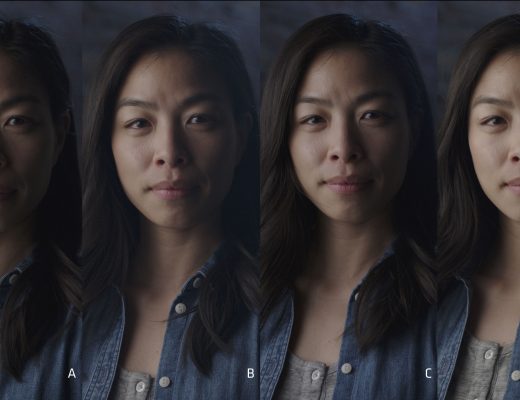
I'm shooting more projects with the Canon C300 but none of the built-in looks greatly appeal to me. While trying to build my own custom C300 look at a local rental house I spied an Arri Alexa in the next stall over... and asked, "Can I put that next to this C300 for a while?" The results are really interesting...
Read More
6 Comments
Faster cameras means extreme low level lighting here to stay. Here are some examples from the days of (gasp) 400 ASA film!
By Art Adams | January 17, 2013
There's something amazing about shooting low light images with a wide open lens. Now that the average camera is rated at 800 or faster, we can take advantage of using smaller and smaller lights and even shoot scenes that look brighter on the monitor than they do by eye...
Read More
1 Comments
Bigger is not always better, but smaller isn't quite ready for primetime... yet.
By Art Adams | December 31, 2012
In 2011 I bought an iPad 2, and in 2012 I traded it up for an iPad 3. For 2013 I've opted to experiment with the first generation iPad Mini, and while this generation won't replace my iPad 3 I suspect--and hope--that the next one will.
Read More
0 Comments
Make the most of any camera's dynamic range by placing your mid-tones in the right spot...
By Art Adams | December 24, 2012
After years of looking at dynamic range charts I noticed that almost all camera gamma curves emphasize mid-tones within a consistent IRE range. What does this mean to you? Find out by clicking through...
Read More
0 Comments
In theory a DP should be able to light a set without a camera, using only a meter. But does that really work in video?
By Art Adams | December 20, 2012
My latest obsession is trying to match reflectance values with IRE values to create a "Zone System for video." This is both easy to do and impossible, so click through if you'd like to see how far I've gotten…
Read More
0 Comments
I see X-Rite Colorcheckers in every expendable supply store, which is strange as they really have nothing to do with HD.
By Art Adams | December 19, 2012
Most camera rental houses have an in-house expendables store, and during a recent visit to one such store I ran across a stack of X-Rite "Macbeth" ColorChecker charts sitting on a shelf. I'm firmly convinced that the only reason people buy these is because they think there is a reason to use them for film-style production... but if there is a reason I can't think of what it is. Let me explain:
Read More
2 Comments
The good news was that we shot on a nice sunny day. The bad news is that the sun moved. Here's how we dealt with that pesky annoyance over the course of a full shoot day...
By Art Adams | November 30, 2012
These days it's all about getting the most bang for your budget, and this promo for a new Kendall-Jackson wine pairing iPhone app had to look spectacular for not a lot of money. Fortunately the Canon C300, a sunny day and a great grip crew made this possible...
First, watch the...
Read More
1 Comments
Every day I learn something that I had no idea I didn’t know.
By Art Adams | November 30, 2012
It has long been whispered, in dark corners of the industry, that our reflected light meters aren’t telling us what we think they’re telling us. I’ve recently stumbled upon some evidence that states that this is, indeed, true. I don’t have a definitive answer yet, but you might be interested in knowing what the definitive question is…
Read More
1 Comments
There's one case where an incident light meter can tell you just as much about a lit surface as a reflected meter can...
By Art Adams | November 26, 2012
Incident meters can only tell you how much light is striking them, and nothing about how bright things are in the real world... except in this one situation. This handy trick for measuring the brightness of diffuse backlit surfaces may be the one way you can surprise your gaffer.
Read More
0 Comments
Incident meters don't tell you how bright things in your shot are, but it's surprising how handy they can be if you know a few simple facts about light and reflectivity.
By Art Adams | November 13, 2012
Way back when I shot film I was a serious devotee of The Zone System. I lived and died by my spot meter. I have a much harder time doing this in HD, however, so I'm rediscovering the joys of using an incident light meter. I've picked up a few new tips and tricks, and now I'm going to share them with you.
Read More
0 Comments
It's hard to see the differences between color matrices until you look at them side by side. That's when the real education begins...
By Art Adams | October 28, 2012
Accurate color and pretty color are not always the same. Let's compare two Canon C300 color matrices and see for ourselves...
Read More
0 Comments
Working with 90-year-old technology is eye opening: you start to wonder how anyone managed to get quality images on film at all, let alone create dozens of silent film classics. Dealing with dozens of internal camera menus starts to look really simple.
By Art Adams | October 27, 2012
When working with 90-year-old motion picture technology it's not unusual to wonder how anything got made at all. Here's what it took to make sure the shot was in focus and to ensure the operator could actually see what was in the frame.
Read More
0 Comments
There's pretty color and there's accurate color, and they are not the same thing. Read why...
By Art Adams | October 25, 2012
In theory I like the Canon C300. It's small, it's well designed, and it can make pretty pictures. The Canon "look," though, is very different from what I'm used to, and it's taken me a while to figure out how to bend the camera's look into something that I really like. After spending an hour tweaking profiles the other day I think I found something I like. I don't have pictures to show you (I did my tweaking on set for a project that is a little bit secret, at least until next week when it'll be released) but I can describe what I saw reasonably well and you can reproduce my results yourself on any C300.
Read More
0 Comments
I forgot how much fun it is to touch film and thread it through a camera movement and I'm glad I had a chance to do it one last time, before film is gone for good...
By Art Adams | October 03, 2012
There's something special about threading film through a camera and watching it run through perfectly. There's also a lot that can go wrong on the way. Read on to see what's involved in loading a 90-year-old film camera...
Read More
0 Comments