If you agree, please sign the online petition requesting the required updates.

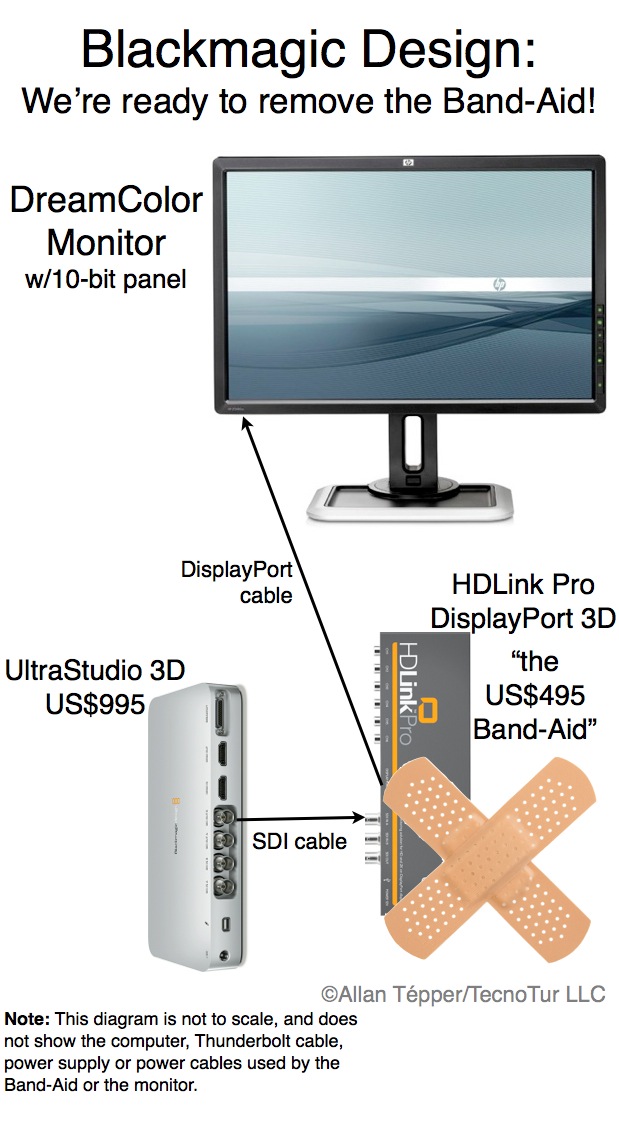
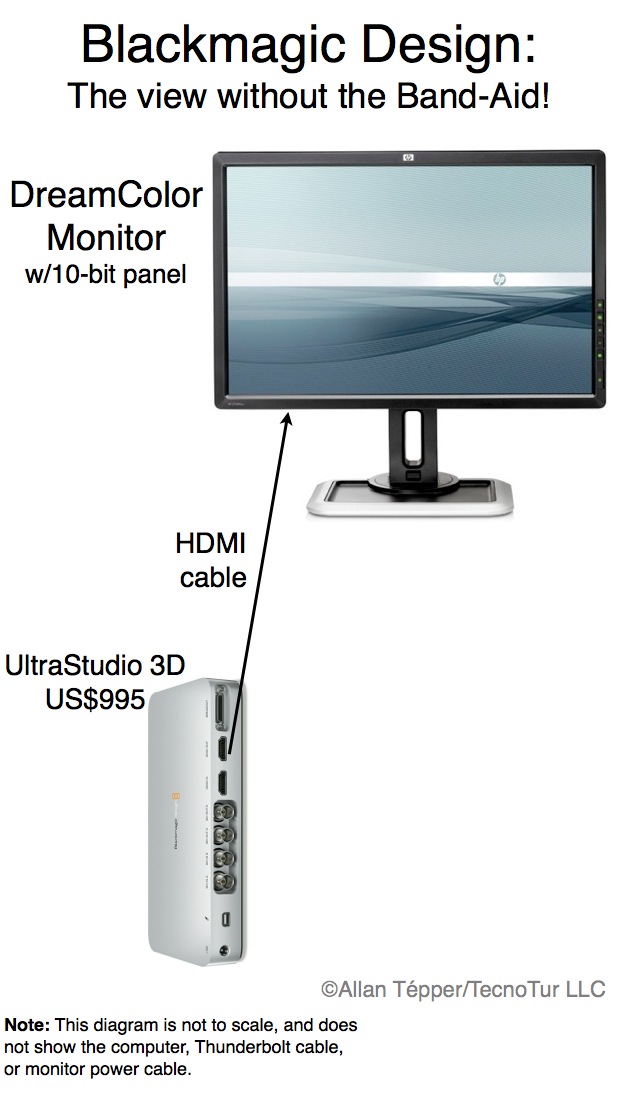
Despite years of diplomatic prodding on my part, both via articles in ProVideo Coalition magazine and private emails, Blackmagic has still avoided and postponed offering RGB on its HDMI outputs. [If you’ve read my articles regarding HP DreamColor connectivity, you already know that the DreamColor engine demands digital RGB (not YUV/component) and true progressive (not interlaced or even PsF).] As a result, until Blackmagic updates their products (hopefully via a firmware and software update), you’ll have to spend an additional US$495 for an HDLink Pro 3D DisplayPort which will take the SDI signal from either the DeckLink HD Extreme 3D card or the UltraStudio 3D external interface. And that also means an additional SDI cable, an additional power supply, an additional power outlet, and having to make additional adjustments in another device. If you agree, please sign the online petition I’ve created.
crit
The last time I contacted Blackmagic about this issue was less than a month ago, just after NAB in April 2012. The answer I received from Blackmagic’s USA public relations department via email was that it would only offer RGB over HDMI “at 1080p60” and from an RGB/4:4:4 timeline as a source. As you probably know, 1080p60.000 is a non-standard signal, since standard progressive signals include :
- 1080p23.976
- 1080p24.000
- 1080p25
- 1080p29.97
- 1080p50
- 1080p59.94
It is certainly possible that Blackmagic’s public relations department (or their internal source) was simply rounding 59.94 to 60 when responding to me. Even so, we really want to send the exact matching framerate of the timeline to the monitor. We don’t want it cross-converted to 59.94 or 60.000 when the timeline is at one of the other framerates. And although everything in a grading program may be transcoded to RGB upon import, that’s not typically the case with video editing software. As stated in several prior articles, AJA and Matrox have all added this capability, which transcodes the YUV (component) to RGB on-the-fly when necessary after the user has selected to force RGB on the HDMI output. I have no idea whether Blackmagic is avoiding adding this digital RGB-over-HDMI feature to the DeckLink HD Extreme 3D card and the UltraStudio 3D on purpose to force us to buy the additional US$495 “Band-Aid” (the HDLink Pro 3D DisplayPort), whether they have simply been busy with other things, or whether it has been an oversight.
Why do I like the HP DreamColor so much?
The short answer is because the HP DreamColor is by far the lowest cost LCD critical evaluation monitor with the following included:
- Beyond CRT gamut
- Color temperature set by adjusting LED backlight, not by manipulating the video signal
- Inexpensive dedicated colorimeter with software for Mac & Windows (both from HP) and for Linux (open source version)
- ITU-R Rec.601 color space for SD video
- ITU-R Rec.709 color space for HD video
- DCI P3 color space for digital cinema
- Adobe RGB
- sRGB
- Custom profiles for atypical client situations
- For pro video applications, all profiles are stored in the monitor, not in the computer
- IPS (In Plane Switching) panel = extremely high contrast ratio even at very indirect angles (off-axis)
- Matte panel (not reflective)
- True 30-bit (10-bit per each subpixel x3) panel, which means full color, and no banding or dithering
- Very low black level (CRT class)
For the long answer, see the links to related articles at the end of this article.
Please sign the petition for Blackmagic to update this via firmware & software
I have created an online petition. Please click here to sign it to ask Blackmagic Design to add the necessary update to these products, and to others if possible.
To make sure you continue to see my upcoming articles, sign up to my mailing list here.
Related Thunderbolt articles
- AJA announces T-TAP, the US$249 palm-sized, self-powered bridge from Thunderbolt to HDMI or SDI
- Thunderbolt in MacBook Pro: a new era for demanding video editors who prefer laptops from February 27th, 2011
- Mac Mini w/Thunderbolt: preferred platform for many new editing systems from August 8th, 2011
- Blackmagic delivers its first Thunderbolt-based i/o interface, the UltraStudio 3D from September 5th, 2011
- Matrox adds optional Thunderbolt connectivity to existing MXO2 family interfaces from September 5th, 2011
- AJA announces Io XT interface with Thunderbolt at IBC in Amsterdam from September 9, 2011
- Blackmagic breaks Thunderbolt price budget with US$299 Intensity Extreme from September 9, 2011
-
Mac Mini for pro video editing: a field report from Guatemala:
Despite gloomy predictions from the naysayers, the Mac Mini beats the MacPro tower for video editing from October 18, 2011 - Pegasus Thunderbolt RAID5 from PROMISE: The high-performance video RAID5 you need for today’s modern Mac systems from January 31, 2012
- AJA's Io XT w/ Thunderbolt is now available, but it is not Riker: What's the cover-up? Why are William Riker and Leo Laporte involved in a Pegasus cover-up? from January 31, 2012
Related DreamColor articles
- Allan Tépper's: Does Premiere CS5 achieve the “impossible dream” for critical evaluation monitoring?
- Allan Tépper's: Why should I care if my monitor shows ITU Rec.709?
- Allan Tépper's: Who is the ITU, and why should I care?
- Allan Tépper's: How to connect your HD evaluation monitor to your editing system properly: Let me count the ways!
- Allan Tépper's review: DreamColor from HP: an ideal tool for critical image evaluation
- Patrick Inhofer's review: HP's DreamColor: A PVM CRT Replacement?
- Allan Tépper's: DreamColor direct interfaces
- Allan Tépper's: DreamColor converter boxes for non-compliant systems
- Allan Tépper's: Matrox's original MXO crashes the Direct DreamColor interface party from January 10, 2010
- Art Adam's: GEEK OUT: The Non-Technical Technical Guide to Sony OLED Monitors from March 6, 2012
- Allan Tépper’s Bandito Brothers use multiple HP DreamColors + Adobe Premiere for Act of Valor from March 9, 2012
Allan Tépper's books, consulting, articles, seminars & audio programs
Contact Allan T©pper for consulting, or find a full listing of his books, articles and upcoming seminars and webinars at AllanTepper.com. Listen to his TecnoTur program, which is now available both in Castilian (aka “Spanish”) and in English, free of charge. Search for TecnoTur in iTunes or visit TecnoTur.us for more information.Disclosure, to comply with the FTC's rules
No manufacturer is specifically paying Allan T©pper or TecnoTur LLC to write this article. Some of the other manufacturers listed above have contracted T©pper and/or TecnoTur LLC to carry out consulting and/or translations/localizations/transcreations. Many of the manufacturers listed above have sent Allan T©pper review units. So far, none of the manufacturers listed above is/are sponsors of the TecnoTur programs, although they are welcome to do so, and some are, may be (or may have been) sponsors of ProVideo Coalition magazine. Some links to third parties listed in this article and/or on this web page may indirectly benefit TecnoTur LLC via affiliate programs.
Copyright and use of this article
The articles contained in the TecnoTur channel in ProVideo Coalition magazine are copyright Allan T©pper/TecnoTur LLC, except where otherwise attributed. Unauthorized use is prohibited without prior approval, except for short quotes which link back to this page, which are encouraged!


Filmtools
Filmmakers go-to destination for pre-production, production & post production equipment!
Shop Now