
Hi Art
Are you using the SuperFlat curve? or just changing the contrast and brightness settings?
I have a 7D and I came to the conclusion that it’s not such a great idea to use those tweaks since I usually end up applying a curve in post to bring it back as it would be on the Neutral settings. What do you think about that?
The word around the blogs is that using the superflat option and lowering the contrast will increase the dynamic range, but on my home made tests it wasn’t true, it just changes the curve adding more contrast to lows and highs and lowers the contrast in the middle, meaning you have more to work in shadows and highlights but much less to work in, let’s say, skin tones.
Am I right?
I would like to see the curves in the three modes using a good chart like yours, in super flat, lowered contrast and neutral modes.
Cheers
Ivan (from Netherlands)
Posted by Ivan Oliveira on 08/31 at 01:02 AM
Art,
The measured dynamic range of the EOS 5D Mark II is 11.9 stops (independent, not Canon figure), by comparison the EOS 1D MkIV is 12 stops and the 7D, 11.7 stops
A camera should always be tested at optimum ISO; that is normally the lowest setting without extending the range.
At 400 ISO, the EOS 5D Mark II the gain is being cranked up by 2 stops, increasing the noise and decreasing the dynamic range.
Nick
Posted by Nick WB on 08/31 at 05:44 AM
Nick,
The lowest ISO on a DSLR is often reached by using negative analogue gain. I would expect dynamic range to be best at 200 or 400.
Art,
10 stops is better than I felt like it would be from my shoots. I’ve always felt the darks fall off fast and tend to look crushed even with the contrast turned down, which makes the image feel like it has less range to me.
I would be interested to see what you get in stills mode…
Charles
Posted by Charles Angus on 08/31 at 02:43 PM
Charles,
My background is 20+ years shooting stills and working closely with one of the prime movers in the RAW processing field. The 5D MkII has one of the finest (still) sensors in production today, quite stunning in that guise when handled correctly nd bettered only by $30,000 of 65Mpix digital back.
However in video mode, it is substantially compromised by the down-conversion to 1080p. This may well account for the difference in measured dynamic range and that achieved in (excellent) real world tests by Art
I agree that negative gain is frequently used on many DSLRs to create ‘low’ ISO. Certainly on some previous Canon DSLRs this was the case and noise and DR suffered. On the MkII however, optimal ISO for the sensor is around 75 ISO and drops off by around 1/2 stop at 400.
Nick
Posted by Nick WB on 08/31 at 03:12 PM
Hi guys-
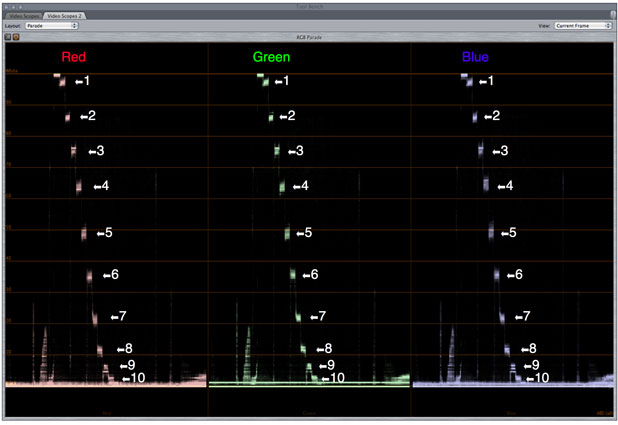
First of all, we ended up as ISO 400 because of the limitations of the chart illuminant (a prototype LED—we now have the ability to use tungsten lighting with the chart)—and also the lens we had available. And while we may be off the “native” ISO in this test (Adam Wilt participated as well—should have mentioned that in the article) I don’t think 400 is so far off that we’d end up sacrificing two stops of latitude. 10 stops seems about right to me, based on my experiences with the camera. I don’t believe 12 stops at all. There’s just no way.It’s a very contrasty camera.
Theoretically all we did was add some noise to the signal. Unless we went to negative gain or extreme positive gain the overall latitude shouldn’t drop two stops.
Posted by Art Adams on 08/31 at 03:29 PM
Hard to get your hands on Alexa?? If only your own personal DIT of the last 15 years had purchased three ARRI Alexas ... and if only one of them was coming back Friday morning to Chater Camera for you to test with ...
Posted by Jay Farrington on 08/31 at 11:25 PM
Hmmm. I may have to take you up on that.
Sadly this chart is currently on loan elsewhere, but I might be able to make do with another…
Posted by Art Adams on 09/01 at 07:52 AM
Well, I have the 13-stop Stouffer wedge, and a quick trip to TAP will get me the diffuser panel my illuminator box is lacking. and then I’d be set to provide test targetry, as well as the 5D to use as a comparative control…
Posted by Adam Wilt on 09/01 at 10:01 AM
Art,
If you have the chart (or the Stouffer wedge) why not test the 5D2 in still mode? It would be very interesting to see the comparison with the video output. Shoot a RAW file at 100 ISO and if you want to sent it to me, I’ll process out the file in a couple of different apps for you to test.
Nick.
Posted by Nick WB on 09/01 at 10:47 AM
Adam- I’ve still got the illuminator, turns out I just had to send the chart itself. You’re welcome to it.
Nick- Good idea, I’m kicking myself for not thinking of that at the time. Tests are weird: they’re very time consuming and occasionally monotonous and it’s easy to become distracted by passersby. I’ll do that next chance I get.
Posted by Art Adams on 09/01 at 12:02 PM
Note that any DR number we come up with for the Canon in stills mode is only useful as a comparison to our DR number for video mode. DR determination is highly dependent on the criteria used for acceptable shadow detail and level discrimination, so our tests will likely not match the exact figures on DPReview, derived using imatest, etc.
Posted by Adam Wilt on 09/01 at 12:27 PM
Oh sure. It’d just be fun to compare and contrast from our perspective as filmmakers.
Posted by Art Adams on 09/01 at 12:35 PM
You cannot compare RAW still image with video. If you want the same kind of latitude in video you either have to add bit depth or you will get banding. There is a reason why AVC-Intra uses 10 bits per color. It is the same reason why older plasma TVs had visible banding and newer do not: because modern TV sets convert 8-bit video into 10, 12 or 14-bit for presentation, interpolating brightness and color for smoothing out the image that has increased dynamic range.
AFAIK, With an 8-bit codec you will not get more than 50:1 contrast ratio even with gamma correction and all these near-black and near-white tricks, no matter what hardware you have or what resolution or encoder you use.
So, next step would be creating an affordable 10-bit codec for the masses.
Posted by .(JavaScript must be enabled to view this email address) on 09/01 at 01:33 PM
Why can’t we compare them? It’s not like we’re trying to match them or claim that they are similar in any way. We’re just shooting in one mode vs. another and seeing what the chart says.
Posted by Art Adams on 09/01 at 01:44 PM
Because within an 8 bit codec a smooth gradient across all of the supposed 10 stops would exhibit banding and the need to use a lot of dithering to cover up that banding.
It’s kind of like saying orange flavored soda is fresh squeezed.
Also its completely invalid technically to even begin to put this camera with its pseudo log curve that I wouldn’t be able to reverse engineer into a conversation about any other pro camera.
Its all about your final display medium, if that medium is youtube or DirectTV great. God forbid you need to get anything shot with these cameras past quality control they’ll just look at you funny and say redo your movie or TV show.
Posted by .(JavaScript must be enabled to view this email address) on 09/07 at 01:42 AM
Jeff,
They just got past the BBC for limited use - you don’t get tougher than that and look at Lucas Film and ‘the Bloom tests’
The world is changing fast - there are stills images being used in glossy magazines(my world), that would never make the grade 5 years ago, but because they have spontaneity and atmosphere not possible with big cameras, they are used.
DSLR quality does not match our expectations, but cost and immediacy are powerful allies in the modern world.
Art, I’d love to see how your test shapes up if you have the time
Nick.
Posted by Nick WB on 09/07 at 01:52 AM
Nick,
Thats nice about the BBC as I sit here looking at a project that just got kicked back from QC for compression artifacts and banding. Things that can’t be solved and now their entire deal is in jeopardy.
Ultimately, making films is a gamble and what people will or won’t accept is at best capricious and at worst villainous.
Oh well I’ll just continue having fun on the projects that actually give a damn about quality and can see the difference.
Posted by .(JavaScript must be enabled to view this email address) on 09/07 at 02:05 AM
Jeff, I know exactly where you are coming from - I work to the highest standards with ‘the right’ gear and then see pitiful work being used because it is cheaper / quicker.
I’m slowly adapting to survive, but it is painful.
Nick.
PS A few are lightly running Noise ninja over 5/7D and effectively taking out the blockiness.
Posted by Nick WB on 09/07 at 02:15 AM
Whats really annoying is I just feel that the “indy” want to do things is just camera manufacturers and indeed even pro video coalition having the need to purport this myth that it doesn’t take hard work to get a good result. I’ll admit I work in a pretty decent post house and I’m spoiled rotten with quality that comes through here.
But I’m still bitter about a commercial that shot the 5D on bluescreen. I ended up having to charge way too much because of so much roto and lost the client because of it. As far as I’m concerned the DP on the project who said yes to that clusterf*ck won’t work again.
Been using Noise Ninja for years it did wonders for underlit Viper footage. Heck I even have a toolset that fixes the 5D’s aliasing sadly for everyone else its only in our high end DI machine.
Posted by .(JavaScript must be enabled to view this email address) on 09/07 at 02:44 AM
Jeff,
What pseudo-log curve?
And what algorithm is your tool using to fix aliasing? I would be surprised if anything other than tracking in a new surface would fix the moiré problems I’ve seen. And I’m not even sure how I would tackle fixing aliasing on thin lines…
I don’t see anyone claiming that it doesn’t take hard work to get a result.
I fail to see how it is “completely technically invalid” to put a camera that people are using up against other cameras people are using. Heck, throw the GoPro in here. That camera looks like crap, but people use it for all kinds of stuff. It’s all just tools in the toolkit, and tests like this help us to know which tool to reach for. Saying we shouldn’t have tests of cameras you don’t like strikes me as a little infantile, to be honest.
Jeff and Burn-E:
8-bit image recording hasn’t stopped cameras like the F900 or the tape-based VariCam from being very popular - both 8-bit to tape. I would be surprised if either of those cameras had much or any less than 10 stops of dynamic range. I’m not claiming the 5d doesn’t have banding issues (it does), just that being 8-bit may not be the reason. I feel like part of their compression is throwing away colours, and possibly compressing the image to <8 bits of precision.
I think if it was only possible to have ~5.5 stops of DR (a 50:1 contrast ratio) on an 8-bit codec, we would have come up against it by now.
Posted by Charles Angus on 09/07 at 07:02 AM
Charles,
A point by point.
1. In the article Art says he uses the flatest curve with low contrast. Necessitating a post manipulation that would by definition eliminate that additional dynamic range to keep skin tones even, while maintaining proper scene contrast.
2. The tool is the Nucoda Film Master for the aliasing, DVO tools. It works been using it for years.
3. Its invalid because of the gamma curve he uses to artificially expand the perceived dynamic range while failing to take into account the quantization errors from pulling it back apart into a “normal” gamma 2.2-2.4 ish space. Which neither the h.264 compression, nor the cheap debayer the camera uses supports.
4. Well infantile maybe but I’d still call a test like this unprofessional FUD, as it offers no context. From the way Art is writing this article he expounds on the camera the same way he does the Alexa with none of the caveats.
5. A Rec 709 type curved 8 bit image with usable not quantizing range can only hold 5.5-6.5 stops before banding can set in when the image is put into any kind of a natural looking range. The way that earlier cameras avoided said banding was that their sensors just weren’t that sensitive.
If you disagree with this I have a video engineers manual for you. After you’ve read it we can continue the discussion.
Posted by .(JavaScript must be enabled to view this email address) on 09/07 at 11:04 AM
1. The flattest built-in curve in the 5D isn’t that flat.
3. See (1) above.
4. How did I “expound” on this camera in a technical article that’s six paragraphs long?
5. Not sure that I understand this at all. The original Varicam captures more than six stops in 8-bit DVCProHD without banding.
Not interested in manuals, only real-world experience.
Posted by Art Adams on 09/07 at 11:13 AM
1. But we’ll never know as the curve isn’t published, and any attempt to capture it would be invalidated by the H264 compression.
4. “The Canon 5D does a remarkable job of making HD images.” There was no counterpoint illustrating the cameras deficiencies ie The jello effect, aliasing issues, or limited color palet. Just a straight up comparison to the alexa as if comparing the dynamic range of the two was even a valid thing to do.
5. Varicam was still an 8 stop sensor for every bit of additional “dynamic range” you include in an image like this the amount of exposure data in the between steps gets muddier creating horrible skin tones and artifacts.
Art I really liked what you said in another article about usable dynamic range. I think the same argument applies here when trying to make a statement about inclusion of too much data for a given container.
Posted by .(JavaScript must be enabled to view this email address) on 09/07 at 03:17 PM
I didn’t compare it to an Alexa, I just said that there’d be more tests like this in the future with an Alexa. There’s no comparison between this camera and an Alexa.
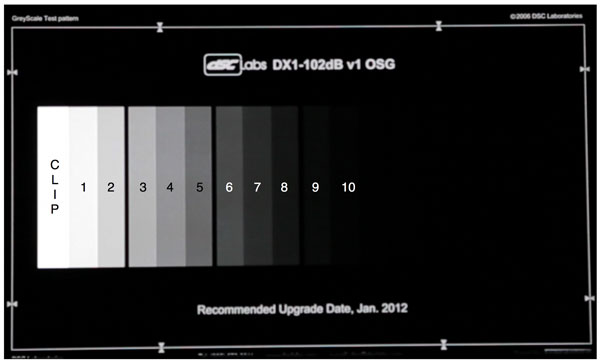
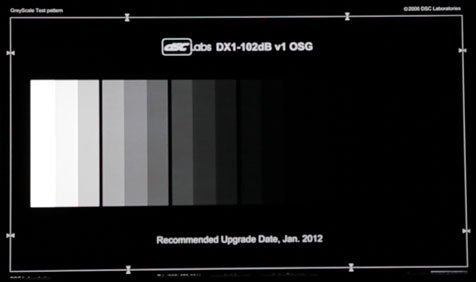
Adam Wilt and I tried to test the dynamic range of this camera using a 13 2/3-stop Stouffer wedge with 1/3 stop increments and those increments were too fine at the bottom edge of the chart to see any meaningful detail. I’m waiting to get my 17-stop DSC chart back (it’s on loan to Gamma & Density at the moment) and really find out what the Alexa can do.
Posted by Art Adams on 09/07 at 03:21 PM
I have to say that just by looking at the image there appears to be significant noise appearing around the number 8 mark and the highlight at number 2 would be completely unusable. I really think this camera allows about 4-5 stops of usable dynamic range.
Posted by .(JavaScript must be enabled to view this email address) on 10/14 at 10:24 PM