
(Page 1 of 1 pages for this article )

Tuesday, April 14, 2009

Filed under: CamerasProductionTips

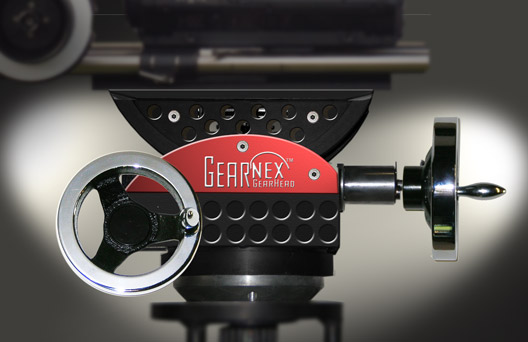
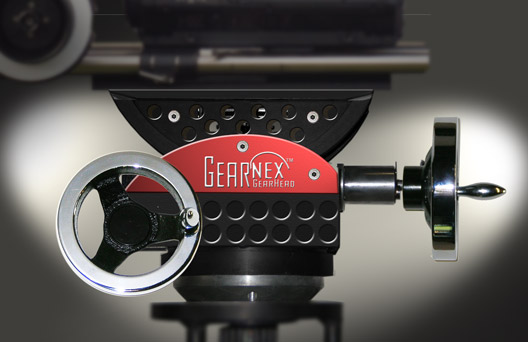
Gear Head for the RED

Art Adams | 04/14

Sacramento company GearNex brings smooth moves to your favorite HD camera

Last spring, while shooting a piece for solar energy company SunPower on the RED, our jib operator asked me to keep a secret. “How interested would you be in a low cost gear head for the RED? I think I’m going to build one.”

HELLO! SIGN ME UP!

I’m a big fan of gear heads, although in my current niche of shooting spots and corporate short form projects in Northern California I don’t often have the opportunity to use them. When I was a camera assistant, and aspiring operator, I’d practice on the gear head at lunch following the art department around the set as they redressed it. I’d often been told to put a laser pointer on the head and learn to write my name on a wall, but I found that following people—who did unpredictable things—was much more useful.

Around that time I read a study where two basketball teams of equal skill were pitted against each other, and afterward they were told to practice in different ways in preparation for their next game: one team would physically practice, and the other would spend time visualizing plays in their heads. Both teams improved by about the same amount at their next game. So every time I watched TV I moved my hands as if they were operating a gear head, following the TV image. A few weeks of that and my hands knew which way to go, often without conscious thought.

When I was offered a job as an operator on a low budget feature I was ready and able to spin the wheels. I couldn’t do everything on a gear head, as I learned the hard way while trying to operate a long shot with a 200mm lens, but the moves I could do were very, very smooth and precise. (For 35mm film the rule of thumb is to use a gear head with lenses up to 100mm; beyond that, a fluid head is a much better option. That’s why the “A” camera generally has a gear head, for wide shots, and the “B” camera has a fluid head, for close ups.)

When I moved to Northern California in 1993 I fell into the corporate video world, and other than occasional trips to LA to operate on features or second unit I didn’t touch a gear head for years at a time. My last experience was on a corporate job about four years ago: the director loved gadgets, and when he learned that I could operate a gear head he ordered one for our next few projects. It was a lot of fun, working with an Arrihead and a Sony F900, and the director was blown away by the quality of the moves. He said it felt as if the camera was floating.

When operator Bret Allen, SOC pulled me aside last year and told me his plan, I asked him to keep me in mind when the time came for testing a prototype. We’d hoped to get together this week as the first production models came off the line, but our schedules won’t allow me to test his baby before NAB. If you get to it before I do (and if you’re at NAB then you probably will) please post your thoughts below in the comments box.

As far as I know, the GearNex Gear Head is the first of its kind to be designed specifically for use with HD cameras. It’s not heavy-duty enough for a Panaflex with a 10-1 zoom and a 1000’ mag but it’ll do fine with a RED, an F900R, Sony F35 or any other camera in that general size category. And it’s priced to be affordable for both rental houses and owner-operators.

For a GearNex Gear Head test drive at NAB, go to

WHERE: AJA BOOTH, #SL-2513

WHAT: GearNex Gear Head

WHY: Smooth moves for the BIG screen

WHEN: NAB

WHO: Gearnex

HOW MUCH: Pre-order price, $3,995. Normally $5,995.

Tell them you read about it on PVC!

Art Adams is a DP who used to spend a lot of time spinning his wheels. His web site is at www.artadams.net. He is an active member of the Society of Camera Operators (SOC).

(Page 1 of 1 pages for this article )

                    Clip to Evernote


Revisiting the RED workflow, Smoke 2012 style

Marc-Andre Ferguson | 02/03

image

My love affair with RED Digital Cinema began in 2007, when my brief stint as demo artist in the NAB RED booth turned into a regular gig at events and trade shows.…

4K > 1080P?

Matt Jeppsen | 01/30

Why you probably don’t need a 4K TV in your living room

image

There’s a nice, ranty article over at CNET entitled “Why…

Donny Osmond to Keynote NAB Show Luncheon

PVC News Staff | 01/26

The NAB Show Radio Luncheon will include the 25th annual presentation of the prestigious NAB Crystal Radio Awards

image

Renowned entertainer Donny Osmond will deliver a keynote address at the NAB Show Radio Luncheon, sponsored by ASCAP, on Tuesday, April 17 in Las Vegas. Osmond,…

You must be registered to comment. This is an effort to reduce spam. Please REGISTER HERE.

Interesting ProVideo Coalition article.

Never used a geared head. The article talks about a geared head being better for shorter focal lengths and a fluid head better for longer ones.

Please explain why?

Posted by .(JavaScript must be enabled to view this email address)  on  04/15  at  09:35 AM


Longer focal lengths tend to require both more dramatic and subtler moves: following someone’s head as they speak can be pretty subtle, while a closeup of someone running is going to be very fast. The lowest gear on a gear head (they tend to have three speed adjustments) isn’t low enough to do really subtle moves on a long lens: for example, third gear on an Arrihead is great for tight shots of someone talking on an 85mm lens but is absolutely useless on a 200mm lens shooting just about anything.

A fluid head, with adjustable drag, is a great tool for just about anything, although a gear head can be arguable smoother, more precise (you can stop the wheels very quickly), and is a great way to disconnect your body movements from the camera in the event of, say, a sudden stop of the dolly.

Fluid heads make the camera an extension of your body, which is great for a lot of things. Gear heads isolate the camera so it does only what you tell it to do without interference from anything else (you, wind, sudden changes in speed, etc.).

There’s also something very zen about dolly moves: it’s quite easy to get into the rhythm of a move (if you have a good dolly grip) and get the wheels going at just the right speed to be able to track a subject perfectly.

Posted by Art Adams  on  04/15  at  09:54 AM


Thanks for the detailed explanation Art.

grin

Posted by .(JavaScript must be enabled to view this email address)  on  04/15  at  12:56 PM


Name:

Email:

Location:

URL:

Smileys

Remember my personal information

Notify me of follow-up comments?

Submit the word you see below:


Revisiting the RED workflow, Smoke 2012 style

Marc-Andre Ferguson | 02/03

image

My love affair with RED Digital Cinema began in 2007, when my brief stint as demo artist in the NAB RED booth turned into a regular gig at events and trade shows.…

4K > 1080P?

Matt Jeppsen | 01/30

Why you probably don’t need a 4K TV in your living room

image

There’s a nice, ranty article over at CNET entitled “Why…

Donny Osmond to Keynote NAB Show Luncheon

PVC News Staff | 01/26

The NAB Show Radio Luncheon will include the 25th annual presentation of the prestigious NAB Crystal Radio Awards

image

Renowned entertainer Donny Osmond will deliver a keynote address at the NAB Show Radio Luncheon, sponsored by ASCAP, on Tuesday, April 17 in Las Vegas. Osmond,…

Affordable PL-mount Primes Compared

Adam Wilt | 01/06

85 minutes of lens tests!

If you’re in the market to rent or buy “affordable” PL-mount primes (e.g., under $10,000/lens), you won’t want to pass up this test.

To be considered for listing, contact pr (at) provideocoalition (dot) com


Copyright © 2011, HD Expo, LLC a division of Diversified Business Communications. DBA Createasphere

All rights reserved. HD EXPO, High Def EXPO, Createasphere, E-Tech, Entertainment Technology Exposition, 3D Production Workshop, VariCamp, P2 Camp, ColorCamp 101, and Lighting, Filters & Gels for HD are all trademarks of HD Expo, LLC.

Terms of Use  |  Privacy Policy

Check PageRank