

Filmtools
Filmmakers go-to destination for pre-production, production & post production equipment!
Shop NowExposure latitude tests reveal perhaps too much about the RED ONE

I’ve learned more about how cameras work by learning what the RED doesn’t do. But, with every software build, it does more. Build 20 looks to be the best yet… but it’s not perfect.
I shot these tests with Adam Wilt, at the Meets the Eye studios in San Carlos, CA. We shot two batches of over- and underexposure tests on one of their RED ONE cameras, first loaded with build 17 and then upgraded to build 20. I originally had planned to do a comparison of the two builds, but the scope of that article proved greater than my current workload will allow. Here I will focus strictly on build 20.
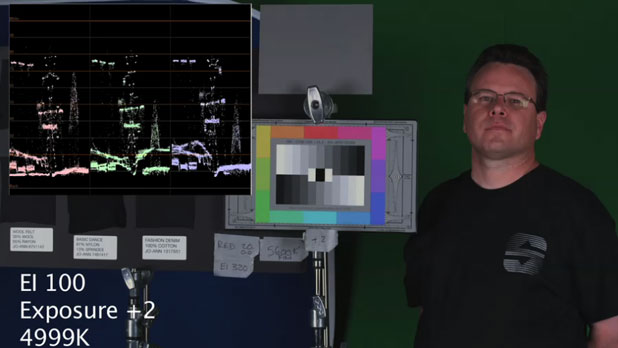
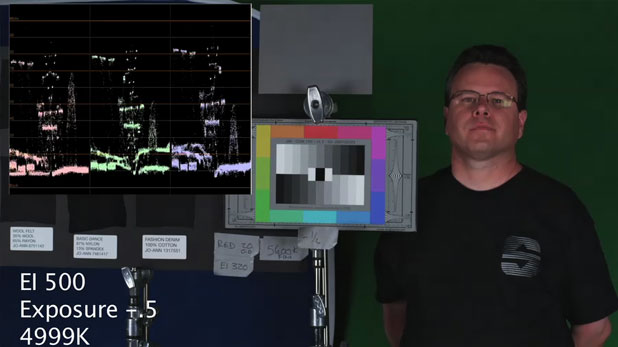
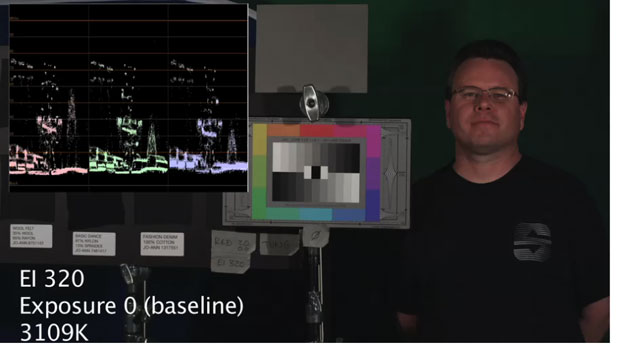
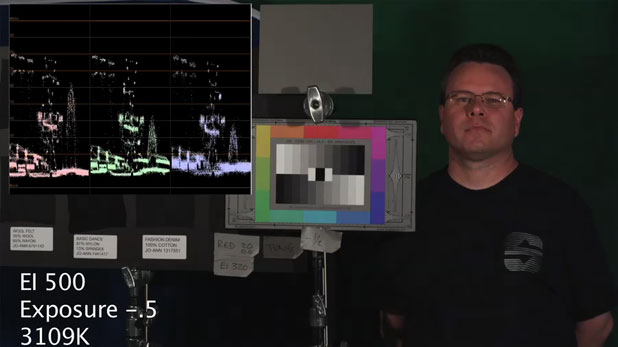
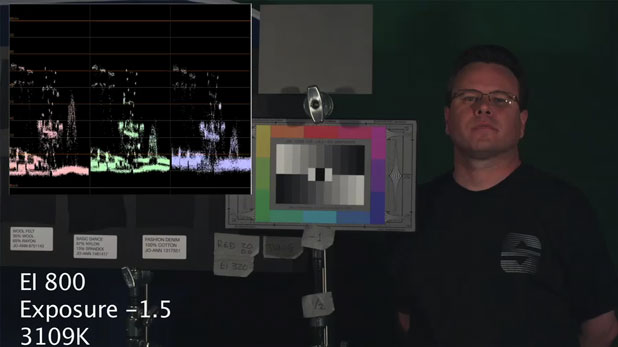
Here’s the layout:
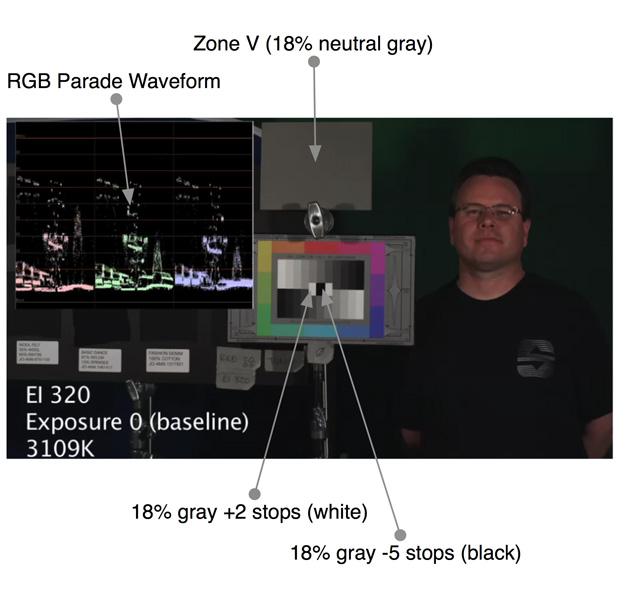
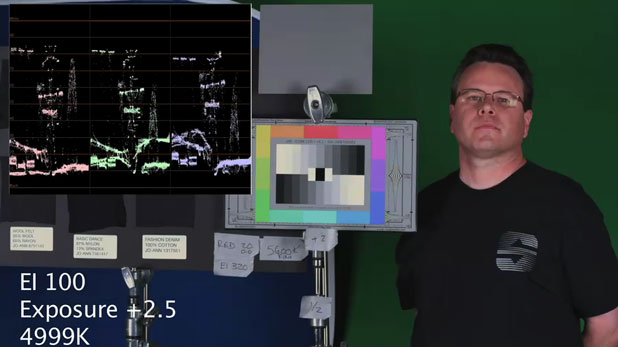
Yes, that’s me in my best “This is only for my drivers license, right?” pose. (I’m wearing a Sim Video shirt that I picked up at CineGear. I’m not endorsing them, even though they are an excellent company; it simply happened that I wore that shirt that day, and Adam insisted we have some flesh tone in the shot that wasn’t him. I hadn’t planned on being a model.)
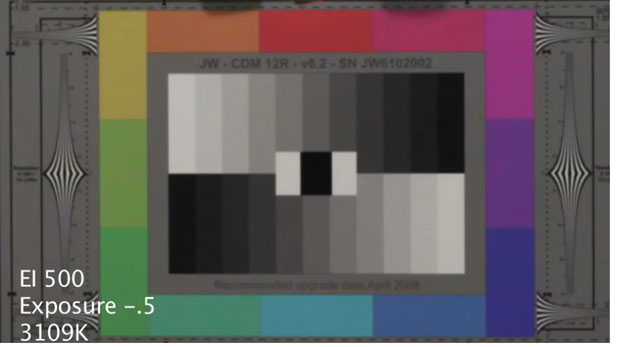
The exposure that I read off the Kodak 18% gray card, with my Minolta Spotmeter F set at EI 320, determined our base exposure. The gray on the DSC Labs Chroma Du Monde chart is .5 stops brighter. The white chip on the chart is at 2 stops over the gray card exposure, and the black chip is approximately 5.2 stops under. (The card with black fabric squares is my new IR test chart, which did not play a role in this test.)
At the top left of the frame is an overlay of the waveform readout for that frame. I also zoomed in, using the Motion tab in Final Cut Pro, to frame only the DSC chart. When you see those zoomed-in frames please ignore the resolution trumpets as they are not accurate.
I didn’t include every exposure step as this article would not be finished until sometime just after Christmas. The frames that are shown are the ones that are pertinent to this exposure test. If you wish to see the entire build 20 test, please look for links to the Quicktime movies on the last page.
We shot tests under both tungsten light and daylight. The tungsten sources were two Lowell Totas, while the daylight sources were Kino Flo Image 80’s. The camera was set for RedSpace gamma, and I processed the clips in the latest version of RedCine that incorporates RED’s new build 20 color science. I used the Rec 709 color space in RedCine as RED has modified it considerably from previous builds, and also because the brightly saturated colors of Rec 709 are more likely to turn up any obvious problems or color shifts. The export gamma was RedSpace, which put black at around 10 IRE and white at about 80 IRE. (The RED never puts blacks at 0 IRE, requiring that they be pulled down during color correction.)
Personally I prefer the Camera RGB color space, but Rec 709 has always been RED’s weak spot and, as build 20 claims to make their Rec 709 implementation considerably better, it seemed appropriate to focus on it.
I white balanced once on the baseline exposure for each test and then applied that correction to all subsequent frames. We shot the tests in half stop increments with the goal of adjusting the EI in RedCine to bring the exposure back to normal. (For example, underexposing one stop on set would result in rating that clip at EI 640 in RedCine.) When I brought the footage into RedCine, however, I discovered that the EI ratings are in third stop increments. The half stop increments are pinned to the adjacent third-stop ISO rating that was the best eyeball match to the previous clip.
There are four tests: tungsten overexposure, tungsten underexposure, daylight overexposure and daylight underexposure. If you don’t like engineering details then skip to the last page for my exposure recommendations. Otherwise, turn the page for a look under build 20’s hood…
Daylight Overexposure
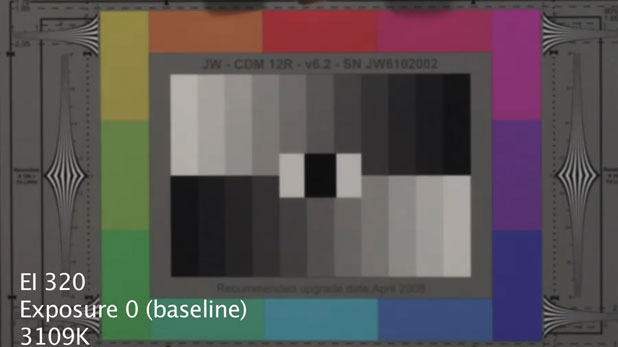
Here I am at our baseline exposure reading of EI 320. This is what RED says the camera should be rated at, so we took them at their word with the goal of determining whether we thought they were right or not.
Remember, I zoomed into this chart in Final Cut Pro–so while it shows accurate color, please ignore the resolution trumpets as they are nowhere close to accurate.
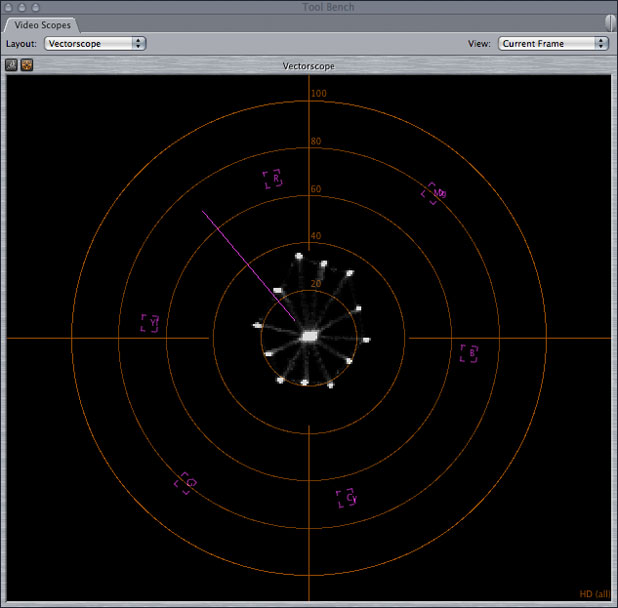
Build 20’s Rec 709 pattern looks pretty good. It used to be stretched out on the green/magenta axis, resulting in greens and magentas being exaggerated. If there are two colors you don’t want to emphasize in flesh tone and clothing, it’s those two. (Green is worse.)
The colors on the red-magenta-blue side of the scope look more saturated than the yellow-green-cyan side. Orange, between red and yellow, looks the least saturated. Tertiary colors, between primaries and secondaries, are consistently less saturated.
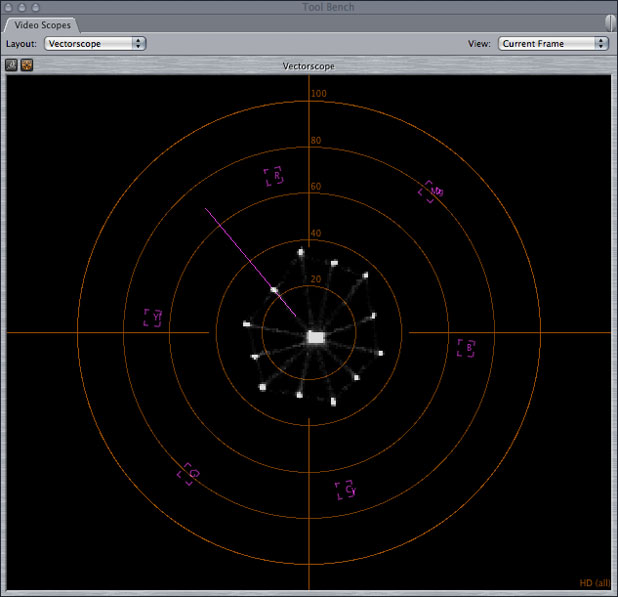
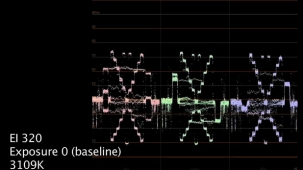
The waveform shows a shift toward blue, as does the vectorscope above. This is most likely an error in RedCine’s “white picker” white balance tool, which doesn’t seem to be terribly accurate. At least any errors it created are consistent as I took the white balance it gave me for the baseline exposure and applied that number manually to all the other exposures.
My goal was to find where the white chips started to clip, and to see what channel clipped first. Since nothing significantly changed between this exposure and 1.5 stops overexposed–other than a consistent increase in saturation with each increase in exposure–we’re going to skip ahead.
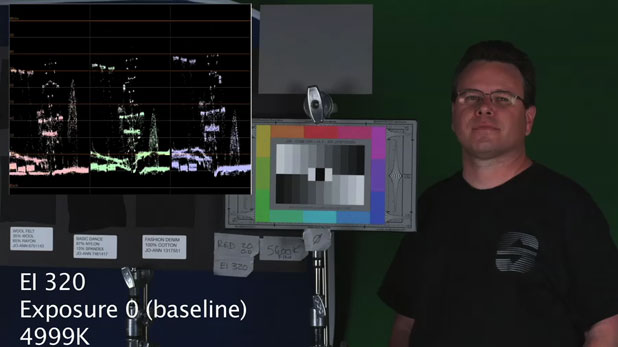
Everything looks fairly normal here. The red, green and blue steps on the waveform are nice and crisp, showing an absence of noise and a nice sharp signal.
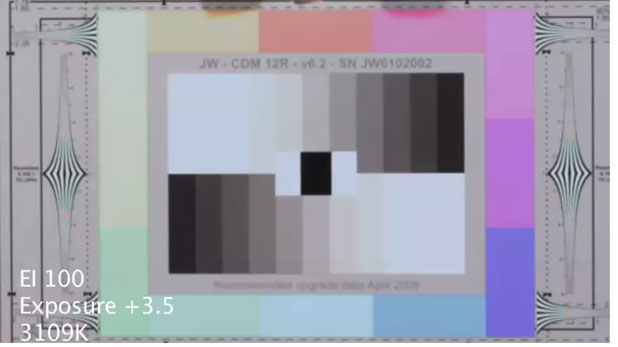
At this point the white chip on the DSC chart is 3.5 stops brighter than the 18% gray card.
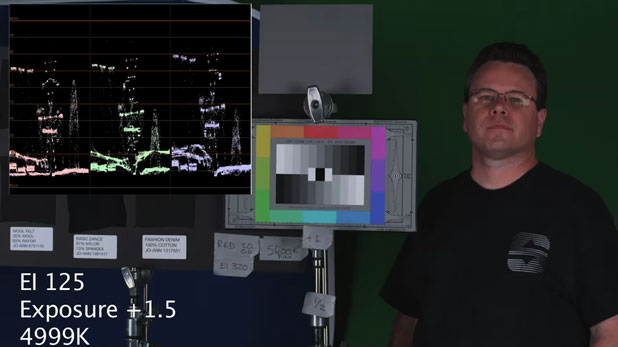
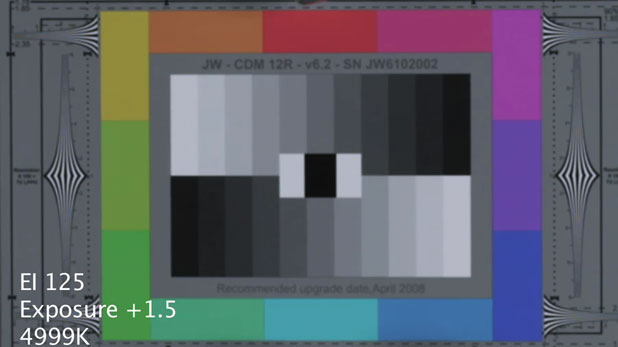
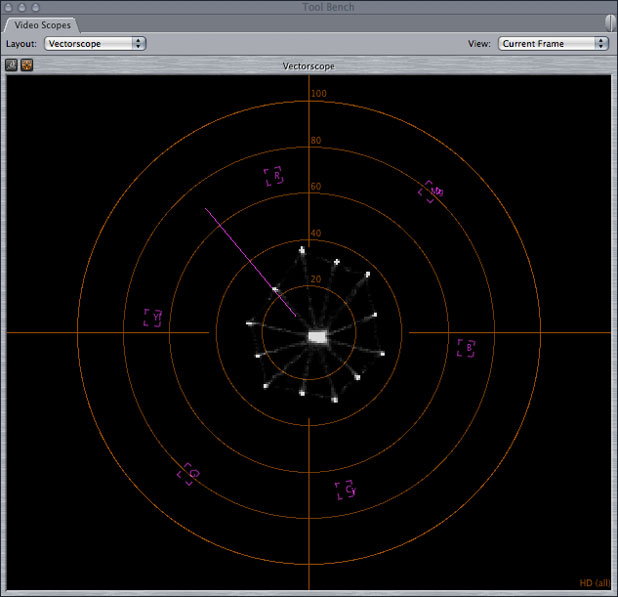
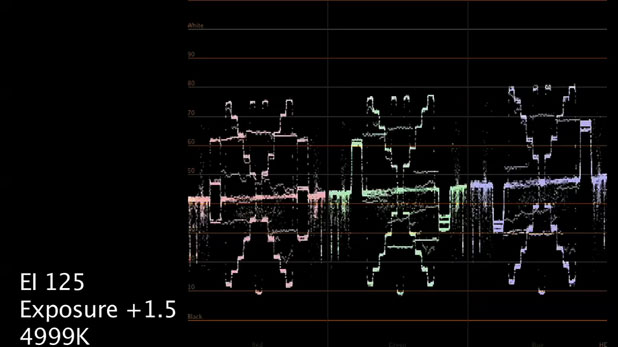
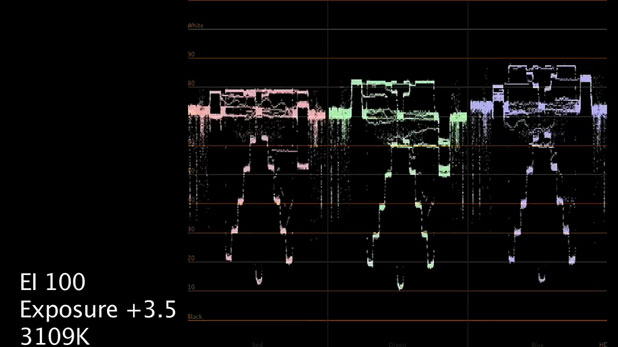
This is where things start to become interesting. The RedSpace gamma curve is starting to compress the blue channel. Notice how the top of the “ladder” on the blue portion of the waveform is curved compared to the red and green channels. So far the underlying “raw” data is fine, but the RedSpace gamma curve knows that the blue channel is going to clip shortly and is trying to flatten it out to squeak out some extra detail.
At this point the white chips on the chart are 4 stops brighter than 18% gray.
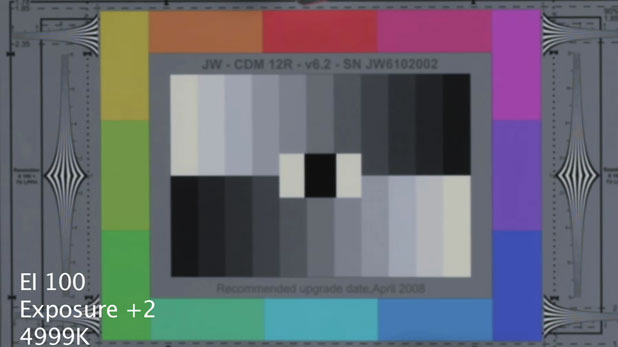
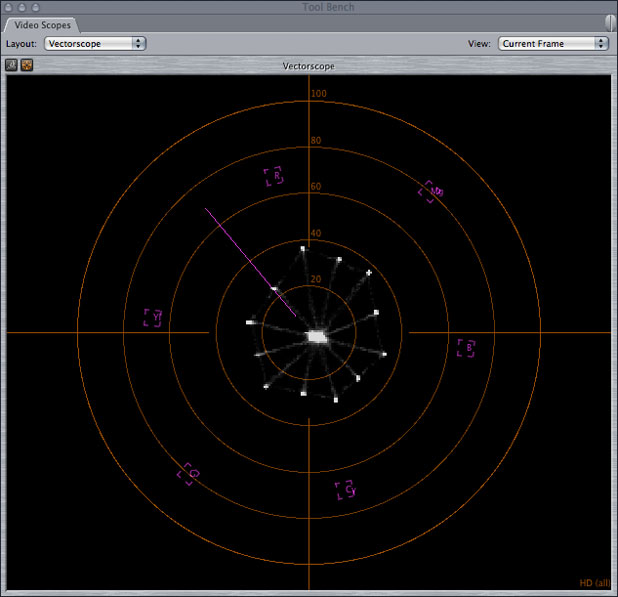
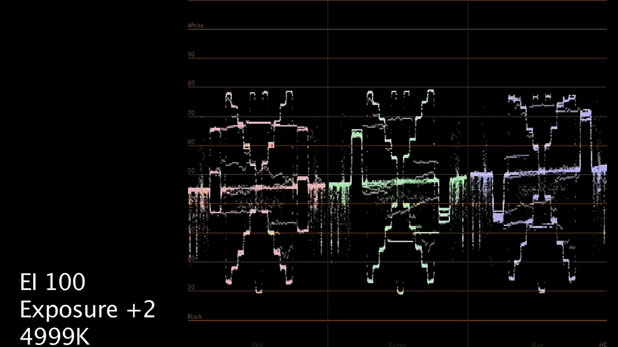
This is pretty impressive. The blue channel is now severely compressed but the remnants of the stair-step pattern in the top of the blue signal show that there is still some detail there. The RedSpace gamma curve is working overtime, but it seems to be doing a good job. The green channel is starting to be compressed as well.
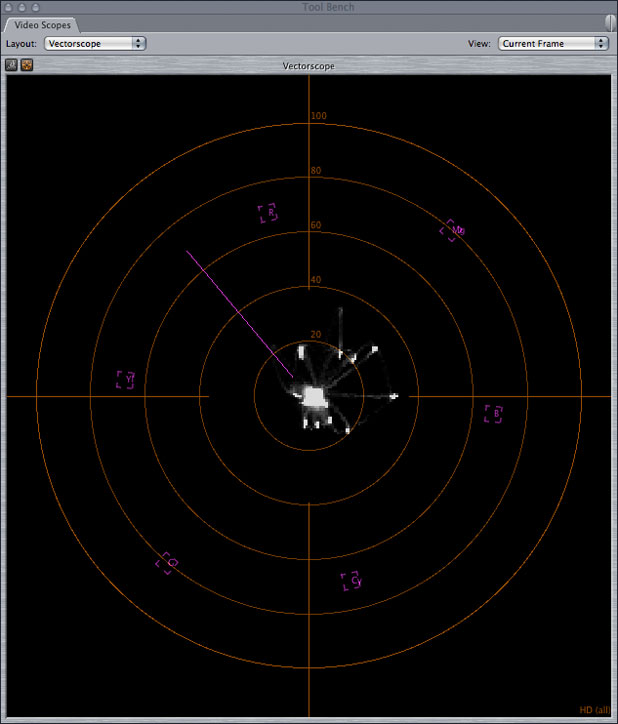
The vectorscope shows that cyan is beginning to fail, as the points on that side of the scope are collapsing inward, showing loss of saturation.
The white chip is now 4.5 stops brighter than 18% gray.
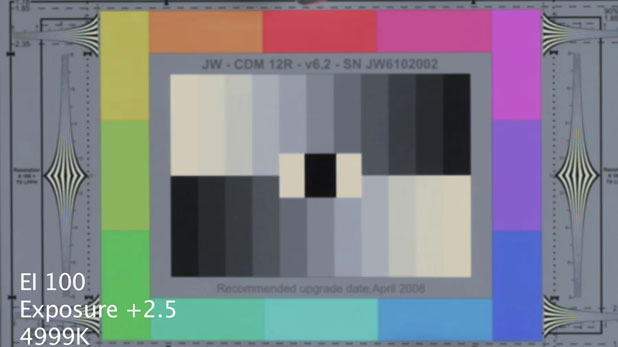
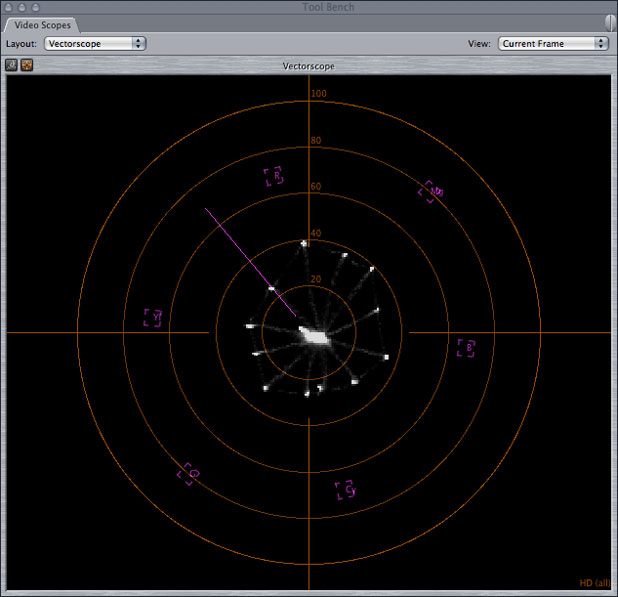
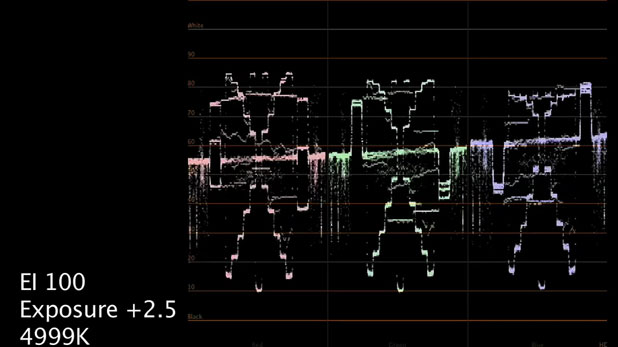
This is the end of the line for daylight overexposure. The flat lines on the waveform show that both blue and green have clipped, and red is heavily compressed and just short of clipping. This makes complete sense, as the amount of red in daylight is significantly less than either of the other two colors–the exact opposite of tungsten light, which has a lot of red and very little blue.
What’s really strange is that notch on the blue channel that extends above the point where the blue channel appears to be clipped. That represents the right side of the color chart where blue, purple and magenta sit. The blue-saturated colors seem not to be clipping, while the neutral color chips that contain all three colors appear clipped, but I’m not sure how they can be flat while the blue colors aren’t. Very weird. Perhaps someone smarter than I can explain that one.
The white chip is now 5 stops brighter than 18% gray.
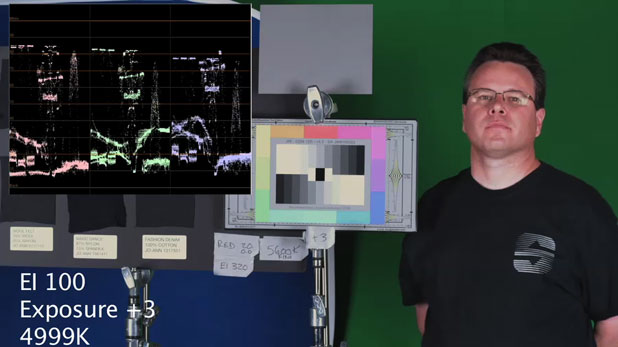
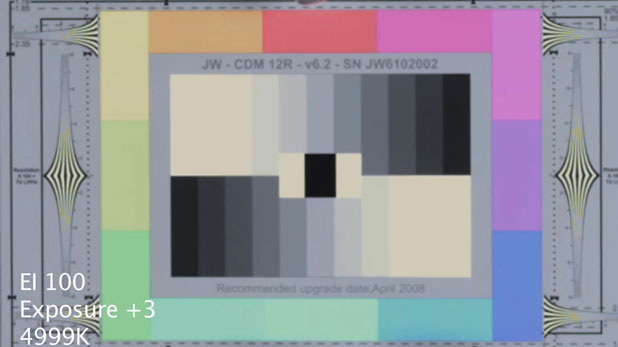
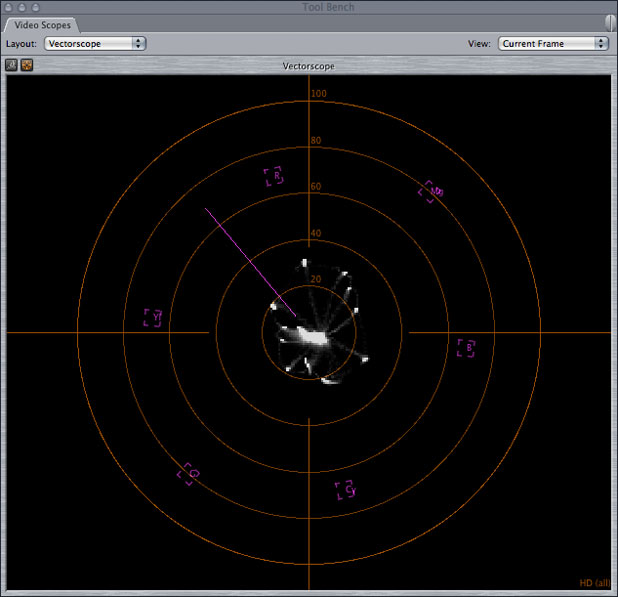
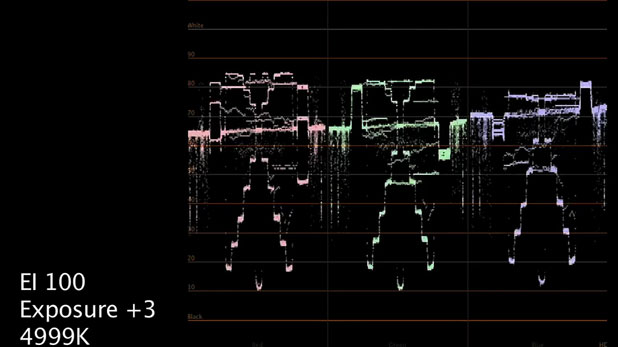
Based on these tests, I see that RED build 20’s daylight overexposure latitude safely handles up to 3.5 stops of overexposure beyond 18% gray, and even extends to 4.5 stops of latitude without significant penalty. (This, of course, is based on exposure of a white object; overexposure of brightly colored objects might result in that channel clipping prematurely.)
Daylight Underexposure
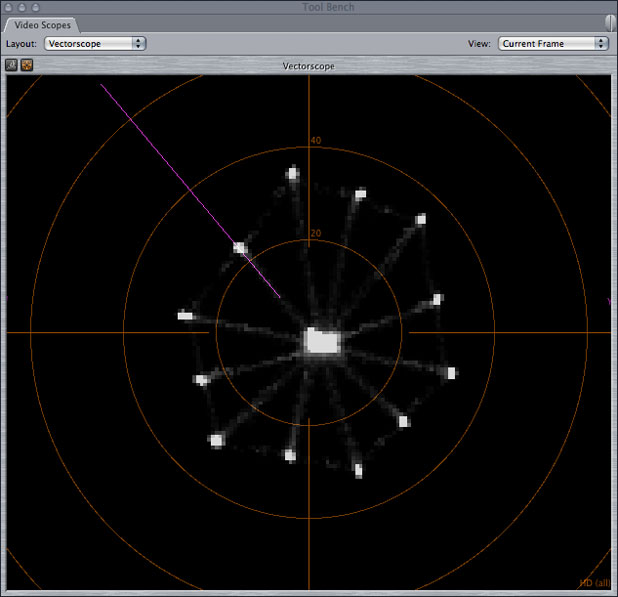
Once again, here’s the baseline exposure under 5600k light. In this example we’re going to pay close attention to the vectorscope below.
It’s hard to see in this still frame, and harder to see using Final Cut Pro’s built-in scopes, but both the colors and white look pretty good here. White, the spot at the center, is a little on the cool side (it bulges toward the blue vector) but otherwise is a nice tight ball that retained this shape consistently throughout the overexposure tests.
It’s interesting to note that steps in the “legs” of the blue channel are fatter than than either the red or green channel, which means that blue is picking up more noise than the other channels.
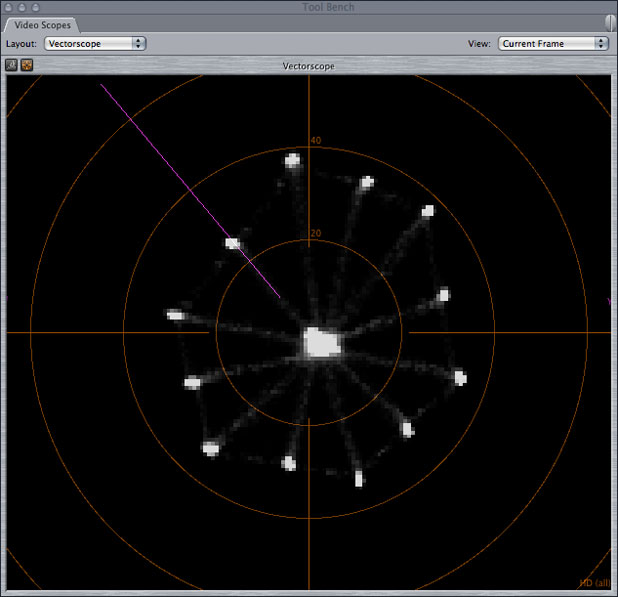
The vectorscope dots are suddenly a bit fuzzy. The spot of white in the center is a little larger and has changed shape, possibly indicating noise, and the dots of color surrounding it are a little larger as well. It’s a surprisingly noticeable change for a half stop decrease in exposure.
The “steps” in the blue channel “legs” are getting a little thicker and less distinct, particularly on the bottom. The lower steps in the red channel look a little thicker as well. This thickness is consistent with those channels becoming noisier.
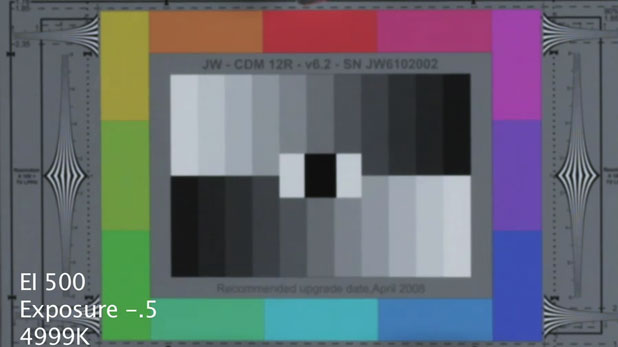
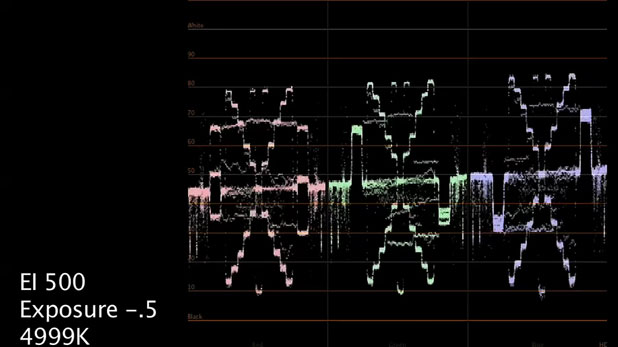
At this exposure both white and the colors look less distinct as they accumulate noise.
The steps in the red and blue channels are both noticeably thicker due to noise.
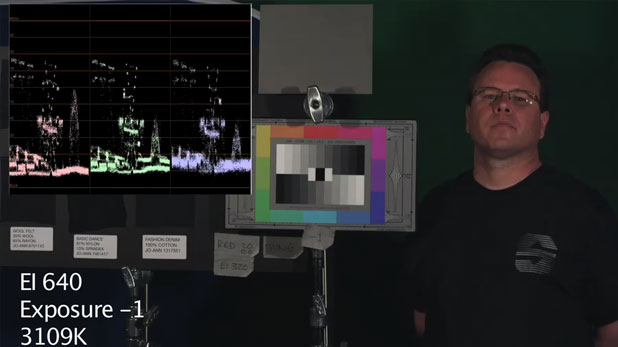
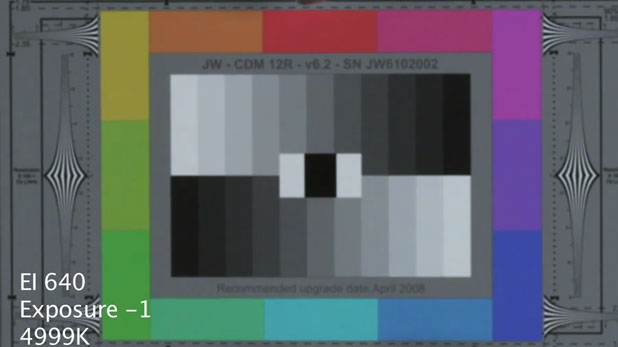
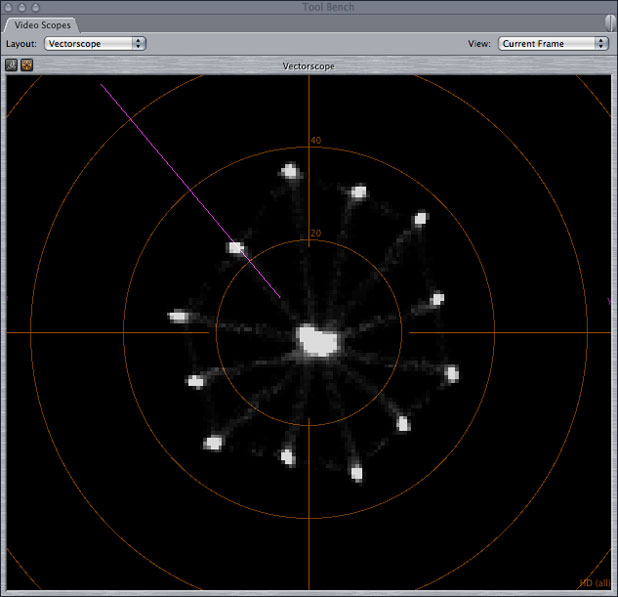
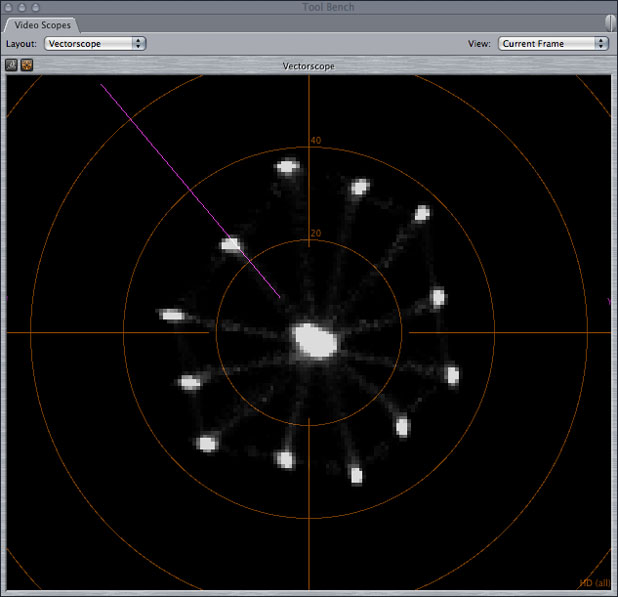
All the dots on the vectorscope are fuzzier and larger than before, indicating a large build-up of noise.
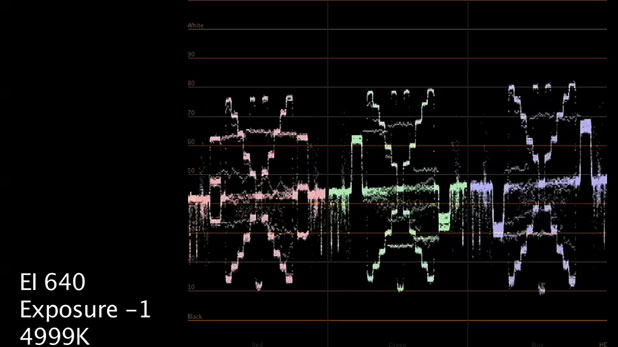
The “steps” in the red and blue channels below 18% gray are very thick now, and green is starting to catch up. The black chip in the blue channel (the blob between the “feet” of the blue channel) is much blurrier than in previous exposures, and red isn’t far behind.
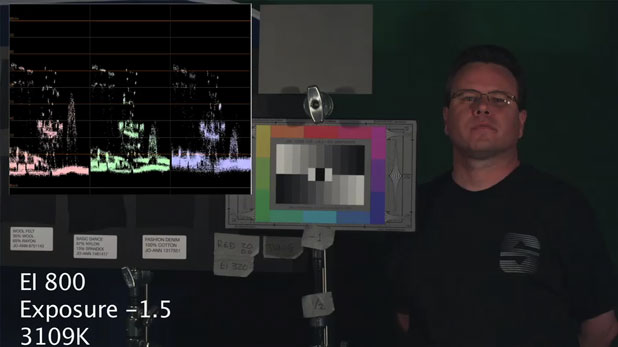
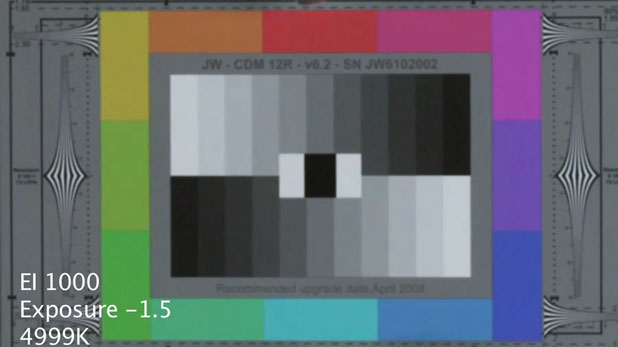
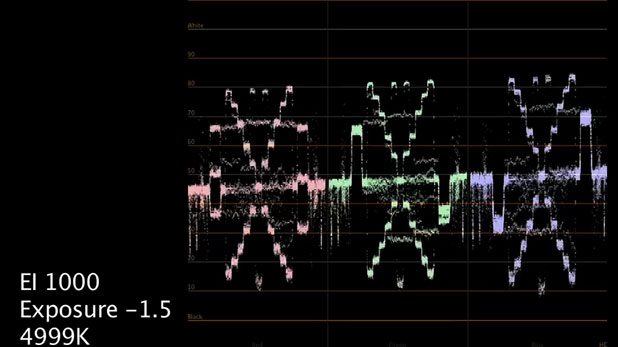
Based on what I see here, EI 320 really does seem to be the sweet spot of exposure. At that rating, tones five stops under 18% gray hold up well and sit just at the top of the noise floor. Any further overall decrease in exposure, such as would happen if the camera were rated at 500 or 640, results in a rapid increase of noise in the blacks.
Rating the camera slower than EI 320 also results in the white chip at 2 stops over 18% gray becoming noticeably noisier.
The noise that we see here is exaggerated as I zoomed into this chart from the larger frame to isolate the color and brightness values. There may be slightly less apparent noise when viewing the full frame, although if you look at the full frame movie of the test (see last page) you’ll see that what we’re seeing on the enlarged chart is a pretty solid indicator of what’s happening overall.
We switch over to tungsten light on the next page…
Tungsten Overexposure
There’s something I want you to notice about this chart: the column of colors on the very left (yellow, yellow-green and green) contains no blue, while the colors in the column on the right side (blue, purple and what appears to be magenta) all contain blue.
Notice how the vectors on the yellow-green-cyan side of the chart are closer to center than the other colors are. That means they’re less saturated.
I wasn’t expecting to see anything startling at this baseline exposure, but life is full of surprises. The “steps” in the blue channel are a little less distinct than the baseline exposure under daylight, but that’s to be expected. Sensors are naturally “daylight balanced” as silicon is least sensitive to shorter wavelengths of light, which is where the color blue lives.
The big revelation, though, occurs when we look at the “notches” in the blue channel. The notch on the left side is the column that contains no blue, so the waveform dips down abruptly to reflect the lack of blue in that section of the chart. The upward notch on the right reflects the column of colors that contains the color blue.
The odd thing is that, under daylight, the notches are equally big. Under tungsten, though,the left notch is too shallow, which seems to indicate that the camera is detecting blue in a column of colors that don’t contain any blue.
Let’s compare the baseline daylight and tungsten waveforms and charts:
When we compare the waveforms we can see that not only is there blue in the yellows and greens under tungsten light (the left notch in the blue channel is not as deep under tungsten as it is under daylight), but blue saturation is down overall (the right notch is not as tall under tungsten as under daylight, indicating less overall blue).
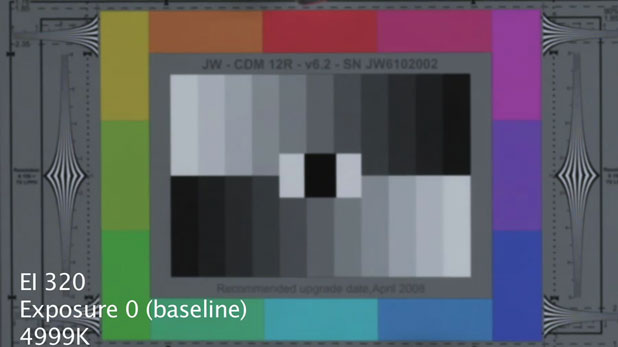
It’s easy to see in these charts that the greens are muted and muddy under tungsten light, which is consistent with having some blue mixed in. The colors that contain blue are also a lot less saturated and rich than they are under daylight.
The whites don’t match between the daylight and tungsten charts and waveforms, but I’m attributing that to RedCine’s inability to white balance properly.
At this exposure everything seems to be holding well. The colors are more saturated than at baseline and all the “steps” in the waveform are nice and thin, showing a very clean signal.
The white chips are 4 stops brighter than 18% gray.
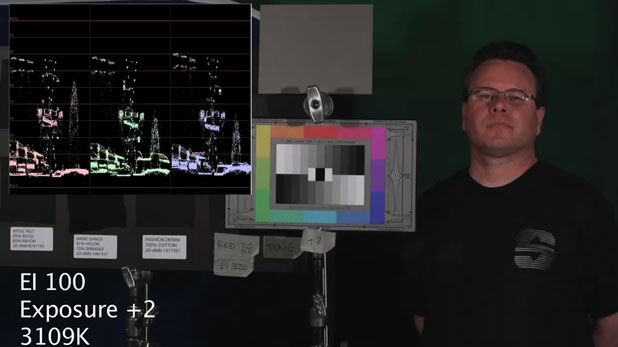
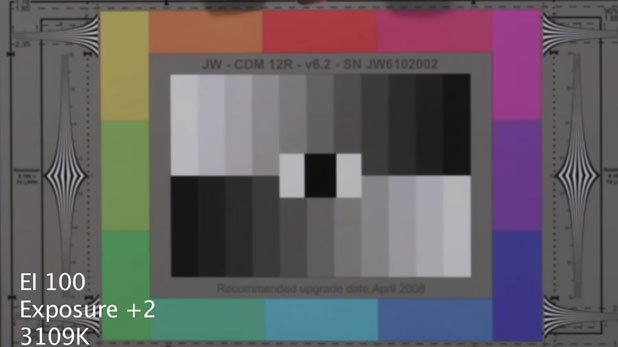
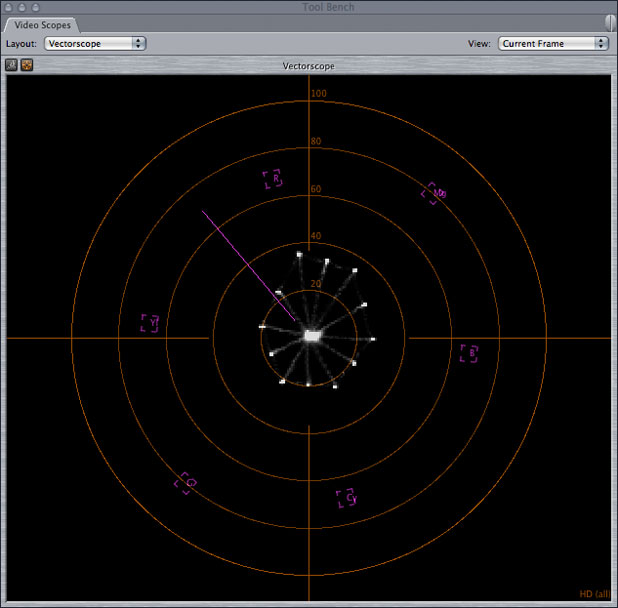
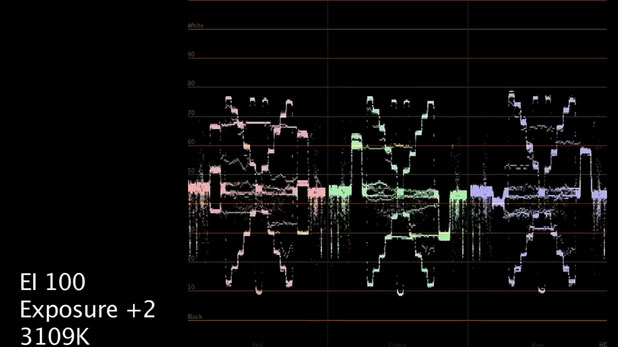
The top of the red channel is compressing, showing that it has entered the very top of the RedSpace gamma curve. The colors remain consistent with previous exposures.
The white chips are now 4.5 stops brighter than 18% gray.
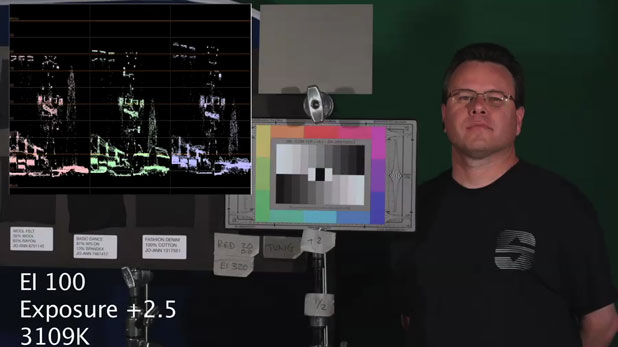
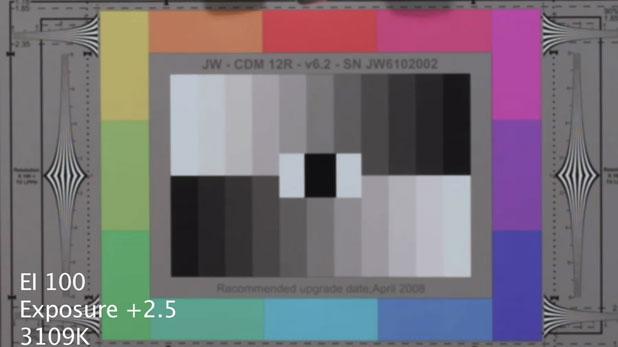
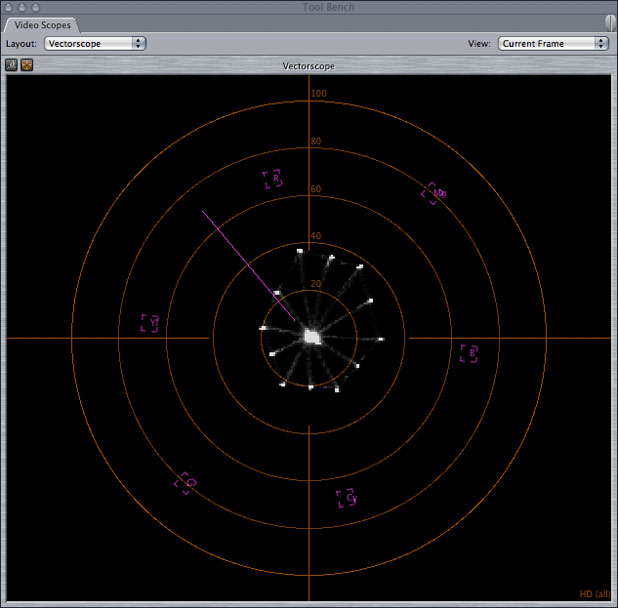
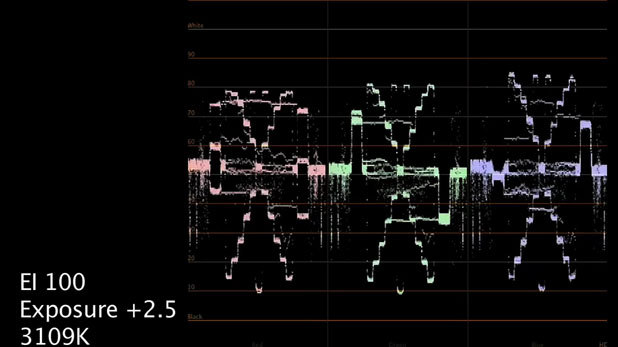
The white chips are now 5 stops brighter than 18% gray. Red is clipping, green is heavily compressed, and blue is starting to compress. The vectorscope is collapsing, mostly on the left side where yellow resides. There’s still detail in the highlights but the colors no longer track with earlier exposures.
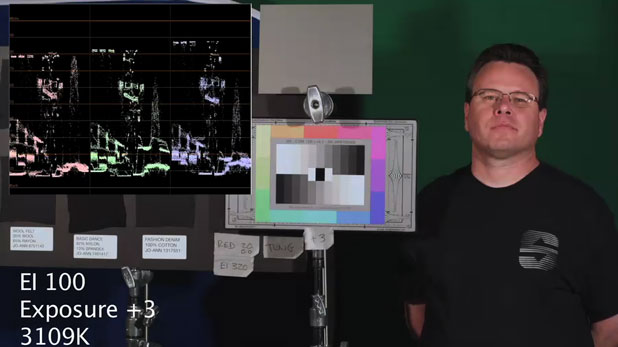
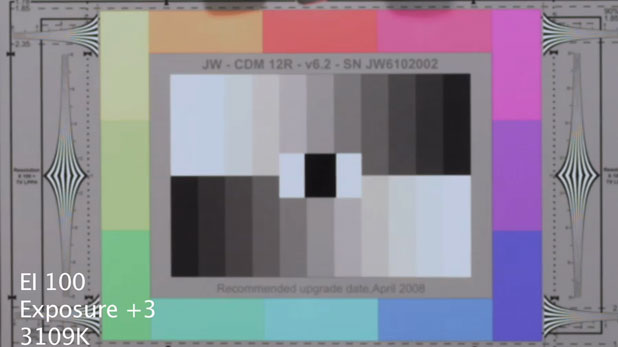
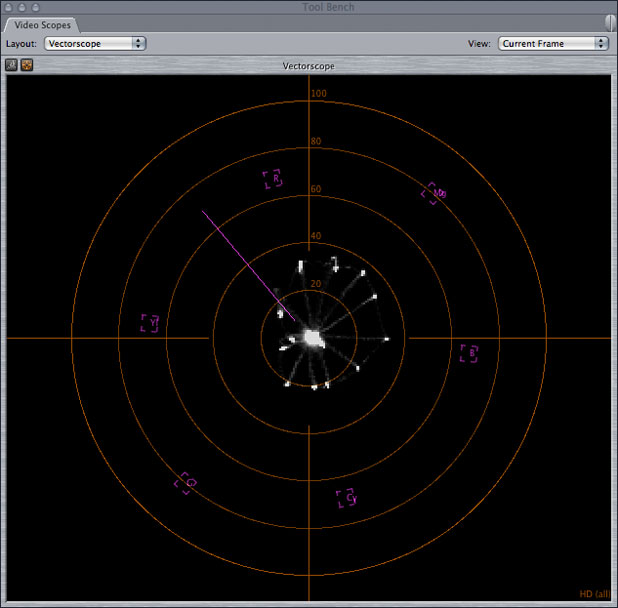
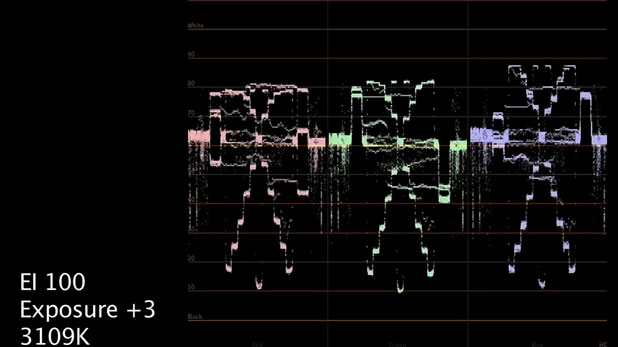
Red and green are now completely clipped, and blue is showing some clipping as well. There’s no longer any distinction between the upper two steps of tones on the gray scale and the vectorscope is a mess. Clearly we’re beyond the threshold of comfortable overexposure.
Notice that as green compresses the downward notch on the left side of the blue channel has inverted, becoming an upward notch.
The white chips are at 5.5 stops of overexposure.
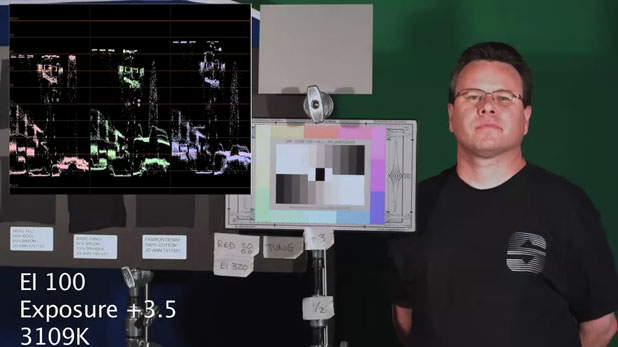
Based on this I’d have to say that the RED under tungsten light can handle 4 stops of overexposure easily, and still retain good detail and color rendition at 4.5 stops. This is a significant change from earlier builds, and it appears that the red gain is being adjusted downward internally to compensate for the larger amounts of red in tungsten light. While the blue contamination in the greens is disappointing, the overexposure latitude is a huge win.
Tungsten Underexposure
Here we are, once again, at tungsten baseline. The blue legs are a little thick with noise, but red and green are very clean. That’s exactly what you’d see in any camera under tungsten light. The center of the vectorscope looks consistent with brighter exposures.
The black chip on the chart is 5 stops under 18% gray.
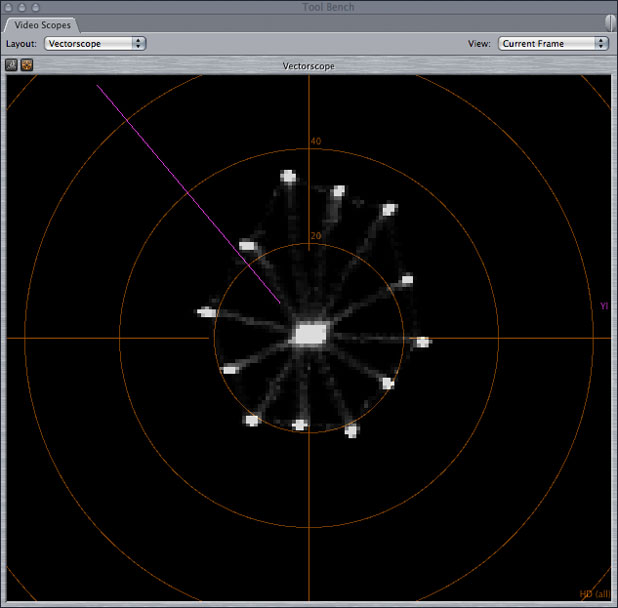
The blue channel “steps” are becoming bigger, indicating an increase in noise.
The vectorscope is becoming noticeably fuzzier.
The black chip is now 5.5 stops under 18% gray.
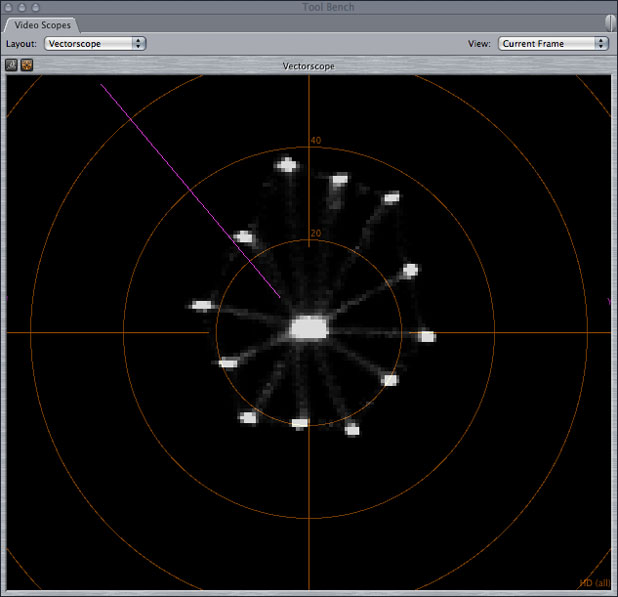
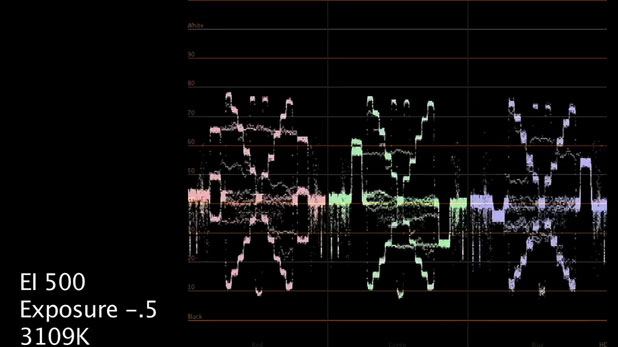
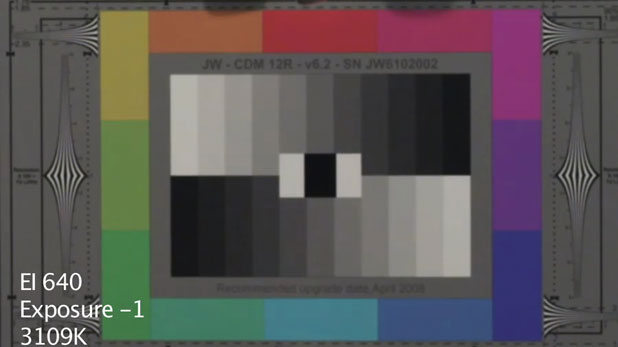
Both the vectorscope and the blue channel waveform are showing a lot of noise.
The black chip is now 6 stops under 18% gray.
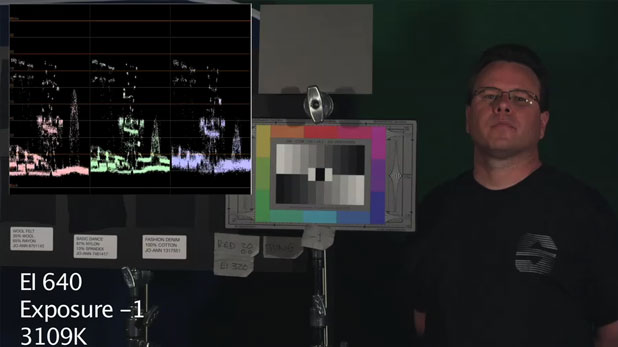
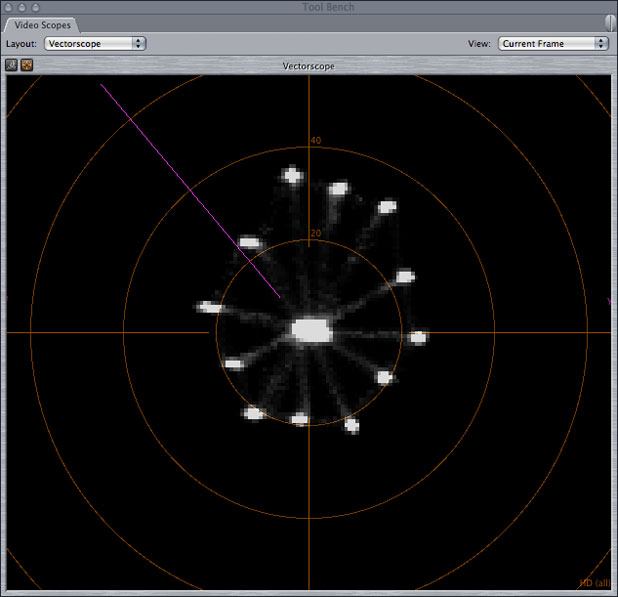
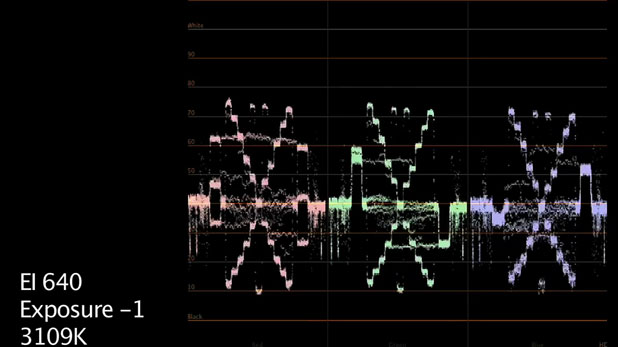
This is the end of the line for the blue channel, whose waveform “legs” are very thick and indistinct, showing a lot of noise. The colors on the vectorscope continue to fuzz out.
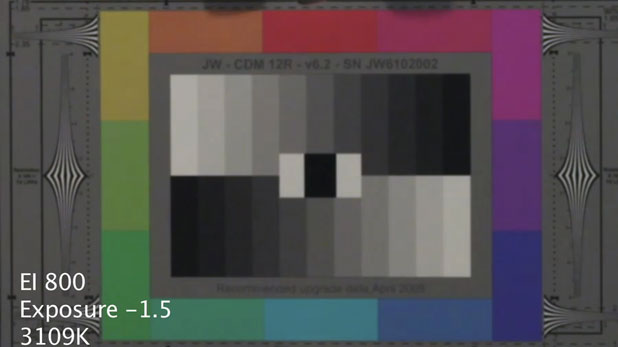
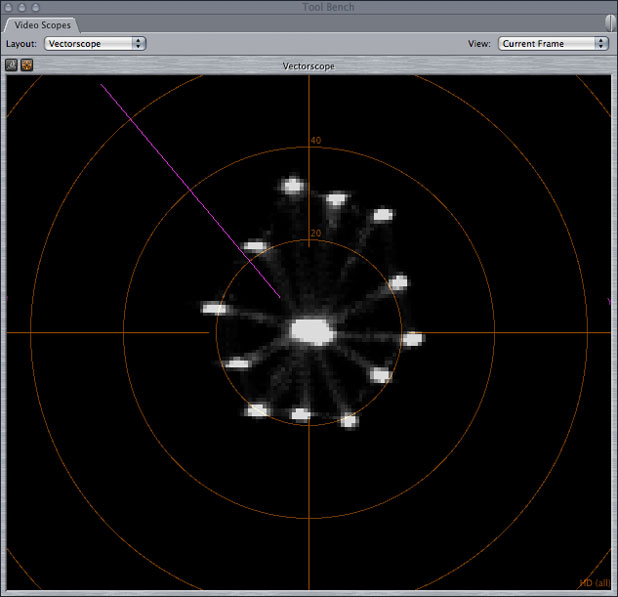
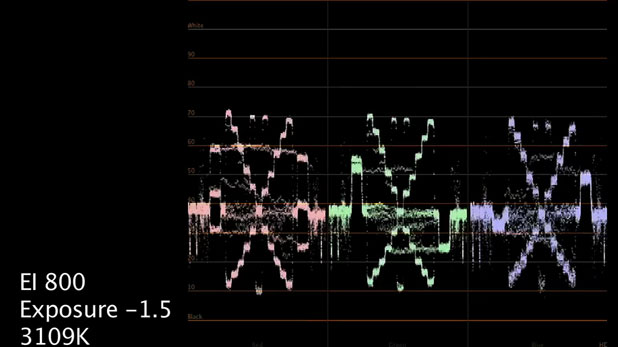
Once again, the camera’s sweet spot seems to be EI 320, where a black chip at 5 stops below 18% gray in exposure is very clean and fairly free of noise. The vectorscope shows that colors pick up a noticeable amount of noise at as little as -.5 stops underexposed, or between EI 400 and 500.
Turn the page for conclusions and a RED exposure cheat sheet…
Conclusions
Film speed is determined by complex math that, frankly, I have no understanding of, but it revolves around a point at the bottom of the gamma curve where the emulsion starts to respond in a predictable way.
How, then, do we apply that same kind of thinking to an HD camera, especially a “raw” one? After looking at the data I decided that I would base my estimated EI around the point where noise started to noticeably corrupt both black and moderate highlights. In the case of the highlights I watched the vectorscope for the first indication that the white chip on the chart, at 2 stops above 18% gray, started being distorted by noise. Similarly, I watched the parade waveform for the point where the black chip on the chart, at 5 stops under 18% gray, noticeably lost definition in one of the color channels (typically blue). Based on those two factors, I determined that EI 320 puts Zones 6 and 7, where flesh tones fall, just above the level where they will start to become noticeably noisy, as well as putting black just above the noise floor. Brighter exposures show less noise but white and black retain consistent characteristics. Darker exposures show white and black devolving rapidly into noise.
This test was semi-scientific in that I did not shoot the DSC Labs chart full frame, but zoomed into it later–exaggerating the noise. This turned out to be a bit of a blessing, however, because when the RED becomes noisy it does so very quickly, and blowing up the chart revealed that threshold quite clearly.
The full frame was intended to show the effect of exposure and light color on flesh tone.
The RED reminds me of stories I heard about older film stocks whose shadows would turn green or red and be muddy unless some small amount of exposure was added to the blacks. It was common for a cinematographer to aim a small light into the shadows so that the toe of the emulsion received a little bit of light, which improved the quality of the blacks enormously. The RED strikes me as being similar, not that the shadows change color dramatically, but that it doesn’t yield a solid technical black at 0 IRE, always requiring some crushing of the blacks in post. It occurs to me that a little extra fill light might clean up some of the noise that otherwise haunts the shadows. Director of photography Geoff Boyle described the Vision Research Phantom similarly: he always light with a little extra fill light and crushes the blacks in post to make them richer and noise-free. I see no reason why that shouldn’t work with the RED.
I’m disappointed by the apparent contamination of the green channel by blue under tungsten light, but that seems to be an insurmountable hardware issue. The Rec 709 colorimetry appears vastly improved over earlier software builds. The tendency for the RED to exaggerate green or magenta seems to be gone. Over time I’ve come to prefer the Camera RGB color space for its subtle colorimetry, but Rec 709 seems usable now. The camera still renders color a lot better under daylight than tungsten, at least as far as the blue channel is concerned, but the exposure latitude under both kinds of light appears to be the same.
Here are my recommendations for under- and overexposure limits when using the RED ONE, build 20, at EI 320:
DAYLIGHT
White object, no color channels compressed: +3.5 stops
White object, maximum compression before clipping a color channel: +4.5 stopsBlack object, just above noise floor: -5 stops
TUNGSTEN
White object, no color channels compressed: +4 stops
White object, maximum compression before clipping a color channel: +4.5 stopsBlack object, just above noise floor: -5 stops
MISCELLANEOUS NOTES
-Color accuracy is greater in daylight
-Blue contaminates the green channel under tungsten light
-Colors containing blue are less saturated under tungsten light
Like any film stock, you should vary the EI of this camera to reflect your personal tastes. Changing the RED’s EI does one thing, and one thing only: it changes where neutral gray falls on the RED’s 9.5-stop exposure scale. For example,
EI 320: 4.5 stops over 18% gray and 5 stops under 18% gray
-The “sweet spot” just above the noise floor, with maximum overexposure latitudeEI 160: 3.5 stops over 18% gray and 6 stops under 18% gray
-Less noise, but less overexposure latitudeEI 640 5.5 stops over 18% gray and 4 stops under 18% gray
-More noise, but more overexposure latitude
You can view Quicktime movies of the test footage here:
Chart Only Test Footage (zoomed in)
Art Adams is a DP who tries not to create a lot of noise. His web site is at www.artadams.net.