

Filmtools
Filmmakers go-to destination for pre-production, production & post production equipment!
Shop NowWe test Hot Mirror filters from three major manufacturers to see which does what on the RED

Not all infrared or Hot Mirror filters are made the same, and not all work the same way on different cameras. In this test we looked at filters from Schneider, Formatt and Tiffen to see how they perform on the RED ONE.
First, let’s review what the issue is with HD cameras and IR:
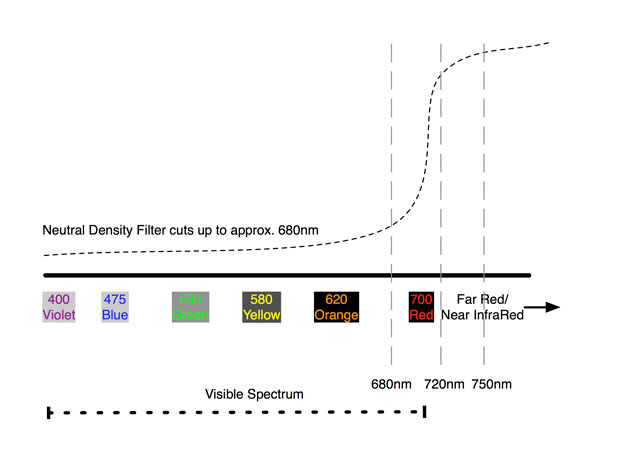
The visible spectrum runs from approximately 400 nanometers to 700 nanometers in wavelength. Unfortunately, silicon is most sensitive to light energy above the visible spectrum: it’s the perfect infrared imaging material. Without some sort of “Hot Mirror” filter (a filter that reflects heat, or IR) this invisible energy will overwhelm the visible light hitting the sensor and ruin our images. Most cameras are built with a Hot Mirror filter mounted to the front of the sensor, but some Hot Mirrors are better than others.
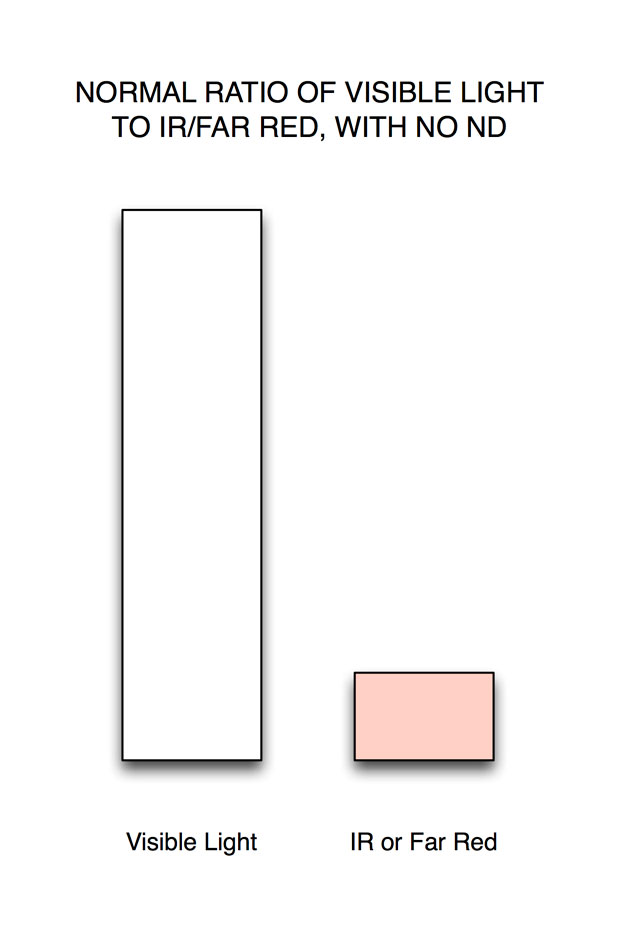
Under normal conditions there is a certain amount of what is called “far red” (red light beyond the visible spectrum, but not yet IR heat energy) captured by a sensor, but it is easily overwhelmed by the amount of visible light in the image so we don’t normally see it:
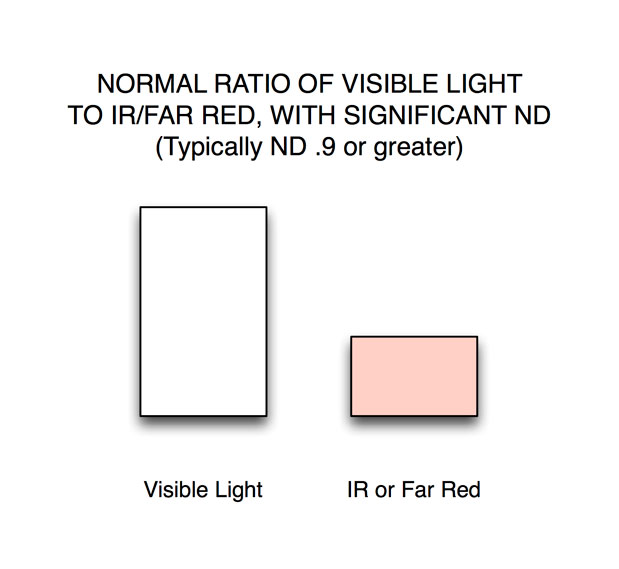
Neutral density filters block visible light but not far red or infrared, so adding ND filters reduces the ratio of visible light to far red light hitting the sensor. At some point that ratio becomes low enough that far red becomes visible and is easily seen in reflective synthetic materials and some clothing dyes, which makes those materials appear a muddy maroon or, in some cases, bright blue.
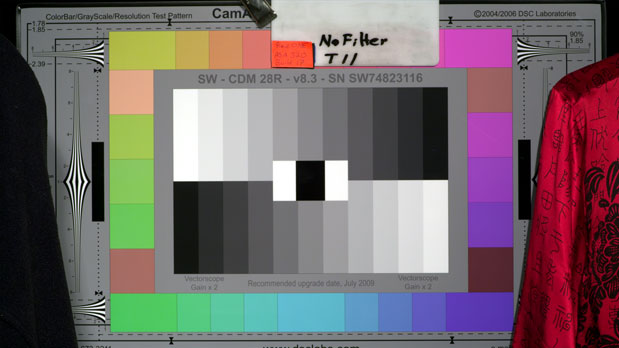
Here’s a test setup shot on a RED with no filtration:
Here’s the same shot as above but with a Schneider ND 1.2 filter:
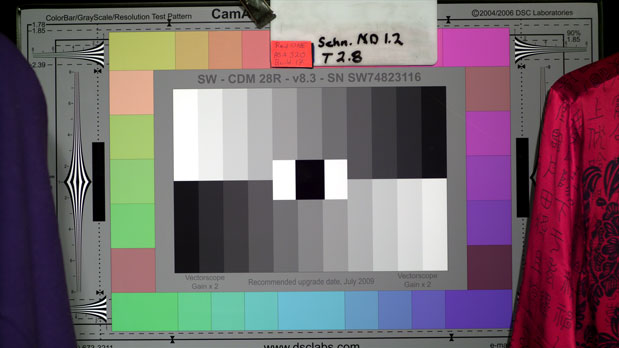
Believe it or not, the bright blue in the black jacket on the left of frame is IR contamination. In the past I’ve only seen IR turn dark objects maroon, and at first I had no idea what to make of this. A conversation with Adam Wilt confirmed that not only was this IR contamination, but that the blue hue was not uncommon. Apparently the blue filtration on most sensors is very good at isolating blue in the visible light spectrum but not always so good at blocking light in the non-visible part of the spectrum. Under certain conditions such as this test, where we’re using a camera that is nominally daylight balanced in a tungsten environment with ND (not a common scenario), this small weak point in the sensor’s blue filtration becomes apparent.
Until single-chip cameras became fashionable we rarely saw these issues. The prisms in three-chip cameras pass only very specific wavelengths of light and are very good at excluding far red and IR. Single chip cameras, though, are a completely different story, and those I’ve tested so far benefit from additional filtration in situations where the ratio of visible to far red light, or IR energy, becomes too low.
The filters we tested all worked in slightly different ways, and it’s fascinating to see what works well and what doesn’t, and why. What’s more, these filters seem to be camera specific, so what works on one camera may not work on another.
All of the footage used for this test was shot in Redcode 28, 4k 16:9, and saved as 2k DPX files, which were then brought into Adobe Photoshop CS4 and white balanced by using the white, gray and black pickers, in the curves adjustment tool, using the following targets:
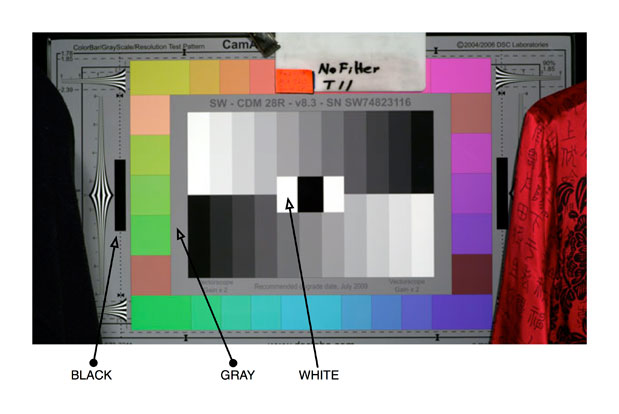
The white balancing was necessary as several of these filters imparts a subtle hue to the image, which is then easily removed in post.
Read on…
THE SETUP
First, here’s the scene we shot for all of our tests:
In the center is a DSC Chroma-Du-Monde chart. On the left side of the frame is a black nylon jacket, which we used as our far red/infrared target. On the right side is a bright red kimono, used to test whether the filters cut to far into the visible spectrum. As you can see from the slate, we’re using a RED ONE with software build 17, and while we technically rated it at EI 320 we really “exposed to the right” until the red channel was clipping in Rec 709 but not clipped when viewed in raw mode. (Raw mode shows what’s really happening, and I’ll frequently open up the F-stop until a color channel clips when viewed in RedSpace or Red 709 and then check that exposure in raw to make sure the channels are, in fact, not clipping.)
We shot this test under tungsten light in order to maintain a consistent look. Although far red/IR effects are most often seen in daylight when using lots of neutral density filtration, tungsten light contains just as much infrared and remains consistent over time.
We used an 85mm Arri/Zeiss UltraPrime, at the stops noted on the slate. It’s important to know that all of the filters we tested use a dichroic coating to reduce far red/IR contamination, and when viewed at an extreme angle they change colors, usually becoming cyan from the camera’s perspective. As an additional test we viewed each filter through a 16mm UltraPrime and looked for color vignetting around the edges. That particular lens comes with its own “darken the corners in telecine” look as you can see here:
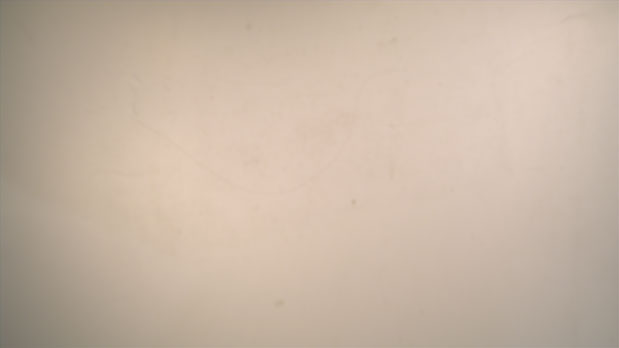
When you see that degree of darkness in the flat field filter tests, please understand that this is due to the lens losing brightness around the edges of the frame and not due to the filter. The filters cause any color shifts that you might see around the edges of the frame. (The flat field was created by covering the matte box with Lee 216 White Diffusion and bouncing a light off a piece of foam core three feet in front of it.)
Let’s proceed to the first round of tests, on the next page…
FIRST UP: SCHNEIDER OPTICS HOT MIRRORS
Schneider Optics kindly got the ball rolling by loaning me three different filters with three different degrees of far red/IR cut: The Tru-Cut 680, Tru-Cut 720, and the Tru-Cut 750. First up is the Tru-Cut IR 680, in combination with a standard Schneider ND 1.2 filter:
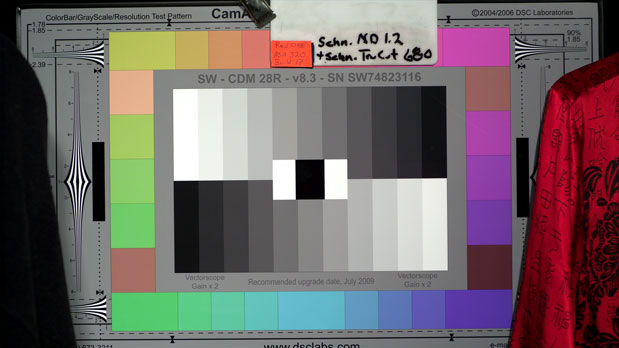
The Tru-Cut 680 is probably the lowest cut filter that we tested, and as you can see it does an excellent job of cutting IR/far red. The black jacket is rich black, with no obvious color shift, and the red kimono is still nice and red. The problem, though, is that the dichroic coating on the filter is very heavy. Dichroic IR filters typically have two sides: the side that faces out appears to be salmon-colored when viewed at an angle, and the side that faces the lens appears cyan when viewed the same way. On wide angle lenses, such as a 16mm lens, the angle of view around the edges becomes so extreme in relation to the dichroic coating that the cyan hue becomes visible:
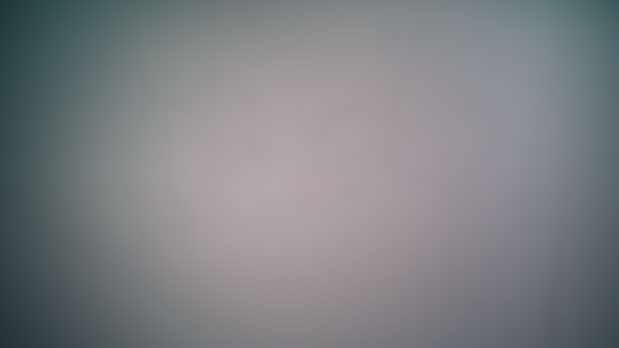
In my Sony F35 tests (to be published shortly) we detected vignetting on lenses wider than 50mm when using this filter, although it was most noticeable on the 16mm and 24mm. So while the Tru-Cut 680 is a great filter for cutting IR, it’s not so good on wide angle lenses.
Next up is the Schneider Tru-Cut 720 + ND 1.2 combination filter:
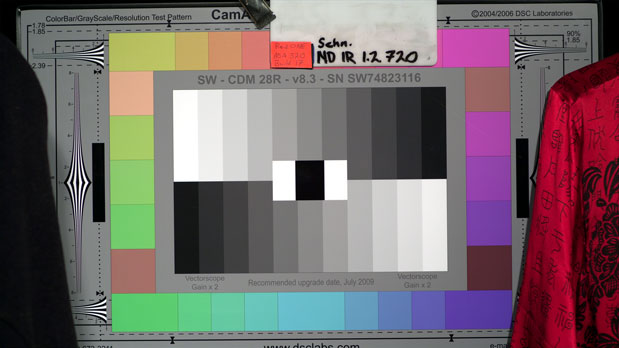
This filter cuts most of the IR from the image after color correction. Before color correction, though, with the blacks lifted up a bit, we can see a little maroon-colored IR infiltration:
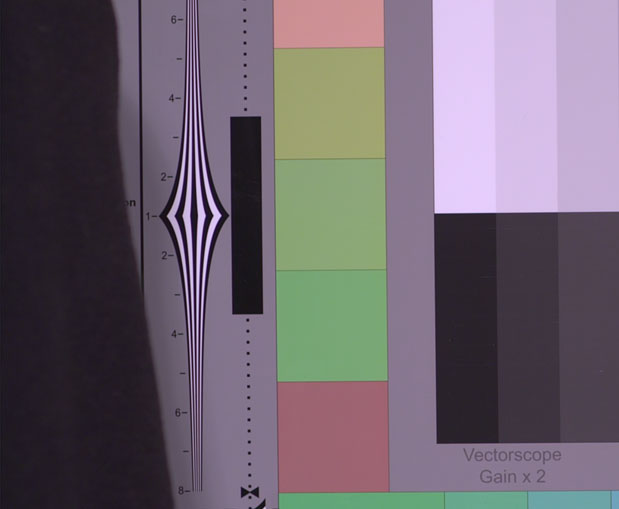
For practical purposes the Tru-Cut 720 filter removes all the IR necessary to recover good blacks in post. The flat field test of this filter shows it has a slight warmth to it:
This tint is easily removed in post. The edges of the frame show no obvious color fringing beyond the natural brightness vignette of the 16mm UltraPrime, so this would be a good choice for an all-around IR ND filter. (We only received this filter as a Hot Mirror/ND combination, so we didn’t test a Tru-Cut 720 clear filter–if it exists. Before this test I’d not heard of the Tru-Cut 720.)
The final Schneider filter tested is the Schneider Tru-Cut IR 750, which has been a staple of local rental houses for the last six months. We stacked it with a Schneider ND 1.2 and viewed the results:
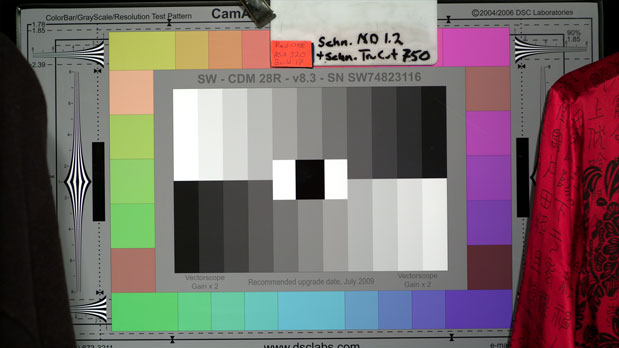
After color correction the filter seems to be doing a fine job, although a look at the frame prior to color correction shows that there is some IR/far red contamination in the jacket:
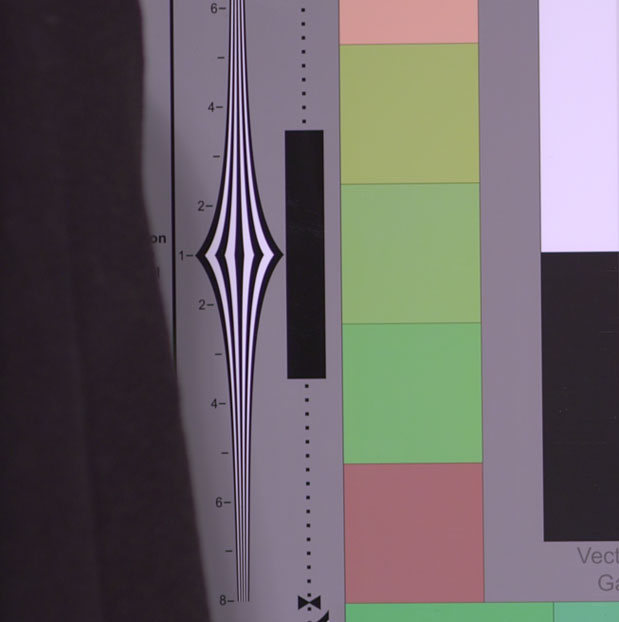
When I mentioned this to one rental house tech, all he had to say was “Every RED rental we’ve had for six months has gone out with one of these filters, and we’ve had no complaints.”
While the Tru-Cut 750 doesn’t do a perfect job, it seems to do its job well enough. Here is the fiat field test on the 16mm lens:
While this JPEG shows some slight color vignetting that appears to be a side effect of JPEG compression. The actual DPX file shows no color vignetting at all.
Schneider was among one of the first companies to offer Hot Mirror filters for the RED, and their offerings hold up well. While the 720 and 750 filters don’t do a 100% perfect job of cutting all IR/far red, they do contain it well enough to effectively eliminate contamination after post color correction.
The camera assistant who helped me with this test, Rod Williams, noted that Schneider Optics coats their filters with a slippery finish, making it very easy to remove fingerprints and other smudges.
We move on to Tiffen IR ND filters on the next page…
SECOND UP: TIFFEN HOT MIRROR ND’S
As Tiffen’s formula seems to be pretty consistent from filter to filter, in that they don’t offer filters with different IR cut levels, we only tested one of their filters: the Tiffen Hot Mirror IR ND 1.2. We pulled the Schneider ND 1.2 from the previous test and used only the Tiffen Hot Mirror ND 1.2 combo filter:
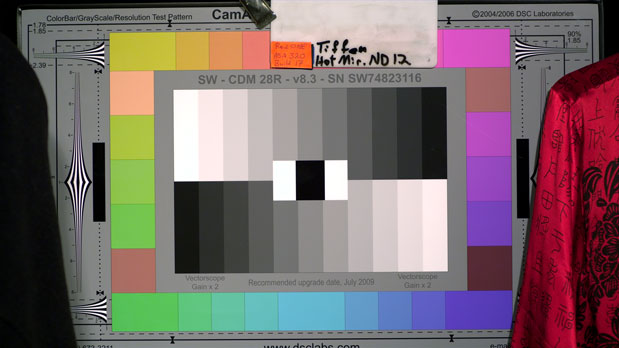
This color corrected image shows no trace at all of IR/far red contamination. The uncorrected image is a little bit startling:
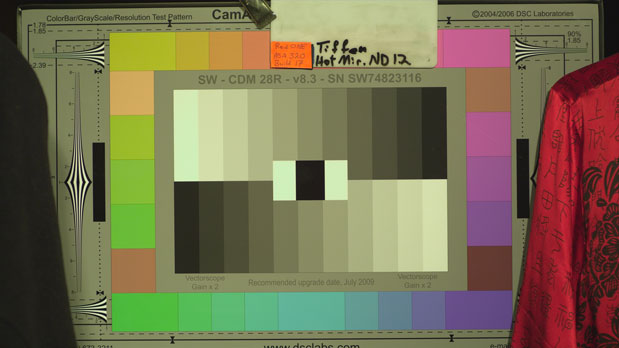
Yes, that’s right: the filter is a greenish-straw color. I have a theory about that:
Tiffen seems to have done something very clever when they devised far red filters for the Panavision Genesis. The Genesis is very sensitive to far red, and while the sensor has a 700nm IR cut filter on it far red can be an issue when using even the slightest amount of ND, which only blocks light up to about 680nm. As the issue wasn’t an IR (heat) issue but a far red (just beyond the visible spectrum of red) issue, Tiffen skipped using a dichroic Hot Mirror and instead created a filter that appears to be the exact complimentary hue necessary to remove that little slice of far red between 680nm, where most ND filters start to pass light, and 700nm, where the Genesis sensor’s Hot Mirror filter kicks in. During my tests with the Sony F35, which is an updated version of the Genesis, we discovered that the Tiffen IR ND’s, which are not Hot Mirror filters but contain only the greenish-straw tint, did the best job by far of eliminating far red contamination on the F35.
As the RED ONE’s on-sensor Hot Mirror filter seems to be either lacking or nonexistent, Tiffen devised a Hot Mirror version of the Genesis/F35 filter. There is an important distinction between the two lines of filters:
Tiffen HOT MIRROR IR ND filters are for use on the RED and other cameras whose built-in Hot Mirror filters don’t do a very good job of blocking IR, typically above 750nm.
Tiffen IR ND filters (which do NOT contain a dichroic Hot Mirror) are made specifically for the Panavision Genesis/Sony F35 and are the only filters that effectively cut far red contamination on those cameras. This is important, because the Hot Mirror adds about US$400 to the price of each filter–so don’t buy Hot Mirror filters for your Genesis/F35 because it’s a waste of money. The dye in the IR ND filters only cuts far red between 680nm and 700nm, and that’s not enough for the RED.
Here’s the flat field test on the 16mm:

There’s no color vignetting on this Hot Mirror filter, although this shows off the color of the filter nicely. Once again, I have to state how impressed I am that they came up with this dye formula to cut far red, in addition to the dichroic IR Hot Mirror.
Let’s move on to our final test with Formatt…
LAST BUT DEFINITELY NOT LEAST: FORMATT’S HD HOT MIRROR
I haven’t used Formatt filters very often but I understand they have a very good reputation in Europe. We tested the Formatt Hot Mirror IR ND 1.2 filter:
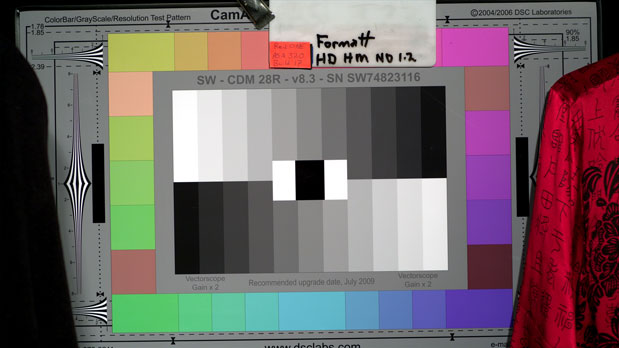
Off all the filters we tried, we liked the way this rendered blacks the best. Here’s the uncorrected version:
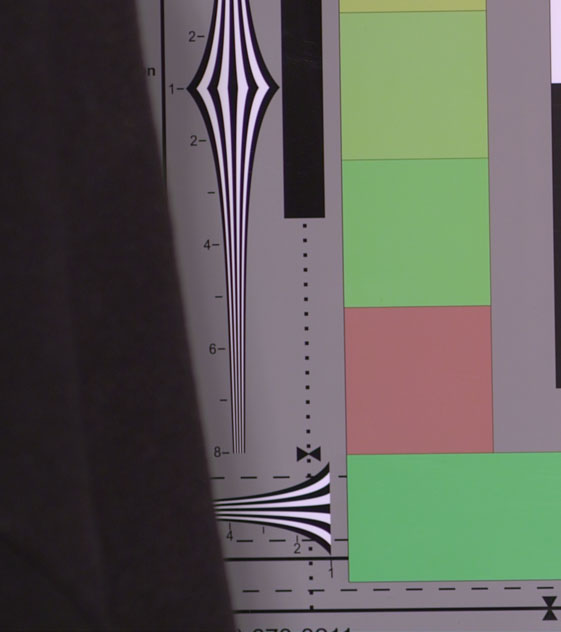
The black jacket appeared to us to be completely neutral black. This filter has a slight greenish tint, in addition to a dichroic Hot Mirror, and my theory is that Formatt is doing something along the lines of what Tiffen did with its green-yellow far red blocking dye, in addition to the Hot Mirror.
The only downside is that we did see some mild cyan vignetting on the 16mm lens:
It’s not horrible, but it is there.
Move on to the next page for some summary bullet points…
WHAT WE LEARNED
Different levels of IR/far red cut have different effects, depending on the camera and filter combinations.
The lower the cut, the heavier the dichroic coatings seem to be–and the more likely you’ll see color vignetting (usually a cyan color) on wider lenses.
The lighter the dichroic, the lighter the cut–and the more contamination you may see in synthetic fabrics and certain dyed fabrics. If the filter does a good enough job then the IR/far red contamination may be hidden by bringing the black levels down to normal in post.
The RED requires filters with a dichroic Hot Mirror. The Tiffen IR ND’s, which DO NOT have a Hot Mirror, work only on the Panavision Genesis and Sony F35. They do NOT work on the RED. The RED requires use of Tiffen’s Hot Mirror IR ND filters, which are (unfortunately) more expensive because of their dichroic coatings.
If a Hot Mirror is not labeled as to which side should face out the front of the matte box, it seems that the salmon-tinted side (when viewed at an off angle) should face out, away from the lens, and the cyan-tinted side (when viewed at an off angle) should face in, toward the lens. Hot Mirrors do have a front and a back, and it’s important that they sit in the matte box the right way.
Stayed tuned for the Sony F35 IR filter test, which should appear on Friday if my shoot schedule doesn’t change dramatically.
Thanks to camera assistant Rod Williams, video engineer Jim Rolin and Videofax for their help in this test. Any errors should be attributed solely to the author.