(Page 1 of 3 pages for this article  1 2 3 >)

Wednesday, June 03, 2009

Filed under: CamerasPre-ProductionProduction

The Last Far Red Filter You’ll Ever Need?

Art Adams | 06/03

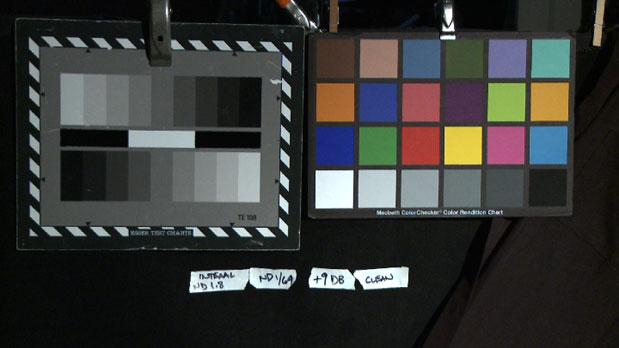
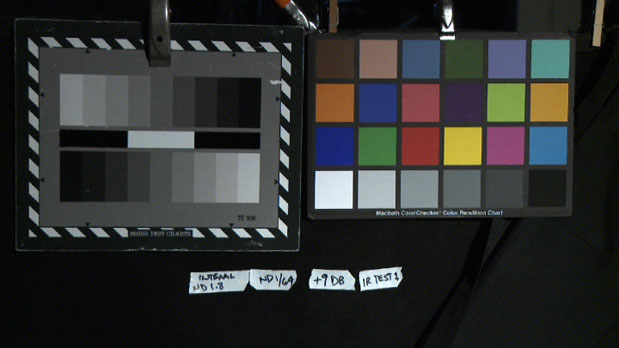
Tiffen’s latest test prototype kills far red dead on both the EX1/EX3 and the F35

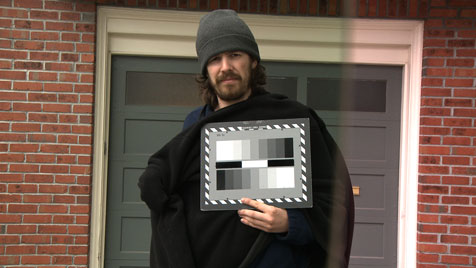
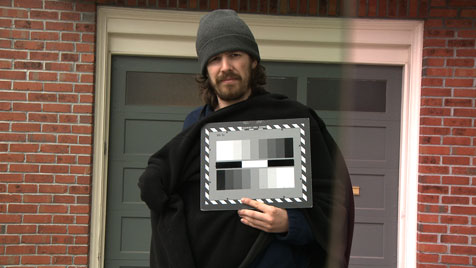
The Sony EX1/EX3/F35 cameras have a little issue where they are over-sensitive to far red. This new prototype filter from Tiffen cleans up far red, and then some.

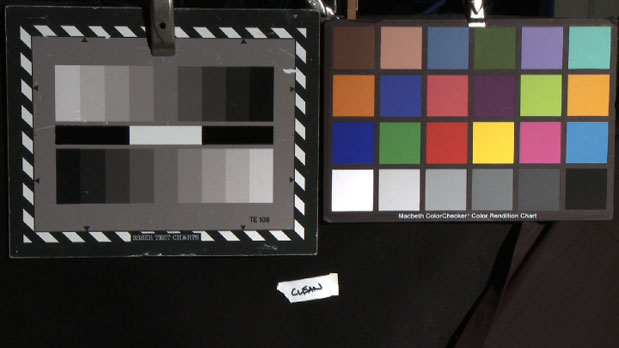
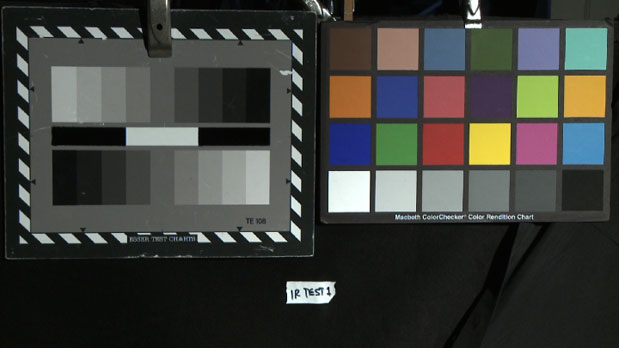
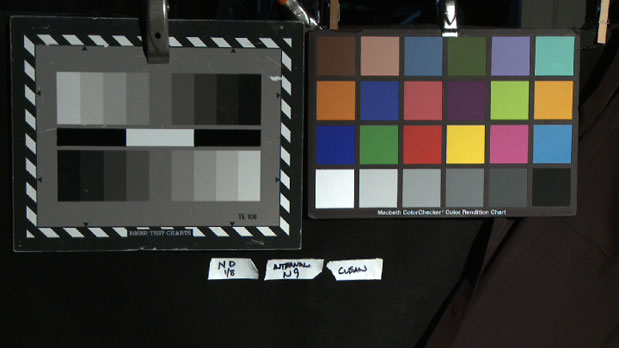
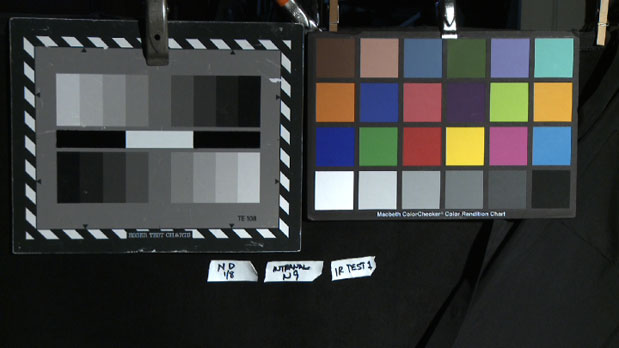
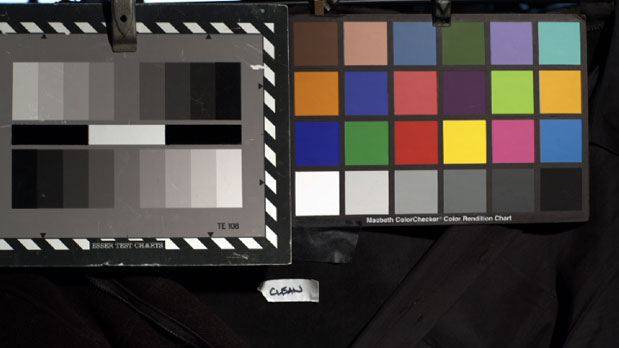
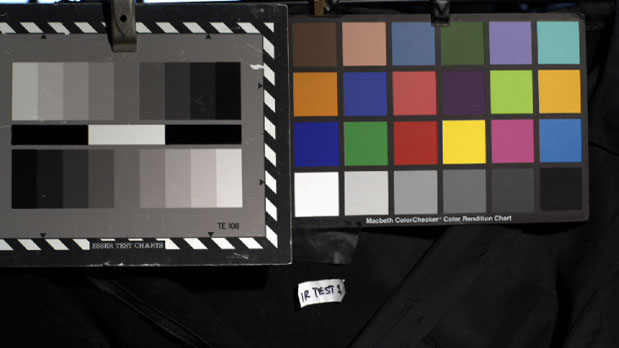
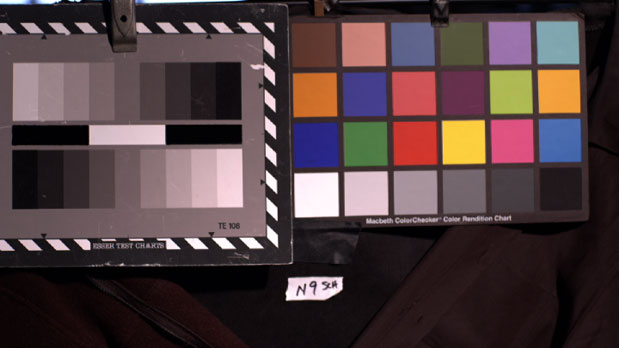
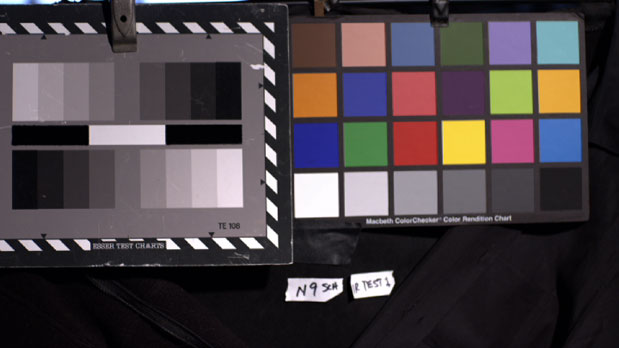
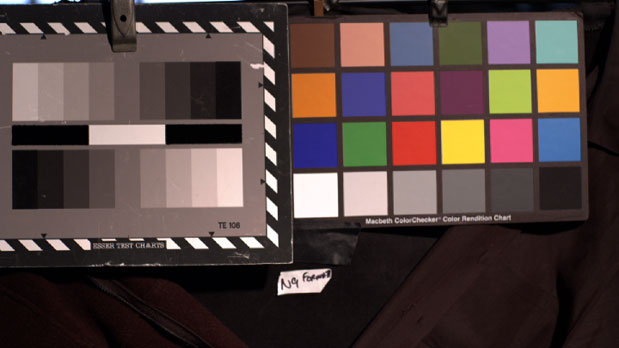
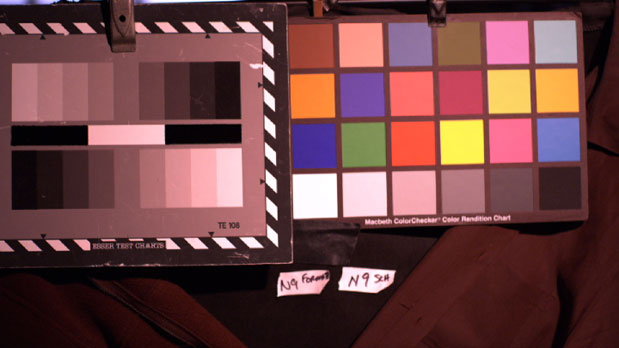
Before we get into the exciting world of test charts, let’s take a look at what far red contamination means to you. Here’s Anthony, prep tech at Videofax, modeling the finest in synthetic black fabric wear:
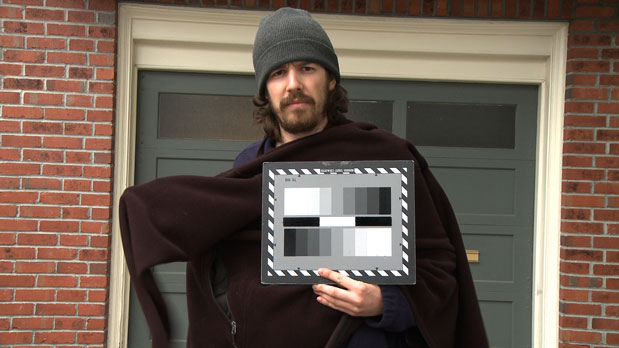
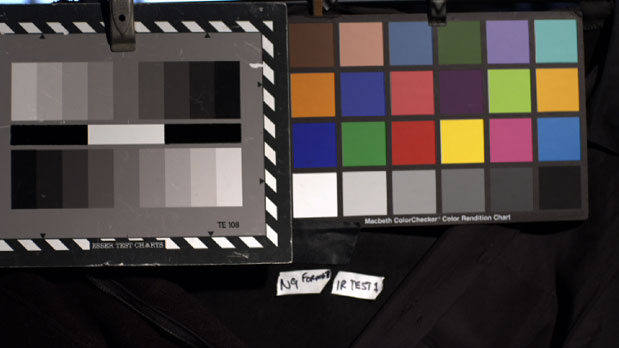
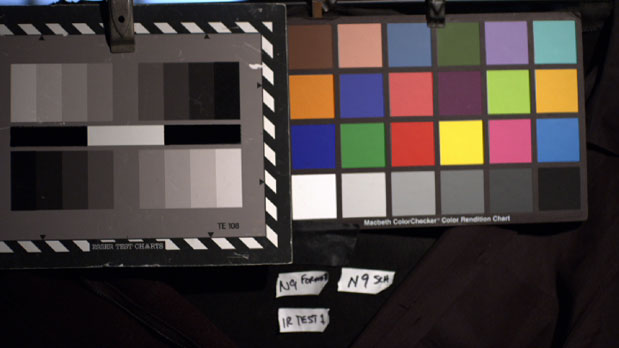
I know what you’re thinking. You’re thinking, “But Art—that’s not black at all! That’s some sort of maroon, and it went out of style in the 1980s!” And you’d be wrong on both counts. The jacket Anthony is holding is really black, and that maroon color went out of style in 1975. Here’s what it should look like:
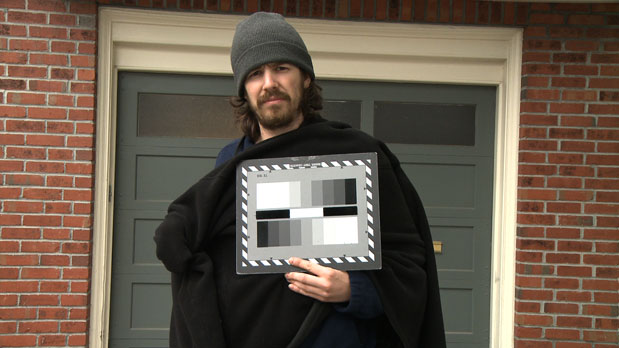
The bottom image, shot through Tiffen’s prototype no-ND far red filter, shows that Anthony’s fashion sense isn’t stunted at all. With so much black he could easily be mistaken for either an artist or a DP.

Let’s move on to what this really means. And thanks to DP Lenny Levy for shooting the images above during our testing session last Thursday.

If you were thinking something along the lines of “More test charts, please!!!” then proceed to page 2…

(Page 1 of 3 pages for this article  1 2 3 >)

                    Clip to Evernote


NAB 2012: Assorted Snapshots

Adam Wilt | 05/08

A few cool things I saw at the show that didn’t fit into any other articles.

NAB is too big a show in too short a time to see more than a fraction of it. I’ve covered a few things in some depth (as have other PVC folks), but there’s plenty more that slips by without proper coverage. Here, I have a few photos…

Sony quietly announces the NX30 camcorder, a little sister to the NX70

Allan Tépper | 05/08

With an 1/2.88" sensor and 26mm wide angle (35mm eqv), the NX30 should ship in June for well under US$2500.

image

Although during the past year I’ve written quite a bit about the Sony NX70 (officially, the HXR-NX70) here in ProVideo Coalition magazine, I haven’t…

NAB 2012: Cameras & Lenses

Adam Wilt | 05/02

A brief sampling of interesting photographic tools at NAB.

I’ve already covered the basics of what Sony and Panasonic announced, as well as looking at Canon’s…

You must be registered to comment. This is an effort to reduce spam. Please REGISTER HERE.

An interesting issue that Art only hints at are the implications of the fact we could see the “so-called IR” problem on black fabrics looking through some ND filters with the naked eye.

Thus we saw not just warm ND filters which is common but apparently neutral ND filters that showed excess red in black fabrics in the “not quite far red” visible spectrum. In our tests those were virtually all the 4x5.5 ND filters at Videofax at the time - Schneider, Format and Tiffen - a good cross section of commonly used professional filters! Some were warm to the eye but some looked fine until we checked the black fabrics.

However I had some 77mm ND’s on hand with my Ex-1 - a Heliopan and a B+W. Those showed no trace of the black fabric red issue. Moreover at home I took a peek through a 30 year old Tiffen ND9 in my closet.  No visible red contamination. Likewise 5 ND grads I have from Harrison and Harrison and Van Dienem ( both no longer in business.) Again no visible Red Contamination.

So I’m wondering whether some of the problem we have been assuming was a camera problem dealing with IR or “far red” in daylight with ND filters might not be a camera problem at all - merely a false alarm caused by a shockingly high number of bad ND filters. Filters that don’t even quite cut all the visible Red light.

I think a return visit to Videofax might be in order.  Check your ND’s fellas and gals.

Posted by Leonard Levy  on  06/03  at  08:47 PM


How were you looking at the fabrics? Daylight or tungsten? That might have something to do with it. The fact that tungsten has a lot more red in it may enhance the effect. I’m suspicious that you saw the effect at Videofax on fabrics lit with bright tungsten light with three different filters but not at home under different conditions with any filter—including an old Tiffen ND .90. I’m guessing Videofax’s Tiffen Series 9 ND .90 wasn’t quite that old. smile

The other factor is the ND dye itself. According to an interview I did with Ira Tiffen a year or so ago, most ND dyes start passing light around 680nm, which is below the 700nm cutoff in the EX cameras and within the ITU-709 spec of 750nm for red. Not all dyes are the same, though, so some filters may do better at cutting far red than others. Ira told me that the ND’s that he designed had a slightly cool cast to counteract the far red effect, at least for film. (As best I know, film doesn’t have the same problem with seeing near IR, although the blue layer is typically sensitive to UV.)

So as far as seeing the “so-called IR” problem on black fabrics by eye, we weren’t seeing IR: we were seeing far red, and that was to be expected as ND’s only cut light to a point somewhere in the high red’s. (Far red is red that is on the border of visible and invisible light.) And until recently most cameras handled red with a heavy hand because it was difficult to reproduce and broadcast properly under our old video system.

I have a hard time believing that three manufacturers (Schneider, Formatt and Tiffen) released “shockingly” bad filters over a large enough period of time that we could pick three at random and see a problem that otherwise wouldn’t be there. I remember we even saw variations in the filters: Schneider’s was reddish, Formatt’s was yellowish and Tiffen’s was reddish, but less so than Schneider’s.

In the case of the F35 and EX1/EX3, I think we’re seeing the results of broadband color filters that haven’t been used on broadcast cameras in the past. NTSC hated red, so the cameras downplayed it to the point where this wasn’t an issue. Now, with digital cinema, it’s a selective problem where certain synthetic fabrics react poorly but at the benefit of capturing reds not before seen digitally.

It’s a good problem to have. Red has been a neglected color for too long.

And yes, I’m sure we’ll be heading back to Videofax soon to drill into this some more. smile

Posted by Art Adams  on  06/03  at  09:49 PM


Definitely: if you have the EX1/3 or F35, this filter will be a must have… With no excuses.

Posted by Gabriel Soares  on  06/03  at  10:02 PM


Interesting results. Likely this filter will become the standard “protection” filter. Seeing IR by eye? Surely something else is going on. Of course you state only “far red”, rather than IR. Be nice to quantify spectrographically to quiet my scepticism.

Posted by .(JavaScript must be enabled to view this email address)  on  06/03  at  10:43 PM


Not sure how to do that. smile Far red is visible light, it’s just on the edge. Near infrared is what most cameras have a problem with: it’s typically 720-750nm and up, and we can’t see it by eye.

That’s why filters like the Schneider Tru-Cut 750 and the Formatt Hot Mirrors don’t work on the F35 and the EX cameras: they cut infrared, not far red, so they cut too high. They work great on cameras like the RED where the problem really is infrared.

This particular Tiffen filter has no effect on the RED because it blocks far red but not infrared. It only seals the hole between where ND’s leave off (680nm) and where the sensor’s hot mirror kicks in (700nm).

That’s how I’ve been able to narrow down what’s going on with different cameras: a dye filter blocks visible light by absorbing part of the spectrum; a hot mirror blocks invisible light by reflecting specific wavelengths with a dichroic coating. You can tell a lot by figuring out which one works on a specific camera.

Posted by Art Adams  on  06/03  at  10:54 PM


A spectrograph is the device for quantifying a spectrum, but not a usual bit of film gear; employed by filter manufacturers (and many others in science). Would save a lot of educated guesswork and establish firm conclusions. Obviously Tiffen have been through this and would be great to see their lab results.

Posted by .(JavaScript must be enabled to view this email address)  on  06/04  at  12:30 AM


Well I admit “so called IR” problem and “shockingly bad” were poor choices of words. Too much coffee tonight, my apologies.  Also good point about my other filters at home as I looked in daylight. But I think there was a valuable point in there somewhere.

I just checked my filters under tungstun lamp light and sure enough there was a difference from daylight. The old Harrison and Harrisons still showed no Far Red effects on the black material at all and look very neutral. The old Tiffen N9 showed a little - I suspect not as much any of the 3 we checked at Videofax, but I couldn’t say without testing.  My Van Dienem’s showed more red despite looking a touch green to the eye.

However that still leaves my 77mm filters, and my old Harrison’s not showing any visible affects in the black fabrics. This implies they are effective throughout the visible spectrum including the “far red” that other commonly used ND’s don’t reach.  Do all ND’s cut off at 680nm or do they differ substantially.

So my question is whether some of the daylight issues that have been noticed with ND filters on CCD might disappear with other ND dyes.  In other words could they be ND filter problems not camera problems? 

So to do a poor mans quick test of this idea I just pulled out my EX-1 CMOS and an old PD100 CCD and looked at them under warm tungstun household lamp light.

The PD100 had less sensitivity to the black fabrics than the EX but did show some red in them. With the H&H;ND grads the red disappeared entirely. The Heliopan and B+W combo reduced it a little bit. The old Tiffen N9 increased the red substantially.

On the EX-1 the H&H;reduced the red but some still remained. With the Heliopan/B+W combo it stayed the same and again the Tiffen increased it noticeably.

I’ll try this again under daylight tomorrow. How much we have time to learn in the middle of a recession.

One thing is for sure though. The new Tiffen filter is a huge step forward.

Posted by Leonard Levy  on  06/04  at  12:53 AM


Art, just saw your post on CML and I see I spoke too soon again as you explained what I was curious about on the CML forum.

“The other factor is the ND dye itself. According to an interview I did with Ira Tiffen a year or so ago, most ND dyes start passing light around 680nm, which is below the 700nm cutoff in the EX cameras and within the ITU-709 spec of 750nm for red. Not all dyes are the same,  though, so some filters may do better at cutting far red than others.  Ira told me that the ND’s that he designed had a slightly cool cast to counteract the far red effect, at least for film…...And Sony confirms that there is some far red correction on the internal ND’s, and that the far red that you do see is a result of broad spectrum dyes on the EX1/EX3/F35 sensors that are aimed at providing a wider color gamut for digital cinema. That’s why the problem doesn’t get worse when you add internal ND. “

I suspect the Tiffen engineers may have their eye on all of these issues with the new dye.

Posted by Leonard Levy  on  06/04  at  01:06 AM


By the way do you know the limit of visible far red? In a quick check I saw everything from 700nm to 770nm.

Posted by Leonard Levy  on  06/04  at  01:12 AM


Art

What was the ND effect of the latest Tiffen test filter?
The first batch was about a half stop.

Posted by .(JavaScript must be enabled to view this email address)  on  06/04  at  06:57 AM


Hi Serena- I think the odds of Tiffen showing us their lab results are slim to none. Trade secrets and all that. So far none of the other filter companies have come close to matching this filter.

Hi Freedom- Exposure compensation looks to be 1/2 stop.

Yo Lenny- The ITU-709 spec says visible red extends to 750nm, but I’m a little skeptical. That’s probably where it trails off, although I don’t know for sure. I suspect I can find someone to ask…

Posted by Art Adams  on  06/04  at  09:12 AM


Just did another poor man’s test with PD100 and Ex-1 with daylight

Similar results. Even on the old CCD of the PD100 the Tiffen ND had a significant problem with red fabrics, while neither the electronic 5600 pre set, a daylight auto white balance , nor the internal ND filter showed any red contamination ( I don’t know if its electronic or physical in that camera) . The tiffen N9 however showed no visible Red to the eye. Again the H&H;and my 77mm filters were virtually Red free.
(Ex-1 was similar just more sensitive to the red)

My suspicion is that many of the NDs we have used for years have had this problem with many video cameras, but we never noticed it because the internal ND’s had “longer red dyes” . As a continuation of the “poor man’s test” I want to check out an old workhorse like a D30 type Sony camera.

Do you know how sensitive ordinary color film is too far red? A few charts I briefly looked at indicated they cut off at around 700nm. If so then this would not have been an issue for photo filters in the past. Until recently video cameras were not a big market for ND sales so it may have just been missed - (though there’s always been a market for grads.) Do still photgraphers use ND’s much or rely on shutter speed? You’d think they would notice this long ago.

I am still kind of surprised that so many manufacturers would not have noticed red contamination issues that were boldly visible to the human eye (hence the “shockingly bad” remark.) I suspect that’s because until the Red and Ex-1 had such drastic issues it just kind of slipped by unnoticed and they weren’t checking fabrics. Just my guess though.

Posted by Leonard Levy  on  06/04  at  11:46 AM


Generally the photographic IR spectrum is reckoned to be 700-900nM and data for colour film shows red response out to about 680nM, but generally not zero at that wavelength. If the EX1/3 and RED maintains greater red response to 780nM (compared to film and other digital cameras), then maybe this is new territory for ND filters.

Posted by .(JavaScript must be enabled to view this email address)  on  06/04  at  05:30 PM


Or at least new territory for photographing synthetic materials!

Posted by .(JavaScript must be enabled to view this email address)  on  06/04  at  05:31 PM


Sony says the hot mirror on the sensor starts cutting at 700nm, and it’s pretty much done by 720nm as the Formatt hot mirrors cut there and they have very little effect on the F35 and EX cameras.

Live, from Burbank-

Posted by Art Adams  on  06/04  at  06:27 PM


Any update on when the new filters will be available?
What sizes? I have the standard & the EX specific W/A lenses plus I’ll be adding a Nikon tele zoom, so I’ll probably want 3 filters, altho I might be able to use the 77mm on the Nikon with an adapter

Posted by .(JavaScript must be enabled to view this email address)  on  06/11  at  08:52 PM


The colours on the clean shot do look better, but if you add a 5 to 10% saturation to the filter shot then that looks even better.

Posted by Vincent Oliver  on  06/28  at  02:05 AM


I have read with great appreciation the multiple articles on the far red contamination.

I am using a new EX3.

I am concluding that the far red contamination doesn’t increase with the use of the internal NDs.

My question:
If I were to use the Tiffen no-ND IR, could I then use the internal ND filters AND external ND grad filters?

I am going to be using the camera on a shoot with lots of scenics. The ND grads have been a standard tool for control.
Sometimes on top and bottom (different strengths).

Were I not to be able to obtain the no-ND IR, can you imagine any way to use the standard ND grads without the selective “reddening” of part of the frame?

Again, my thanks for the informed discussion.

Posted by .(JavaScript must be enabled to view this email address)  on  07/09  at  02:44 PM


The Tiffen filter is not available yet as they are apparently still doing R&D;. You are right in your understanding of how it should work with external and internal ND filters. The only available filter for the EX-1 is the Schneider 486 but that will vignette green at wide angles;.

That said I wouldn’t worry about IR contamination of Scenics at all. It seems to only affect certain black and very dark fabrics which are extremely unlikely to be prominent in scenics. Once you see the IR problem it pops out at you, but I know people who have happily used the EX-1 for 2 years without every noticing any problem at all. I had to point it out before they saw it.

Lenny Levy

Posted by Leonard Levy  on  07/09  at  03:25 PM


I have appreciated this series of articles on the EX1’s “far red” problem.  (I wish they would have been published 6 weeks earlier.)  I just purchased three EX1’s for my employer, a small non-profit, and we are absolutely plagued by this problem.  We tend to shoot actors in a black box studio wearing black clothing under 3200K lighting.  So far, the only black fabric that doesn’t look like it is glowing maroon is the plush black curtains.  Cotton, wool, polyester, rayon—they all look maroon.  Even navy blue looks maroon.  I cannot believe that Sony would put out a product that has such a signficant flaw.  We’re obviously anxious to get our hands on the Tiffen filter that is discussed in these articles.

Curious readers can refer to this frame grab to see what I’m talking about. http://www.flickr.com/photos/30693386@N00/3834410183/

Posted by .(JavaScript must be enabled to view this email address)  on  08/18  at  04:50 PM


The 486 filter will fix your problem and I suggest hiring those until the Tiffen is available for purchase.

Posted by .(JavaScript must be enabled to view this email address)  on  08/18  at  06:15 PM


Thanks for the suggestion, Serena.

Posted by .(JavaScript must be enabled to view this email address)  on  08/18  at  09:16 PM


The 486 may turn the corners of the frame cyan on wide angle lenses…

Posted by Art Adams  on  08/18  at  09:26 PM


True, but that’s better than maroon blacks. That’s also why I proposed hiring the filters, since they will be a temporary fix.

Posted by .(JavaScript must be enabled to view this email address)  on  08/18  at  11:30 PM


Temporary? Interim is the better term.

Posted by .(JavaScript must be enabled to view this email address)  on  08/18  at  11:31 PM


Name:

Email:

Location:

URL:

Smileys

Remember my personal information

Notify me of follow-up comments?

Submit the word you see below:


The Best of Stunning Good Looks
LIGHTING: Advanced Cucoloris Use Illustrated by a Solar Eclipse
CAMERAS: Food Fights with the FS700
CAMERA MATH: The Importance of Ratios
GEEK-OUT: The Matrix, Reloaded
Lighting Fire and Liquids: Playtime with the Sony FS700
LED Light Tests: Flesh Tone and Color Comparison Shootout
BEHIND THE SCENES: Smoke in the Woods with the Canon 5D
LED Light Tests: PRG Sponsors an LED Light Shootout
CANON C300: Trimming White Balance, Plus a Look at Daylight vs. Tungsten Color
CAMERAS: Now It’s Rocket Science
Lights, Camera, Kids: Shooting a Childish Spot for T-Mobile on the Canon 5D
GEEK OUT: The Non-Technical Technical Guide to Sony OLED Monitors
LIGHTING STRATEGIES: Rough Guide to Illuminating a Bounce Card
LIGHTING STRATEGIES: Exploiting a Single Light Source
BOOK REVIEW: “How to Shoot Movies Without Shooting Yourself in the Foot”
LIGHTING STRATEGIES: Placing the Fill Light for Faces
LIGHTING STRATEGIES: What Makes Soft Lights Cast Soft Shadows?
For You, a Panel Discussion
LIGHTING STRATEGIES: Soft Light vs. Hard Light
Pulse Width Modulation is NOT Your Friend
LIGHTING STRATEGIES: Placing a Hard Key Light
The Simplest, Fastest Interview Lighting Setup—Ever.
The Future of Technology is You
Fill Light: The Underdog of Lighting
Blue Nile Shines Thanks to the Canon 5D and Apple Color
You’ve read my writing, now hear my talking
Anatomy of a Spot: T-Mobile
DSC Labs Hawk Chart: The Simplest Color Chart That You Can’t Live Without
Arri Alexa and Rosco LitePads Come Through for OnLive’s First National Spot


NAB 2012: Assorted Snapshots

Adam Wilt | 05/08

A few cool things I saw at the show that didn’t fit into any other articles.

NAB is too big a show in too short a time to see more than a fraction of it. I’ve covered a few things in some depth (as have other PVC folks), but there’s plenty more that slips by without proper coverage. Here, I have a few photos…

Sony quietly announces the NX30 camcorder, a little sister to the NX70

Allan Tépper | 05/08

With an 1/2.88" sensor and 26mm wide angle (35mm eqv), the NX30 should ship in June for well under US$2500.

image

Although during the past year I’ve written quite a bit about the Sony NX70 (officially, the HXR-NX70) here in ProVideo Coalition magazine, I haven’t…

NAB 2012: Cameras & Lenses

Adam Wilt | 05/02

A brief sampling of interesting photographic tools at NAB.

I’ve already covered the basics of what Sony and Panasonic announced, as well as looking at Canon’s…

NAB Sunday: Panasonic and Sony Press Conferences

Adam Wilt | 04/15

What the two big camera companies taked about officially.

When big companies hold press conferences, they’re a mix of marketing / sales encomiums from happy customers, and some actual useful information about technologies and products. I’ll mostly focus on the tech stuff that Panasonic and Sony…

To be considered for listing, contact pr (at) provideocoalition (dot) com


Copyright © 2012, HD Expo, LLC a division of Diversified Business Communications. DBA Createasphere

All rights reserved. HD EXPO, High Def EXPO, Createasphere, E-Tech, Entertainment Technology Exposition, 3D Production Workshop, VariCamp, P2 Camp, ColorCamp 101, and Lighting, Filters & Gels for HD are all trademarks of HD Expo, LLC.

Terms of Use  |  Privacy Policy

Check PageRank