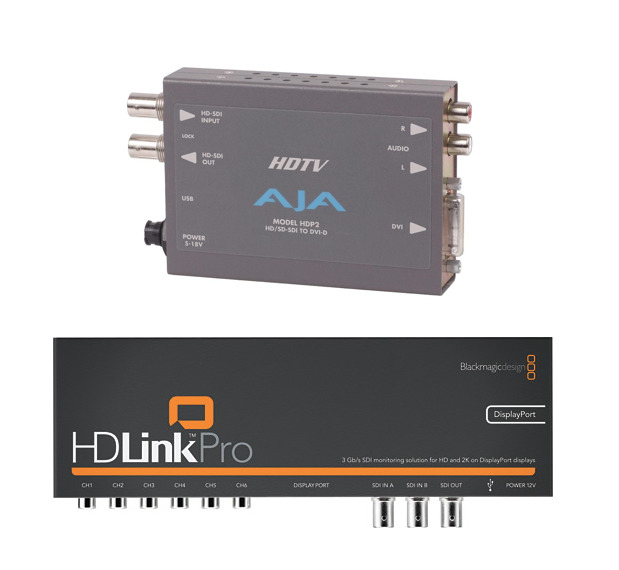

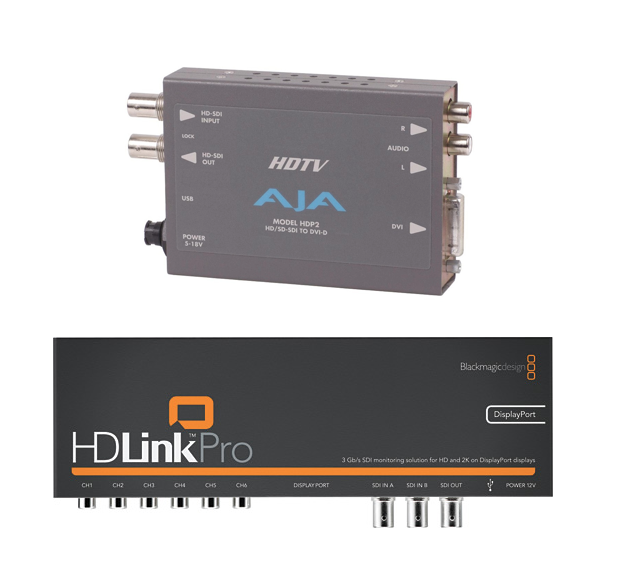
This article is to help people who have determined that their current NLE or grading system does not currently comply with the DreamColor Engine, and are looking a converter box to make it comply. As stated in my DreamColor monitor review, the DreamColor Engine is very demanding: it absolutely requires a true progressive digital RGB signal over HDMI or DisplayPort. Interlaced video, PsF, and/or digital YUV over HDMI are not welcomed by the Engine. If you supply either or both of those, the DreamColor Engine will shut off, the settings for color space will become inactive, and the monitor will display full gamut, which is much more saturated than ITU Rec.601 or ITU Rec.709. These are some of the DreamColor monitor’s most important features. Make sure you take advantage of them by making your system deliver a compliant signal.
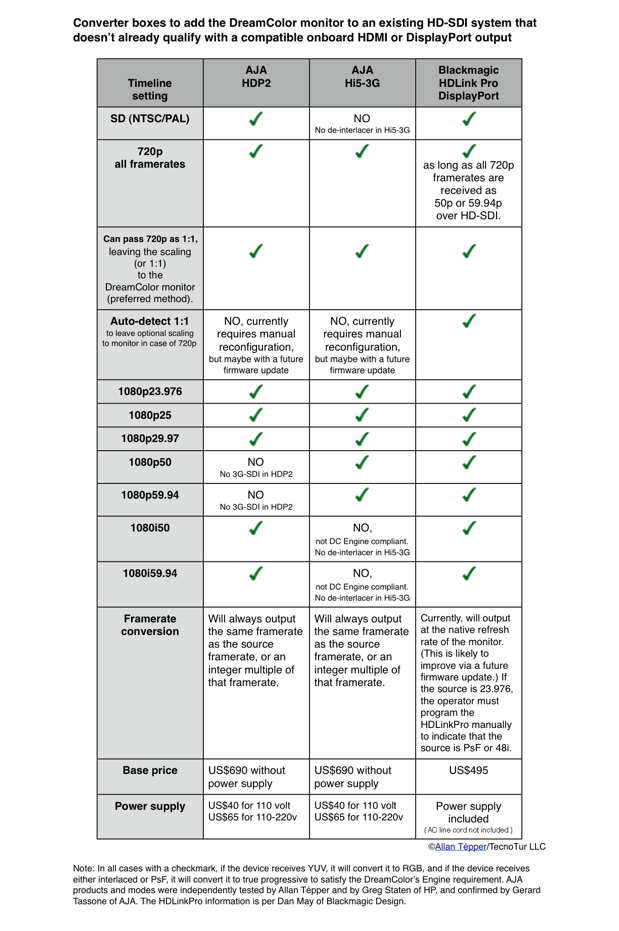
Click here to see this comparison chart in a full-sized PDF.
As you will see in the chart, neither the HDP2 nor the Hi5-3G covers all modes by itself, but depending upon your typical formats and framerates, you may discover that one of them covers everything you do. On the other hand, the HDLinkPro DisplayPort covers all of the modes, all though at present, instead of passing the source framerate or an integer multiple of it, it matches the monitor’s default resolution, although Blackmagic Design says that will likely change in a future firmware update.
Alternative to a converter box
Instead of using a converter box, you may consider replacing your current NLE or grading interface to have an all-in-one-experience with less connections and hassle. For that, see the companion article DreamColor direct interfaces.
Read the related articles
- DreamColor review
- Why should I care if my monitor shows ITU Rec.709?
- Who is the ITU and why should I care?
- DreamColor direct interfaces
Allan T©pper’s articles and seminars
Get a full index of Allan T©pper’s articles and upcoming seminars at AllanTepper.com. Listen to his podcast TecnoTur, together with Tanya Castañeda, Rub©n Abruña, and Liliana Marín, free via iTunes or at

Filmtools
Filmmakers go-to destination for pre-production, production & post production equipment!
Shop Now