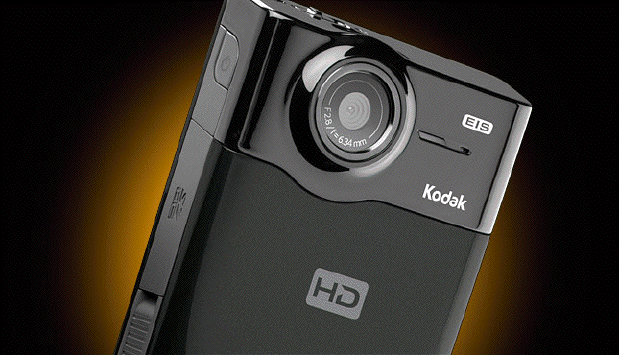
First camera in its class with a 1080p mode, first with a smooth 720p59.94 mode, and first with external mic input.

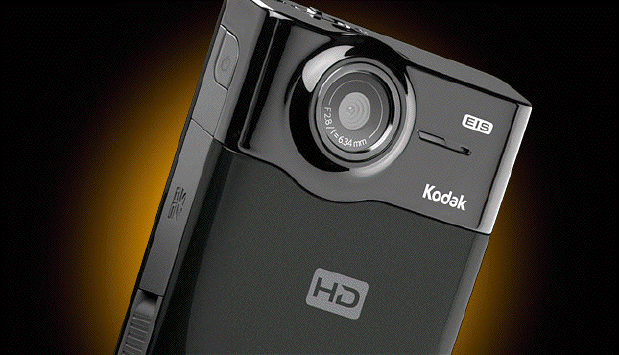
Ever since I first saw Kodak’s announcement about the new Zi8 HD camera, I was intrigued. Yes, this camera costs less than US$180. I mentioned it to my friend Jorge González of Acquest Multimedia here in Miami, and to make a long story short, he bought one as soon as they began shipping. Jorge doesn’t usually buy such inexpensive cameras. His “other” HD camera is a Panasonic AG-HPX500, which you may know is a 2/3″ model which lists for US$14,000 without lens. Later in this article you’ll see our impressions, plus Jorge’s first quick test shot with the Kodak Zi8.
The Kodak Zi8 has a list price of US$179.95. Jorge was anxious to order it, and no one else seemed to have them in stock yet, so he went to purchase it directly from Kodak.com, where it was not only available for immediate shipment, but also with a 25% discount!
Kodak Zi8 specs
The Zi8 is a pocket-sized camera that is available in three different colors: black, aqua, and raspberry. The sensor is a tiny 1/4.5″, 1.6 megapixel CMOS. It can shoot either at 1080p29.97 (evidently, via what I call “video alchemy”), at 720p29.97, or at 720p59.94, which logically gives the smoothest result. It can also shoot WVGA video (848-480). Finally, the Zi8 can also shoot still photos at an interpolated 5.3 megapixels (what I call “photo alchemy”).
Kodak Zi8 stabilization
The Kodak Zi8 has stabilization. It works poorly and consumes the battery much faster. Don’t use it! Put the camera on a tripod and shut off the stabilization.
Focus
The Kodak Zi8 is a fixed-focus camera. You do not have to focus it: There is nothing to focus. However, you must make sure that you are within the limits of the fixed focus. In normal mode, Kodak says that the focus is from 100 centimeters (±40 inches) to infinity. In our experience, be a little more conservative and make that 120 centimeters (±48 inches). In macro mode, Kodak says the maximum distance is 15 centimeters (±5.9 inches).
Zoom
There is no optical zoom, only a 4x digital zoom.
Scaling, or what?
The Zi8 is strange, and at first, we weren’t sure when it scaled and when it didn’t. Usually, when a camera has scaling (i.e. most HD video professional cameras from the major manufacturers), focal length remains the same when you switch between 720p and 1080i/p. The exceptions I knew of before were at too different extremes of cameras and make sense: The RED One camera apparently has no inboard scaling, and that’s why at the 4K mode its focal length is “normal” for an operator who is accustomed to 35mm, and in 2K mode, it is much more telephoto. Similarly, at least one Casio Exilim camera model becomes much more telephoto in HD video mode as opposed to photographic mode. In that Exilim model, the 1080 mode is more telephoto than the photo mode, and the 720p mode is more telephoto than the 1080i/p mode. It makes sense because in non-scaled 720p mode, it is using much less of the sensor. However, in the case of the Kodak Zi8, Jorge González and I were surprised to see that the 1080p mode is more telephoto than the 720p mode! This is strange, but good news for those of us who like the smoothness of 720p59.94 (aka “60p”) and are more concerned about maximum wide angle as opposed to maximum telephoto. (59.94p is also ideal to extract slow motion.) After checking the Kodak specs, we saw that Kodak reiterated the mystery (although didn’t explain it) by officially stating the following the actual lens is 6.3 mm, with a 35mm equivalent of 61mm in 1080p mode, a 35mm equivalent of 46mm in both 720p modes and in WVGA mode, and a 35mm equivalent of 42mm in still mode. Translation: the Zi8 is scaling in absolutely all of its modes, and is inconsistent in the amount of scaling.
Jorge’s video, shot with the Kodak Zi8: El mecánico (The Mechanic)
Kodak Zi8 y el mecánico. from acquest on Vimeo.
Here is the video, which Jorge shot in 720p59.94 on the Kodak Zi8. I cringed when I heard that he had edited it using the DV100 códec (aka “DVCPRO-HD”) instead of ProRes422(HQ), since that meant that he had subsampled the original footage from 1280×720 down to 960×720 unnecessarily… but apparently he had a temporary shortage of disk space. Jorge also said that he reduced it from the original 59.94p to 29.97p while encoding his H.264 for Vimeo. I am trying to convince him to re-render at ProRes422(HQ) and let me encode it myself for our server. But here it is the way he did it so far.
Pros
In my opinion, the Kodak Zi8 produces unimaginably impressive HD images if you shoot 720p59.94 (which Kodak rounds to “60p”), with good lighting, from a tripod with the stabilization de-activated, and within the focal limitations listed above. The Kodak Zi8 produces very unimpressive video if you do pretty much anything else! The Kodak Zi8 is much better than a Flip video camera, an iPhone 3Gs camera, or an iPod Nano camera.
Cons/What the Kodak Zi8 is not
The Zi8 is not a professional HD camera. The stabilization is not good. Its appearance will not impress your clients. It does not have removable lenses or help you reduce depth of field. It does not have balanced audio. It does not compete with the Panasonic Lumix GH1, the Canon 7D, or Canon 5D MK II… and finally, the Zi8 will not make you want to sell your professional HD camera!
Disclosure, to comply with the FTC’s new rules
Kodak is not paying Allan T©pper or Jorge González to do this review, nor is Kodak giving Allan T©pper or Jorge González a free unit in exchange for this review. Jorge González originally paid for the Zi8 camera, but has already returned it to Kodak for a refund.
Allan T©pper’s articles and seminars
Get a full index of Allan T©pper’s articles and upcoming seminars at AllanTepper.com. Listen to his podcast TecnoTur, together with Tanya Castañeda, Rub©n Abruña, and Liliana Marín, free via iTunes or at TecnoTur.us.

Filmtools
Filmmakers go-to destination for pre-production, production & post production equipment!
Shop Now