

Filmtools
Filmmakers go-to destination for pre-production, production & post production equipment!
Shop NowUncompressed 1080 50p/59.94p, timecode, and even RGB 4:4:4 from your camera’s HDMI port!

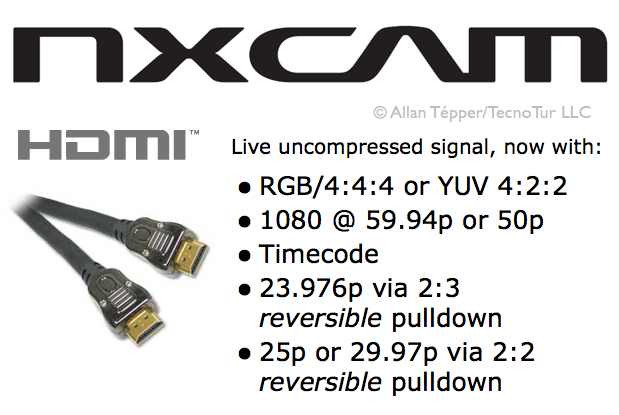
Sony’s latest NXCAM cameras fortunately feature unprecedented new features with their live HDMI outputs, including uncompressed 1080p at 50p or 59.94p, timecode, and even RGB 4:4:4 capabilities as an alternative to the standard YUV 4:2:2 modes. They also offer special pulldown modes for 23.976p (2:3), 25p (2:2), or 29.97p (2:2) (model dependent) with flags to help an external recorder reverse-telecine and recover the original, pure progressive signal. This is great for those of us that -for certain projects- want to record an even better signal than what’s possible inside of the camera with AVCHD. However, today’s external HDMI recorders don’t yet support these new features. This article is about which NXCAM models include these new features, more details about them, and the response from each external recorder manufacturer about the likelihood of supporting these features, either in their current -or future- models. We’ll also explore which new NXCAMs say farewell to 29.97p.
Three new NXCAMs which have the unique HDMI features
The following are new to the Sony NXCAM family, were shown at NAB 2011, and join the first NXCAM, the HXR-NX5, which were covered here in ProVideo Coalition by Adam Wilt and myself.
- The most publicized of the three new NXCAMs is the NEX-FS100, which is more commonly known simply as the FS100. This model has had much press and its single most unique characteristic (in its price range of US$5,850 list, without lens) is its true Super35mm sensor, together with its removable mount system. UPDATE: Adam Wilt is the good and now authenticated messenger who just brought us this sad news: “According to Sony’s Juan Martinez at Cine Gear, the FS100U (US model) is not upgradeable to WorldCam 50/60Hz compatibility; the hardware won’t support it. To shoot 50 Hz formats, you’ll need the FS100E (European) model instead.” And of course the FS100E lacks 23.976p, 29.97p, and 59.94p. The FS100E offers 25p, 50p, and 50i. 2nd UPDATE: I have now been requested to set the FS100 WorldCam status back to “Unconfirmed”. Apparently they are exploring possible ways to make it possible to offer a WorldCam option after all. We hope so! 3rd UPDATE (December 26, 2011): It’s now official! The FS100 is about to go WorldCam via a free firmware update at the beginning of 2012! Click here for details.
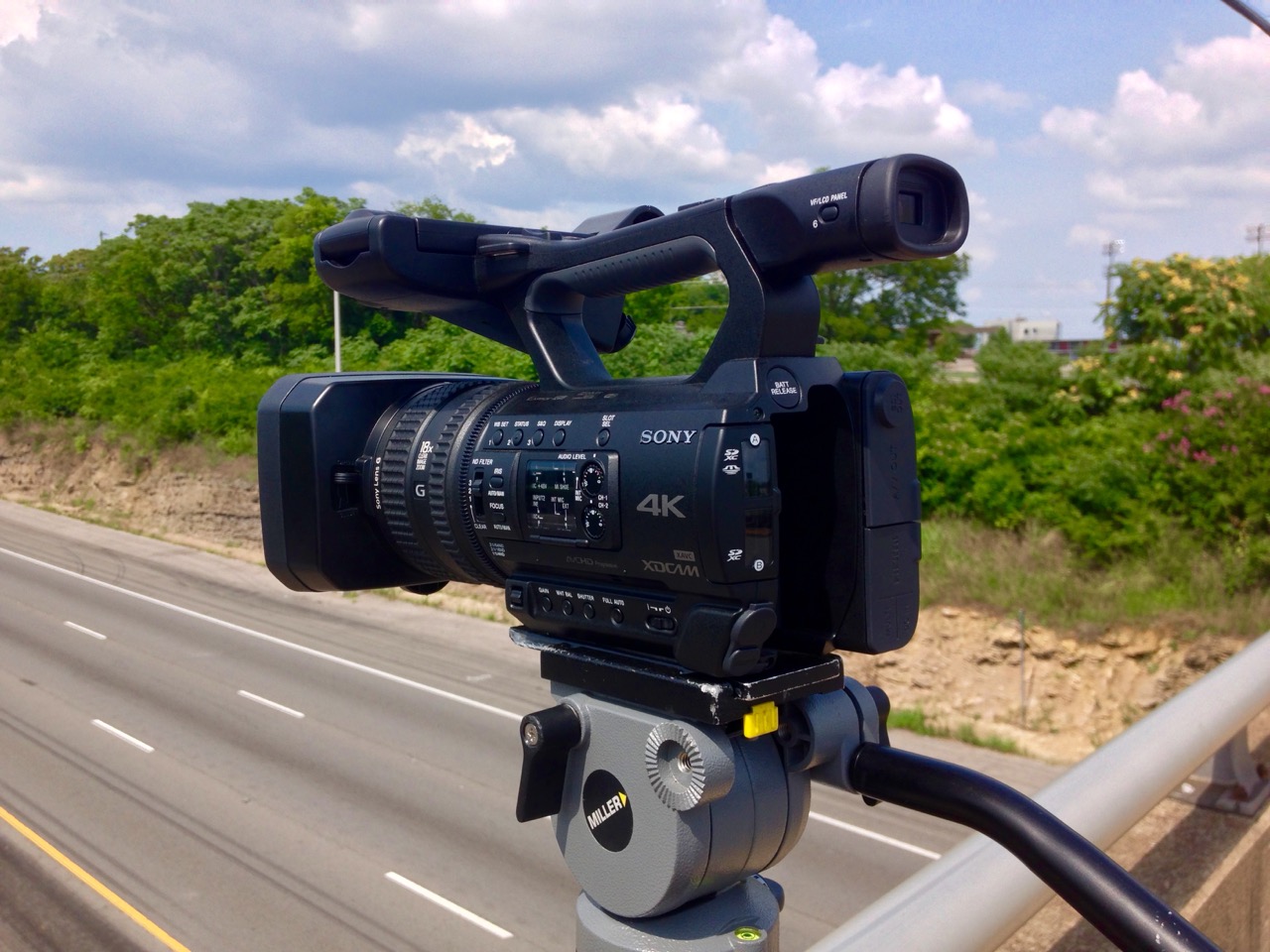
- The next new NXCAM, is the HXR-NX70, although it is more commonly known simply as the NX70. Its notable characteristics (at its list price of US$3,200) include its being highly water-resistant (except for the removable XLR audio unit), its back-lit Exmor-R sensor (known for low-light sensitivity, image clarity and drastically reduced noise), and its extreme framerates of 23.976p and even 1080/59.94p in addition to 59.94i (these framerates in the USA-segregated version). The 50Hz-segregated version offers 1080 at 25p, 50p, and 50i. At publication time, Sony USA was not able to confirm upgradability to WorldCam for this model, but I will update this if and when that confirmation arrives. I have requested the NX70 to review it, but haven’t received it yet. Standby!
- Finally, the first 3D model in the NXCAM family, officially known as the HXR-NX3D1. At publication time, the list price wasn’t yet available. In addition to its 3D capability, it is notable that this model will ship standard as WorldCam! However, in 3D mode, its framerates will include 59.94i, 50i, and 23.976p (no 25p in 3D), although in 2D HD, it will include 59.94i, 59.94p, 50i, 50p, 25p, and 23.976p. I have requested the HXR-NX3D1 to review it, but haven’t received it yet. Standby!
Say goodbye to 29.97p?
Both the NX70 and NX3D1 say goodbye to our familiar 29.97p. If you expect your footage shot with these two NXCAMs to be distributed on an AppleTV, iPad, iPhone, or iPod Touch, then shoot your “normal” shots at 23.976p or 25p, and use 50p or 59.94p exclusively for your slow-motion shots, as I explained in my article Why the iPad will dictate your shooting framerate & shutter speed. If you are shooting with the original HXR-NX5 or the new NEX-FS100 (USA-segregated versions or WorldCam versions), then you still have the option of shooting 29.97p. 4th UPDATE (December 26, 2011): The NX70 will receive it’s missing 29.97p framerate via a free firmware update at the beginning of 2012. Click here for details.
Unique HDMI modes in the new NXCAMs
- The possibility of either YUV 4:2:2 or RGB 4:4:4 when requested via EDID (both sadly at 8-bit) over HDMI. [Apple ProRes444 (RGB) has existed for years, although to date not in any standalone portable recorder to my knowledge. Since several of the standalone recorder manufacturers have licensed ProRes from Apple, I hope to see those “matrimonies made in heaven” happening soon!]
- Timecode metadata over HDMI (in the private stream channel).
- 1080/50p and/or 1080/59.94p over HDMI (model dependent) [ Since several of the standalone recorder manufacturers have licensed ProRes from Apple, I hope to see them recording these formats soon.]
- Pulldown versions of 23.976p, 25p, and 29.97p over HDMI (model dependent) [Rather than offering native 23.976p, 25p, and 29.97p over HDMI in the new NXCAMs, Sony has chosen (so far) to use pulldown (2:3 in the case of 23.976p, and 2:2 in the case of 25p and 29.97p) (model dependent) together with pulldown flags embedded in the timecode in order to facilitate reverse telecine prior to creating a native progressive recording on an external recorder. In this public video, Juan Martínez, NXCAM product manager, has explained that this decision for pulldown rather than native is to ensure compatibility with Sony’s professional monitors with HDMI input. This approach is obviously different from the one taken by many consumer Blu-ray players, which offer a menu option for outputting native 23.976p over HDMI when playing a “24p” Blu-ray disk onto a compatible monitor, although I suspect that those players in that mode actually play back the 23.976p at 47.952 fps, repeating each frame just as 24fps is played at 48fps in movie theaters by also repeating each frame.]
- 3D over HDMI [This will likely take much more time to get support in 3rd-party recorders based upon Apple ProRes, since to my knowledge, there isn’t (yet) a specific ProRes standard for 3D in a single file, although there is in Sony’s recent expansion of AVCHD at 28 Mb/s, both for 3D in a single file and for 2D at 1080p50 and 1080p59.94 (model dependent).]
Responses from external video recorder manufacturers
As of publication time of this article, here are the responses I’ve received.
AJA (KiPro or KiPro Mini):
“AJA has a close relationship with SONY, working closely with the company to support their products. AJA therefore plans on providing support for the newest Sony NXCAM camcorders.” However, AJA would not yet specify when this will come, or whether it will come in a new product, or in a firmware upgrade or retrofit for the current KiPro or KiPro Mini. I’ll update this as I receive more details from AJA.
Atomos (Ninja/Samurai):
No response as of publication time. I’ll update if and when they respond.
Convergent Design:
No response as of publication time. I’ll update if and when they respond.
Blackmagic Design (HyperDecks):
No response as of publication time. I’ll update if and when they respond.
SoundDevices (PIX 220/240):
SoundDevices responded that none of their current product supports 1080/50p or 1080/59.94p or RGB over HDMI. Regarding timecode over HDMI: “Until we thoroughly test this, no time code is supported over HDMI, only over SDI. PIX recorders can support this with a firmware update if/when we receive thorough documentation from Sony.” Regarding which current products (if any) will be able to detect the pulldown flags, execute inverse telecine, and create a native 23.976p, 25p, or 29.97p ProRes recording after a firmware upgrade or retrofit, the response was both the PIX 220 and PIX 240.
Make your vote count!
In order to help the external 4:2:2 (and potentially 4:4:4) recorder manufacturers determine which of these features are most important to you when recording from an NXCAM or other camera that may reach the market with some or all of these features, feel free to comment below to place your “vote”. I am sure that they’ll be reading both this article and your “votes” in the comments.
Allan T©pper’s policy on model nomenclature
Since I know we have an international audience and we are living in the global village (thanks Marshal McLuhan!), I am constantly researching the possible variants among model numbers in the international marketplace. Often, video equipment manufacturers restrict certain functionality in regional versions, and sometimes they use a strict regional warranty system. Sometimes the manufacturers do this to avoid grey marketing (i.e. to encourage purchasing of products in a local region, to protect local distribution), and sometimes it’s to avoid extremely high import tariffs in a specific market. When they do this, the manufacturers often add a regional suffix to the model number.
When I mention model numbers, I purposely omit regional suffixes when they make absolutely no difference in a product’s features or functionality worldwide. I include these suffixes only when making specific reference to differences among regional variants. So if you see a model number I mention and you are used to seeing that same model number with an “E”, “J”, “N”, “U”, or “P” suffix, what I am writing is applicable to any version, with any suffix. Those few times I do include the suffix, it’s because I am specifically describing features which are specifically added or missing from that version of the product. I encourage all journalists in all media to do the same.
Read Allan T©pper’s latest book
Read Allan T©pper’s latest book, Unleash GoogleVoice’s hidden power. More info about both the print version and the new ebook version at books.AllanTepper.com. The ebook version is DRM-free and now available from the Amazon Kindle store, Apple iBooks store, Barnes & Noble NOOKbook store, and other popular ebook sources.
Allan T©pper’s consulting, articles, seminars, and audio programs
Contact Allan T©pper for consulting, or find a full listing of his articles and upcoming seminars and webinars at AllanTepper.com. Listen to his TecnoTur program, which is now available both in Castilian and in English, free of charge. Search for TecnoTur in iTunes or visit TecnoTur.us for more information.
Disclosure, to comply with the FTC’s rules
None of the manufacturers listed in this article is paying Allan T©pper or TecnoTur LLC specifically to write this article. Some of the manufacturers listed above have contracted T©pper and/or TecnoTur LLC to carry out consulting and/or translations/localizations/transcreations. Many of the manufacturers listed above have sent Allan T©pper review units. So far, none of the manufacturers listed above is/are sponsors of the TecnoTur programs, although they are welcome to do so, and some are, may be (or may have been) sponsors of ProVideo Coalition magazine. Some links to third parties listed in this article and/or on this web page may indirectly benefit TecnoTur LLC via affiliate programs.