

Filmtools
Filmmakers go-to destination for pre-production, production & post production equipment!
Shop NowPanels and papers at the Tech Retreat

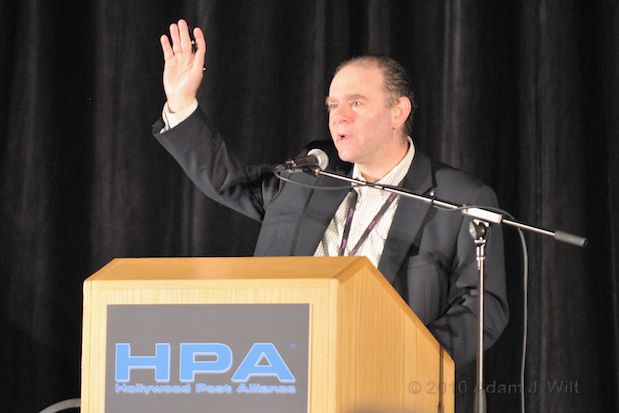
The 16th Annual Tech Retreat was officially opened by HPS President Leon Silverman today. (As with yesterday’s coverage, this’ll be stream-of-consciousness coverage.)
Mark Schubin: Welcome to the 24th annual “this is the year of HDTV”—but press bridges are still analog NTSC, mono audio, 4×3. 1st (or 83rd) “this is the year of 3DTV”. NEP’s first 3D broadcast truck has six (6!) seats for convergence. If 3D makes people ill, do we need 2D glasses for those folks?
Some data: Super Bowl had 106.5 million viewers; largest audience in TV history. Cable penetration has passed 49.5%. [Mark Schubin comments: “Passed” suggests has gone up through. It’s actually gone down to. But the word “passed” was in the slide because it’s a percentage of homes passed by cable (homes that could subscribe to cable if they wanted to, whether they do or not). For ages, the subscriber proportion of the homes-passed was in the range of 2/3 to 70%. Now it’s below 50%. Maybe that’s because there are more homes passed. Maybe it’s competition from satellite, telco, and off-air. Maybe it’s the economy.]
Pete Putman discussed what happened at CES. 720p 32 inch TVs for $399, 47 inch 1080p for $750, 82 inch RP DLP $2880. $16-$17 / diagonal inch below 50 inches, above 50 inches it’s $34-$35/inch. Internet video watching is growing by 10%-11%/year.2/3 households have an HDTV, but only 5% plan to buy 3D in the next two years. 2/3 pay-TV subs will switch for a 20% savings.
CES crowds up (30-minute cab wait vs 5-minute last year), but fewer vendors (like MacWorld Expo). Samsung showed a 1024×768 1000-lumen projector with LED lamps, good for 30K hours.
Some of Mr. Putman’s more amusing slides (all screenshots and slides are copyrighted by their creators):
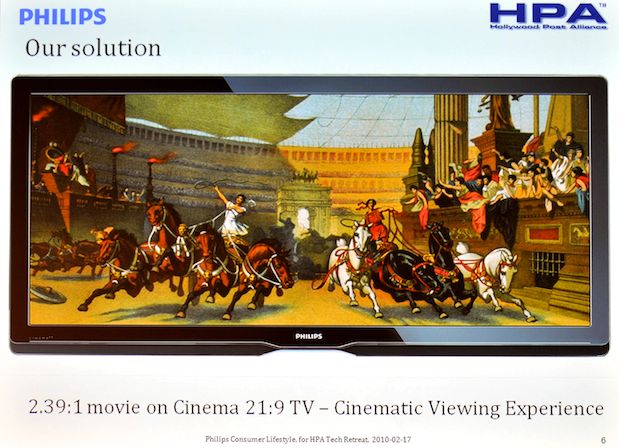
Jeroen Stessen of Philips described the 21:9 Cinema TV 2560×1080, 55.9 inch diagonal, same width as 59″ 16×9 TV, same height as 44.5″ 16×9 TV. Upscales 1920×810 (2.40:1 material) 1.33x to fullscreen.
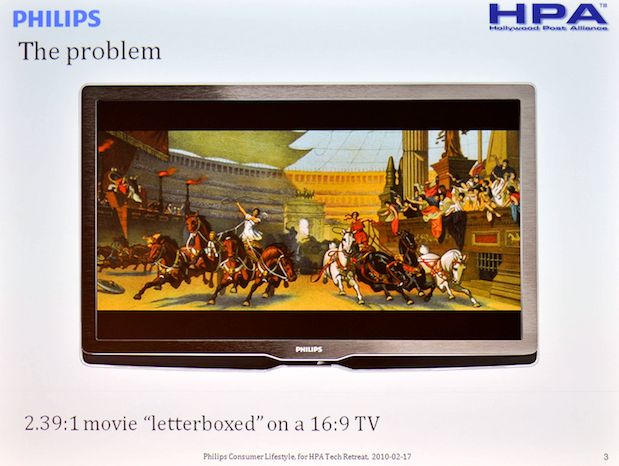
By default, 16×9 material is shown in “superzoom” mode: slight top & bottom crop, slight horizontal stretch as center, large stretch at edges:
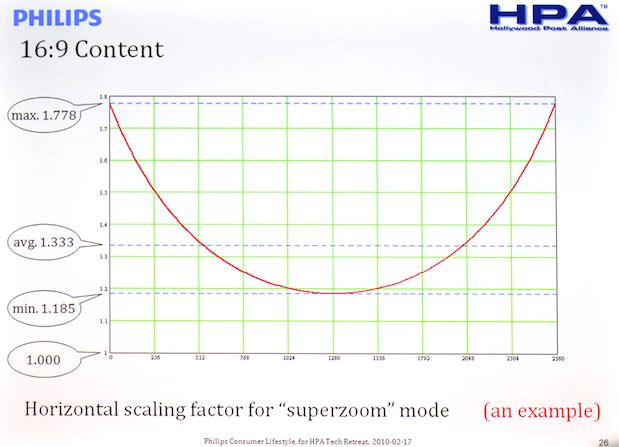
Very few people in the audience approved of this default setting.
Mobile Television Panel – Debra Kaufman, Mobilized TV, Moderator; Jerry Whitaker, ATSC; Paul Childers, Rubber Duck Media Lab; Thomas Ellsworth, GoTV; and Ethan Schur, TDVision.
GoTV is an aggregator / syndicator of mobile TV to handheld platforms for all the major players in the US: Sprint, AT&T, Verizon, MetroPCS, etc. “No handset left behind” (even though there are 200+ video-capable handsets out there).
ATSC’s mobile DTV is carried in the same channels as full-res broadcast DTV as a separate stream; one channel of mobile DTV takes roughly 2 Mbit/sec of the 19.4 Mbit/sec available. It’s based on h.264 video and AAC-V2 audio, transmitted as IP carried in the MPEG-2 stream, with both realtime and non-realtime transmissions possible. The standards are in the ATSC A/153 document set.
Mobile DTV includes channel discovery, Electronic Program Guide, rich-media capabilities, and two way comms. It also includes back-channel capability via phone network for user interaction. Also, of course, live traffic, weather, sports, news, drama, etc—just like regular TV.
Washington DC is being used as a test / showcase rollout market with broadcasters transmitting Mobile DTV and receivers being distributed on a limited basis, but a wider rollout should occur soon (this year); the Open Mobile Video Coalition has 800 TV station members, and the ATSC will be showing a lot of Mobile DTV receivers at NAB.
Ongoing work on A/153 includes provisions for scalable full-channel capability.
TDVision designed the 2D+Delta stereoscopic 3D transport system (seen here at last year’s Tech Retreat) used for mobile 3D, as well as the recently-standardized Blu-ray 3D spec.
A lot of discussion of interaction and mobility as a way to get eyeballs on screens… using smartphone cameras to shoot coupon codes for special offers; finding ways to get folks to watch TV on their mobile devices every day… when it came to delivering the Michael Jackson memorial live to lots of mobile viewers, one-to-many broadcasting worked fine, but one-to-one unicasting bogged down.
What will make this stuff take off? “Enablement at an attractive price” (IMHO this is where OTA(over-the-air) Mobile DTV can trump the offerings of the mobile telcos and their pricey walled gardens). “All the pieces are coming together…” Adobe Flash Player 10.1, just released, works on mobile devices (iPhone excepted, of course!).
Tom Paquin, OnLive, talked about on-line gaming. OnLive offers games on demand with 720p60 video quality over residential-quality networks. The same tech can be used for high-quality interactive media: 640×360 @ 1.2 Mbit/sec with only 1 msec latency (compare to 5 msec for MPEG, 5+ sec for h.264 or Windows Media). The low latency is key. >71% of US households have 2 Mbit/sec or higher, >26% have 5 Mbit/sec or more; 720p60 OnLive requires 1.5 Mbit/sec (peak rate is 4 Mbit/sec with fast action, stereo audio). “The TV is the big deal” though the PC is another usable target. No high-end hardware is needed on the client end as the client’s machine is just a display device; the heavy computing happens in OnLive’s data centers: imagine Crysis on your smartphone. OnLive offers a smartphone-sized “MicroConsole” with power and Ethernet in, HDMI out. Right now in beta, customers need to be within 1000 miles of a data center.
OnLive pays the telcos for the bandwidth its services occupy, of the telcos don’t “get Googled”—left to supply fat pipes but not receiving any revenue for their work.
Since all the serious work happens at the data server, really the big deal is low-latency high-def over wide-area networks. So, can this be used for media distribution? “I can say that Warner Brothers is one of our investors.”
Panel on the Future of Packaged Media: Plastic Disks or Solid State/Brick & Mortar or Kiosks – Steve Cohen, Raging River, moderator; Ratnakar Lavu, Redbox; Tim Hogan, DVD Station; Jens U Horstmann, NCR; Howell Ivy, Raging River; Jim Taylor, Sonic Solutions.
Kiosk DVD sales and rentals (Redbox, etc.) are growing rapidly; video store sales and rentals are declining. Burn-on-demand services; download-on-demand kiosks. Blu-ray rentals as low as 9 cents per hour.
Redbox: started with 8 units in DC-area McDonalds in 2002. Now 22,000 kiosks including DVD Express. $1/day DVD rentals. Three pillars for success: create convenience, great value proposition, and exceptional customer experience. Kiosks are networked; don’t need to return DVD to the same kiosk it was rented from. Online, smartphone UIs for rentals. Central monitoring for maintenance; constant UI improvement through customer feedback. Kiosks use 2-axis robits, embedded PCs; modular design.
DVD Station: also founded 2002; in the kiosk business / digital download & burning for five years. Is there still a place for pre-packaged media in the digital world?
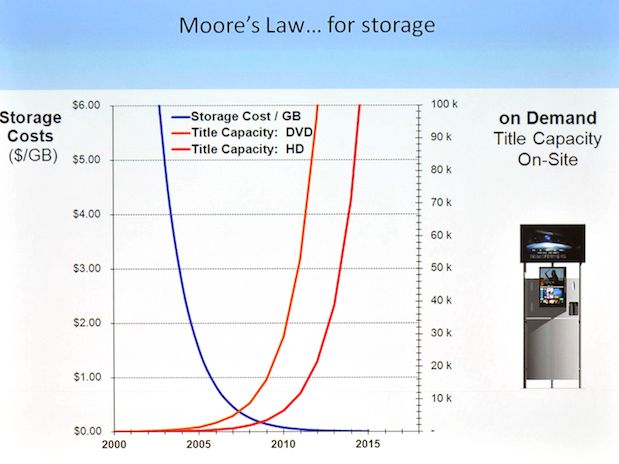
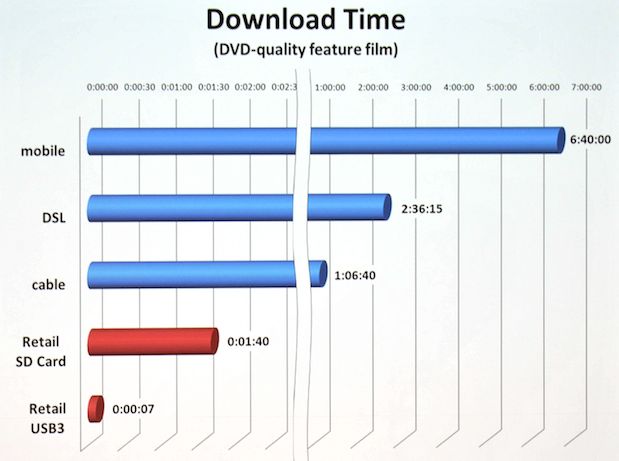
These advances in speed and storage heralds a sea change in content delivery, but yes: retail stores still have a place as a delivery point for media (see those two red bars in the image above).
Sonic Solutions: DVD-on-demand, whether at the factory, at the store, or in the home. How to protect content? Recordable CSS (“Qflix” brand), or anti-rip tech which may not provide legal protection under DMCA. Rights can be stored in a “digital locker”; WBshop.com is using manufacture-on-demand for back catalog deliverables.
Raging River developed mobile digital players used on airlines (I think I used one in 2007 on the late, lamented MaxJet), and has moved onto deliverables as packaged media, FlexPlay disposable DVD, digital downloads using multi-format card writers, DRM-locked deliverables for mobiles. Pre-loaded content on flash media, USB drives. Hardware-level security.
Next: afternoon sessions
Afternoon Sessions
Ralph Brown, CableLabs, discussed the Continuing Evolution of Cable Services & Future of Entertainment & Information. I missed much of the talk (I was engrossed in discussion with Bill Hogan and Jim Mathers about the recent ASC test of the RED and other digital cine cameras vs. film), but the gist seems to be that cable remains a good platform for converged voice, video, and data, and will continue to evolve to carry them.
Broadcasters Panel – Matthew Goldman, Ericsson, Moderator; Bob Seidel, CBS; Richard Friedel, Fox; Bob Allen, KESQ; Art Allison, NAB; Thomas Bause, NBC Universal; Jerry Butler, PBS.
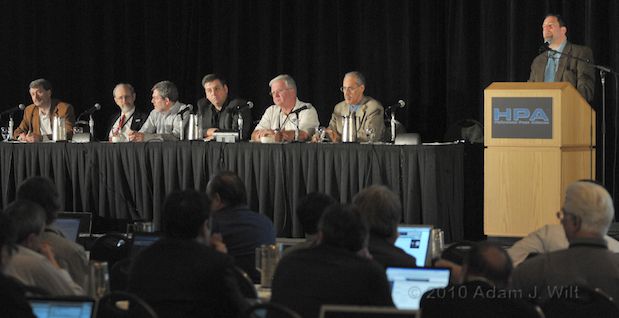
What are the issues for broadcasters?
PBS: DTV: 80% already multicasting 3 or more channels. Those that didn’t apply for power maximization early on are facing issues now; channel crowding. Ingress problems at cable headends; interference from out-of-market channels. Spectrum: questions on mobile TV, and FCC policy issues on broadcast & broadband. HD Production: HD shooting, Center-cut safe areas for 4×3. Web: PBS Kids Preschool; PBS Kids Games; COVE (a sort of universal web player), etc. “From time of ingest, a program never sees tape again.” The weakness is the digital toolbox: hard to troubleshoot without going back to baseband.
KESQ (Palm Springs local station): multicasting on a full-power channel, ABC in HD, Fox, CW, and Telemundo in SD. Within 100km of the border, Mexican stations can cause interference. The new model: more competition for audience (cable, satellite, telco, multicast broadcast, on-demand, and all the web-based stuff). Cable & satellite is 97% of the local market. Broadband wants to take all the spectrum, kill OTA broadcast, and hey: everyone then has to pay for cable or satellite! And the FCC commish supports the spectrum grab. How to survive? Local and national ad sales; per-subscriber payments for cable/sat carriage, web revenue, mobile TV. Payments from broadband providers (hopeful, but no guarantees)?
NBCU: Alternate viewing platforms—TVs, mobile, PCs, etc. Partner Hulu is the #2 online video platform. 2008 Olympics: 7/10 viewed on TV, 50 million online, 6 million on mobile devices. Next step: “TV Everywhere”, being used now for 2010 Olympics. Direct streaming & downloads, both ad-supported and paid-for (but piracy concerns). Post-analog turn-off: still trying to get the image right. NBC uses AFD (active format descriptors for aspect ratio control) but re-transmission pass-though is a problem. Audio loudness control is a similar issue, and the white space issue remains an open question. Spectrum: note that broadcast scales much better for mobile video and has a low incremental cost. Mobile offers new services for consumers, new revenue source for broadcasters.
Fox: Is the DTV transition over or did it all go wrong? Fox encodes all metadata at headend and distributes ATSC streams, metadata has to work throughout the pathway. Loudness and dynamic range control is a big problem; many “theatrical” mixes being delivered instead of TV mixes; commercials still louder than programs—and Fox doesn’t want to process audio. PCR jitter. PSIP, center-cut, AFD? Still issues at affiliates. It’s a systemic problem, not just for Fox.
NAB: a view from DC. Alternative delivery: competition is good, but cooperation is better. IP delivery is quality challenged. Combining on- and off-air offerings is better than one trying to kill the other. Hulu, etc. don’t conflict, but future services may. Besides, the one-to-one model of TCP/IP doesn’t scale from one-to-many. AFD is showing its value; cable headends are using it for downconversion/analog feeds. Interference management still important in DTV; “the allocation model was flawed” using single interferer only, not multiple interferers. FCC & Broadband: DTV maximizes efficiency in broadcast. Other uses should use other bands (hooray!) Long-tail and most-used distribution methods should complement (OTA for most-used, IP for long-tail), thus: converged broadcast-broadband.
CBS: How to release content to alternative platforms? Need audience authentication. CBS News in iPhone app; CBS on FLO TV, tv.com, etc. CBS runs unannounced proof of performance tests (bars/tone/multiburst) to verify all downstream viewers are getting what’s intended. Looking for clipped whites / blacks, pre-filtering, incorrect 709-601 color conversion, recurring audio sync issues, audio phasing, loudness. Super Bowl commercials were run through loudness control. “The US Government is one of the largest users of spectrum; if the FCC wants more, they should look at themselves before they come after us broadcasters!”
Discussion: PBS archives? LTO tape. 3D: PBS has preliminary conversations, especially for kids, but worried about side-effects. KESQ: just doing pass-through: Michael Jackson 3D (anaglyph) tribute looked like something from the ’50s! NBC: we’ll see. CBS: sticking toe in water, mostly with Discovery channel. Hard to do OTA w/o disenfranchising existing 2D viewers. Generally, interest, but concern about effects on audience (both psychophysical and ratings effects). Licensing deals, with (for example) Comcast owning NBCU? Not a huge impact as networks buy most programs, they don’t produce (and own) them. Some Super Bowl bumpers seemed loud—turns out these came from the truck and didn’t go through NY. And the SB content? Hard to control levels on announcers in open booths. 1080/60p? Interesting, but no intent to switch. KESQ has experienced a known and “unfixable” problem with feeds sent to DIRECTV: audio feeds at the upper end of the Dolby Digital bitrate can get a momentary “b-r-r-t” noise burst. Workaround: dial it back a bit. KESQ finds they get more OTA viewers now since the cable/sat folks tend to recompress the signal and visibly degrade it in the process. What are the chances that in 5 years, OTA broadcasting will not exist? KESQ: we’ll be here, but we’ll be fighting for spectrum. NAB: “there are standards bodies without fact or rationality” but at least we have a democracy, so the message will get to Congress so that if the FCC “does something ill-advised” the people will speak out to keep OTA TV. KESQ: RIM put out a white paper that other broadband users are incredibly wasteful of spectrum.
Panel: The Current State of Consumer Video – Peter Fannon, Panasonic, Moderator; Shawn DuBravac, Consumer Electronics Association (CEA); Gary Arlen, Arlen Communications; Gary Merson, HDGuru.com.
CEA: “seeing is believing” for 3D. Under-50s see the 2000s as the era of 3D; older folks skew towards earlier 3D booms. But compare consumer sentiment for 3D with that for HD a few years back:
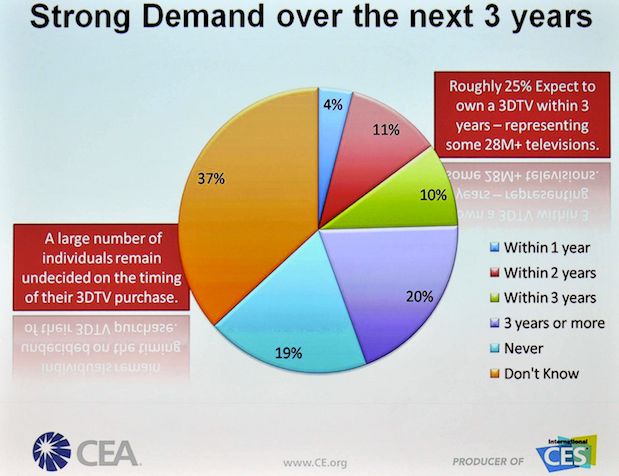
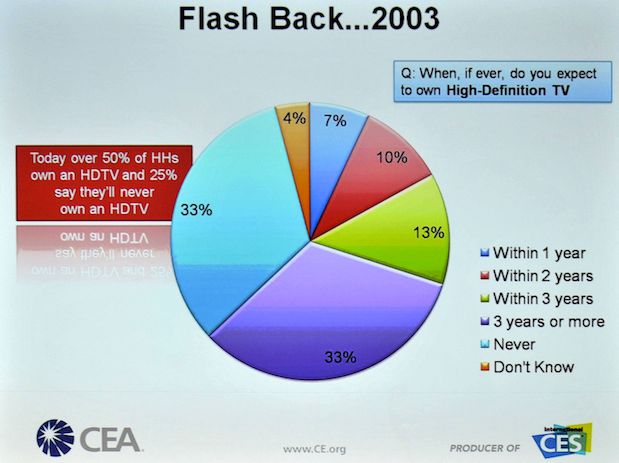
2009 was “the year of the app” for mobile; 2010 may be the year of the app for TVs; widgets like a Skye app. Ethernet- or WiFi-connected TVs 10% in ’09, 20% in ’10, and upwards in future.
On YouTube, 7 hours uploaded every hour; how can we corral and contain all this?
It seems there’s a gap in screen sizes between 5″ and 15″; e-readers have started to fill that gap, along with netbooks, tablets, slates, etc. 20 million screens in this price range this year. These screens, along with “portable but not pocketable” smartphones, are a new outlet for media consumption.
Arlen: Over-the-top video: internet-delivered TV. 230 million “web-enabled stationary devices” by 2013, up 8x over 2009. Half of households will have’ em. Partnerships between CE device vendors and Internet content providers, e.g., streaming Netflix on your Panasonic TV. But who gets paid in these partnerships? Who gets a revenue stream from these bundled services?
Online video usage in January 2010: about 188 minutes per person. 90% of Internet users watch online video.
Alternatives? Hulu will charge for shows; Disney’s “Key Chest”. Next-gen Apple TV? What’s next for Boxee, Sezmi, Vudu, etc.? And what kinds of video will get delivered?
76% of viewers say that they want TV Widgets (think of AT&T uVerse).
OTA mobile video: OMVC (Open Mobile Video Coalition) sustaining the broadcast model; FLO TV, mobile Internet.
FCC National Broadband Plan due to Congress on 17 March. Spectrum grab: serving consumers or business interests?
HDGuru: interviewed Long Island retailers. Xmas and post-Xmas sales revenues were down; prices drop faster than volumes go up. More sales going online at the expense of brick & mortar stores. Only the top-end AV specialist saw good sales. LED LCD TVs are the #1 hot item (“people want them. They can’t say why, but they want them”). Some customers want thin TVs, some want Internet (but customers won’t pay for the hookup during installation; only 2% connect to the ‘net according to some retailers). 720p sets just don’t sell; everyone wants 1080p.
Trends for 2010: low-end HDTVs, not much change. 60 Hz CCFL LCDs, 50″ 720p plasmas. Midrange: higher refresh rates, LED backlights. High-end: thinner (1/3 LED LCD), better contrast & black levels. Edge-lit with local dimming! And 3D, too.
Greg DePriest, NBC Universal, Internet TV: Defining Rules of the Road. Internet piracy isn’t just a casual thing, it’s big money.
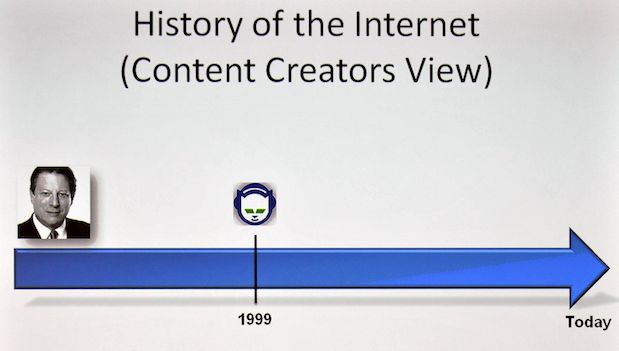
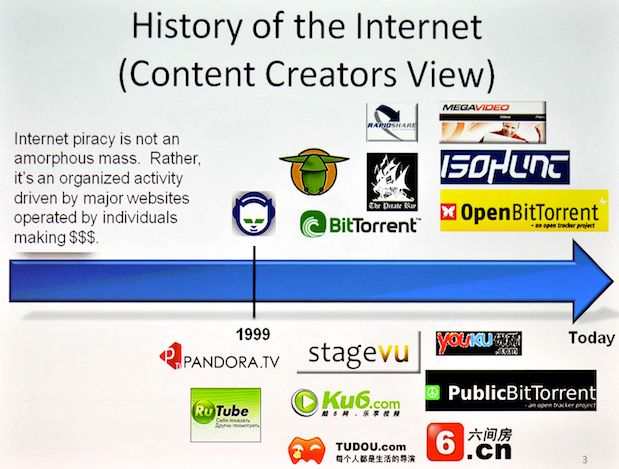
NBCU detects illegal P2P transfers every 16 seconds just within the US—”and we identify only a small number of infringements.” Internet TV threatens revenue, territorial control, and “content integrity” (freedom from overlapping windows, pop-ups, snipes, bugs, tickers, etc.; look at the CNN screen, for example [in my view this was Mr. DePriest’s weakest argument, because TV networks already corrupt their own content shamelessly in this manner!]). Widgets and “open” platforms enable digital theft (whereas the Apple app store at least vets all its apps—but even there, there’s a torrent app for P2P sharing).
Suggested rules of the road: support for new programmer opportunities, new content opportunities, user authentication, not destructive of TV ad revenues, etc. NBCU looking to create a community of interested companies, and eventually promote open standards, “bring some order out of the chaos that would otherwise exist”, and build new services and create new markets.
NBCU has started using digital fingerprinting to track illegal copies, and it seems to help: in 2007 most pirated NBCU video in UGC (user-generated content sites was in the US; in 2009, with NBCU tracking piracy and asking for takedowns, 90% of the illegal content is now sourced from China. YouTube gets fingerprint data from NBCU and can auto-takedown illicit content. Takedowns help; after a user gets video taken down a couple of times, user gets discouraged and stops trying. Viewers then switch from UGC sites like YouTube to NBCU.com and Hulu.com.
Fingerprinting can also be used (theoretically) to enhance user experience: a fingerprint detector in a TV can figure out what show is on, then fetch related content from the ‘Net and present it to the user.
Heiko Sparenberg, Fraunhofer Institut, Production & Projection Techniques for Immersive Media (the PRIME Project). Immersive tech: 3D videoconferences, 3D games, haptic controller feedback (e.g., vibration), even taste/smell perception. PRIME is a consortium of 8 German partners, 5 companies, 1 university, 2 Fraunhofer institutes. One workflow is the “classic stereo” 3D cinema projection. Second workflow is 3D TV production, similar, but using depth curing, autostereo displays, etc. Third is 3D Panorama, e.g. multi-angle viewing , using multiple cameras / displays.
For classic 3D, developed two generations of MicroHDTV box cameras, and the Megacine and Flashbox stereo recorders. Also developed new color-calibration software so that cameras could be properly matched automatically. STAN: STereo ANalyzer system for live monitoring and correction of stereo imaging.
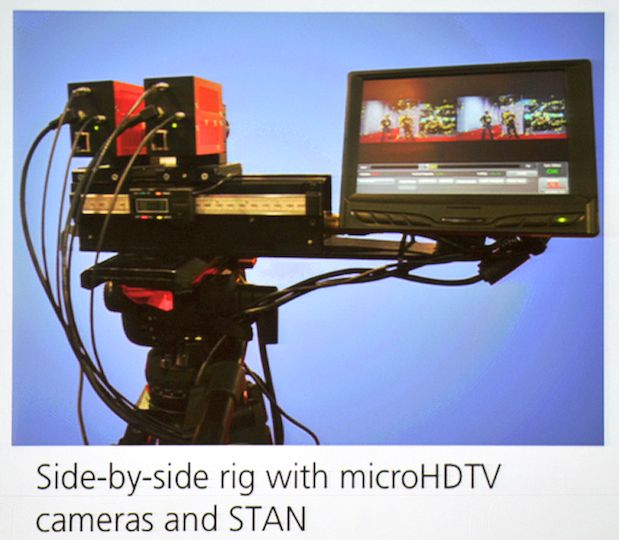
Realtime postproduction on a DVS Clipster system. DCPs made using Fraunhofer’s easyDCP software (shown at HPA last year; this year’s version handles stereo), and easyDCP Player for checking (in realtime with the right NVIDIA GPU).
3D TV: The TV viewing environment isn’t as well controlled in terms of size, viewing angle, etc. The 3D TV workflow encodes a depth map in the image stream so that depth can be adjusted in the playback environment to compensate for both viewer preference and for environmental differences.
3D Panorama is working with a 10-camera rig, capturing a 360 degree image.
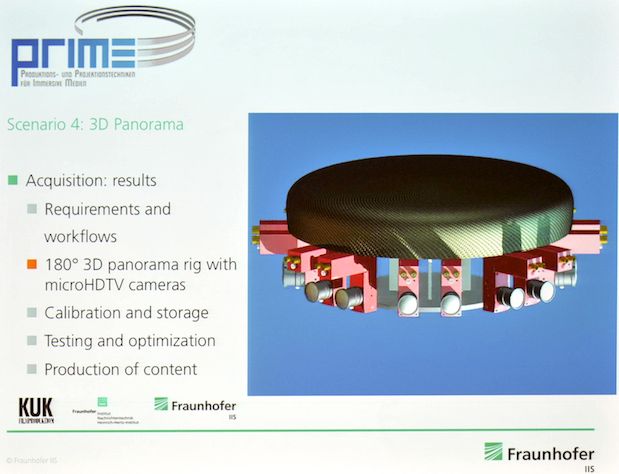
It’ll be displayed in a 180-degree 2D theater-in-the-round (starting this Friday), but will be upgraded to 3D in the future. Come to Berlin to see it! www.prime3d.de
Mark Borao, Ernst & Young, Direction of the Digital World: Media & Entertainment. Insights gained in interviewing CEOs and CFOs of media companies. Common theme: it’s all digital. CEOs are focusing on expansion outside the USA, working towards a digital future, and demanding more of their CFOs. They need to squeeze value from current businesses so they can invest in new products and services. But it’s tricky; fragmenting audiences with lots of choice; “competing with free.” CFOs? Cost cutting is critical to free up cash for new ventures. Social gaming is one such. Invented in Europe, taking off in the US; in-game micropayments.
Digital media usage is increasing (near or at saturation in the US?), at the expense of traditional media. Tracking digital media is very important; rights management is more important than cutting productions costs. Monetization is tough: everyone wants online stuff to be free. Experiments with ad-supported media; what does an ad in the show do to royalty rates? Non-traditional analytics, like tracking game usage; that kind of data can be very useful internally.
Ernst & Young divides the tasks as follows: Digital supply chain management; eCommerce tax planning; digital content protection; contract and I. P. management; 3rd party obligations (a.k.a. royalties) – accruals; 3rd party obligations – receipts; digital CRM (customer relationship management); digital product innovation (marketing across brands); digital monetization strategies (but “nobody’s managed to figure this out”!).
What Just Happened? – A Review of the Day by Jerry Pierce & Leon Silverman
2D glasses for the 3D universe… Technology creates curiosity… Word of the day: KESQ’s Bob Allen’s “Skepthusiast”, a skeptical enthusiast.
How many people in the audience would buy a 21×9 display? Not darned many. Assuming they had that set, how many will watch 16×9 on that set in the stretched mode? Even fewer; maybe two hands went up—but this is a tech-savvy and content-savvy crowd. Philips finds that most people don’t change the default auto-stretch (or don’t complain about it).
How many have video-enabled phones? Most. How many watch video on their phones? Not so many. How many get OTA mobile TV on their phones? Darned few.
The “war of widgets” will be interesting. Kids of today won’t accept walled gardens; if the TV won’t let then see what they want, they’ll go back to their PCs… or just jailbreak their TVs.
Next: Demo Room goodies… and a roast.
Demo Room Goodies…
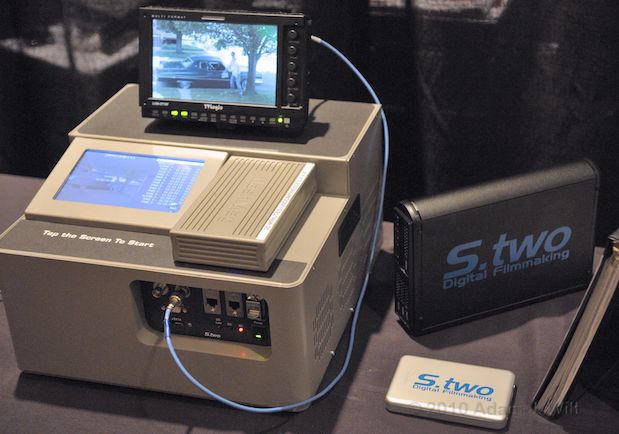
S.two’s field offload station.
S.two’s field station allows offloading of a flashpack to a portable eSATA drive at about 10 fps, or an upcoming S.two 5-drive RAID (black box) at about 32 fps. It’s all driven from the touchscreen next to the flashpack.
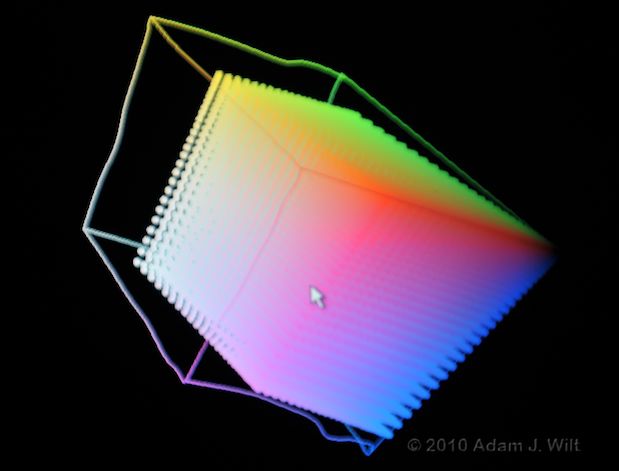
3D LUT used by Cine-tal’s Davio box to match a Panasonic plasma to P3 color space.
Panasonic showed a Cine-tal Davio driving a plasma in the DCI P3 color space.
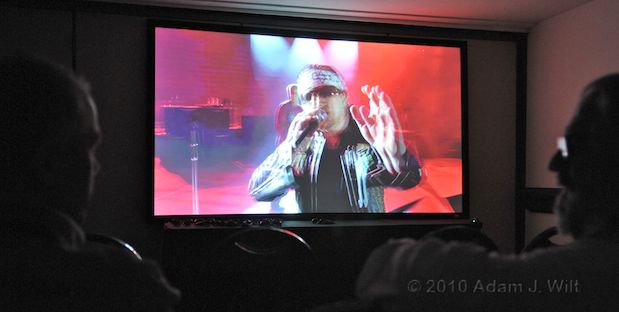
Dolby’s 3D in the home demo.
Dolby demoed 3D 1080p using h.264 compression at 7.5 Mbit/sec. Looked pretty good. Compression artifacts were visible… but only if you went right up to the screen and looked for them.
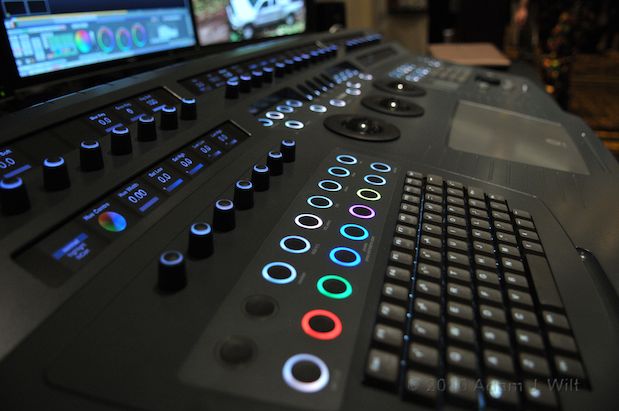
Quantel Pablo NEO color-grading console.
Quantel took two round-the-world trips to work with colorists in the process of designing this control surface. Dang, it’s sweet.
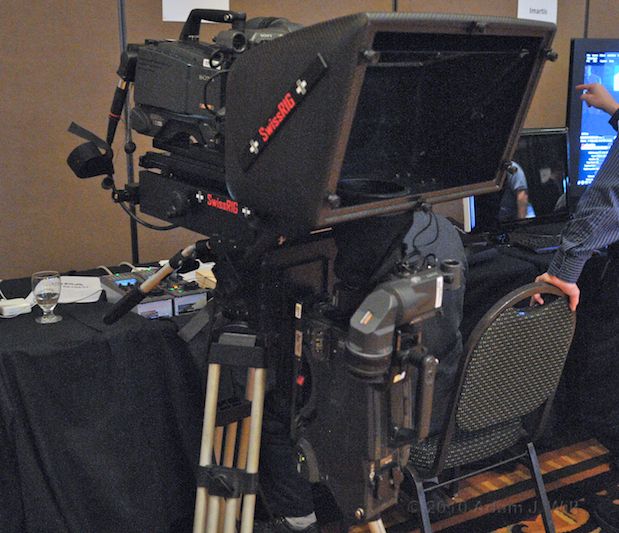
SwissRig beamsplitter 3D rig.
Another beamsplitter rig. This one has the second camera upshooting instead of downshooting.
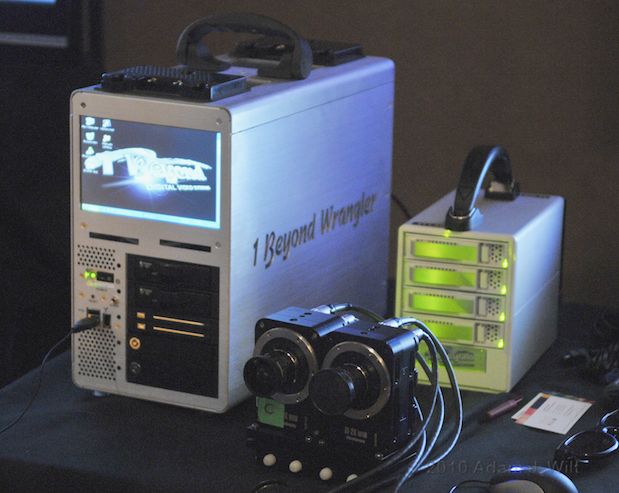
1Beyond 3D field recorder.
1Beyond’s “Wrangler” box fitted out for live recording of dual SI-2K cameras for 3D field work.
And then, at dinner, the HPA roasted Mark Schubin…
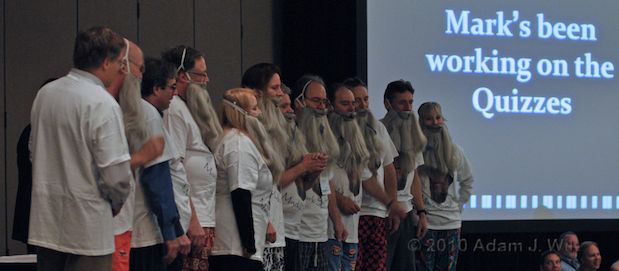
The Mark Schubin Opera Chorus. Frightening to behold.
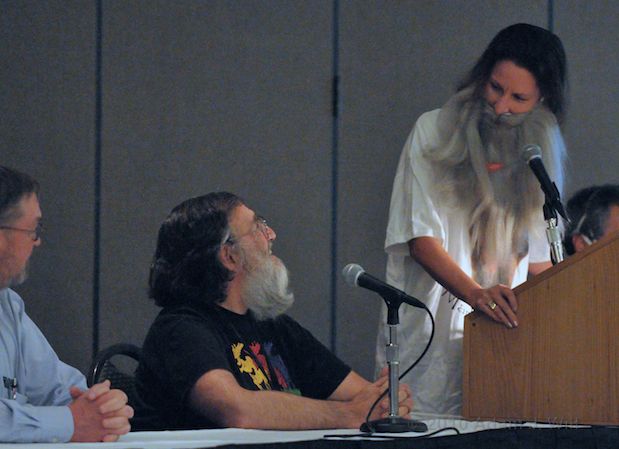
Bearded Lady Deborah McAdams toasts/roasts Mark Schubin.
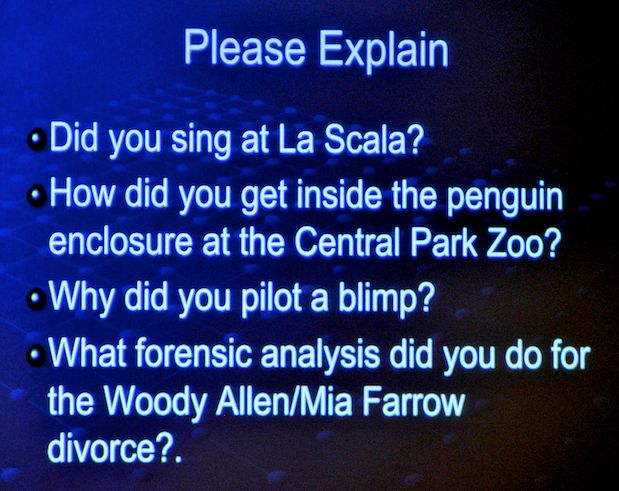
Some of Steve Lampen’s questions for Mark.
Mark’s answers:
• Yes.
• Through the hatch.
• Because it was there.
• I carefully examined a blank tape, to verify that it was blank.
Crikey.
More tomorrow; the Tech Retreat has two days left.
More:
16 CFR Part 255 Disclosure
I attended the HPA Tech Retreat on a press pass, which saved me the registration fee. I paid for my own transport, meals, and hotel. The past two years I paid full price for attending the Tech Retreat (it hadn’t occurred to me to ask for a press pass); I feel it was money well spent.
No material connection exists between myself and the Hollywood Post Alliance; aside from the press pass, HPA has not influenced me with any compensation to encourage favorable coverage.