
(Page 1 of 1 pages for this article )

Sunday, November 07, 2010

Filed under: CamerasHardwareProduction

Quick Look: Panasonic AG-AF100 MFT Cine-Style Camcorder

Adam Wilt | 11/07

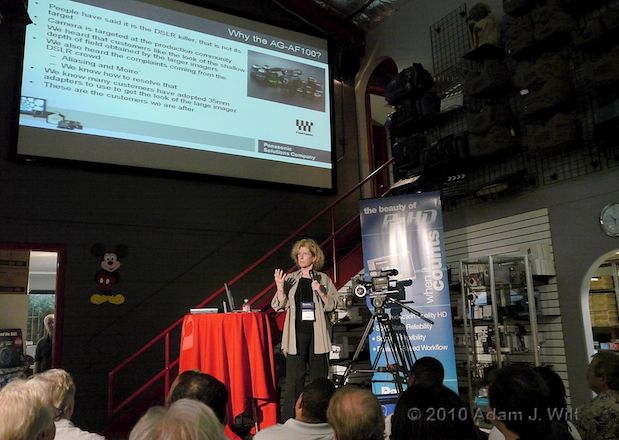
Panasonic shows off a prototype AG-AF100 at Birns & Sawyer

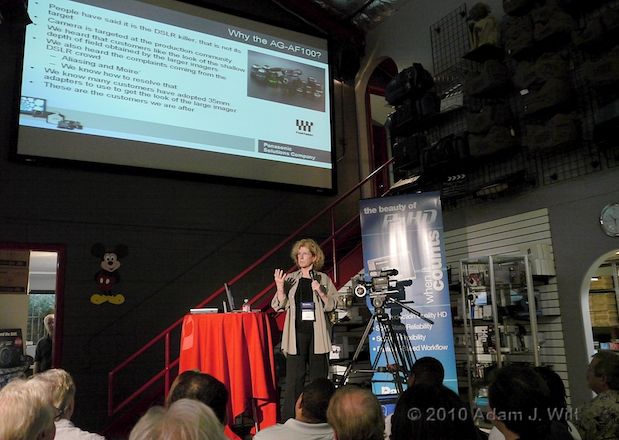
Thursday, 4 November 2010: Panasonic’s Jan Crittenden Livingston appeared at Hollywood rental and sales facility Birns & Sawyer to show off a prototype AG-AF100 Micro Four Thirds cine-style camcorder. I was in town for the Createasphere 3D Workshop, so I stopped by for a look. Herewith, my notes and observations.

The AG-AF100 is a single-sensor handheld camera with interchangeable lenses. It’s based on the Micro Four Thirds (MFT) format, using a bayonet-style lens mount with a ~20mm flange depth in front of an 10.6x18.8mm CMOS sensor—roughly 80% the size of a 35mm motion picture film frame (the flip side is that a film lens on the AF100 will seem about 25% “more telephoto”; a 50mm on the AF100 will have roughly the same angle of view as a 60mm or 65mm on a film camera). Some say the AF-100 will be the “DSLR Killer” for video applications; Panasonic qualifies this as a “DSLR killer for serious uses”. The body alone is (or will be) $4995, so it’s not for the $2500 DSLR crowd.
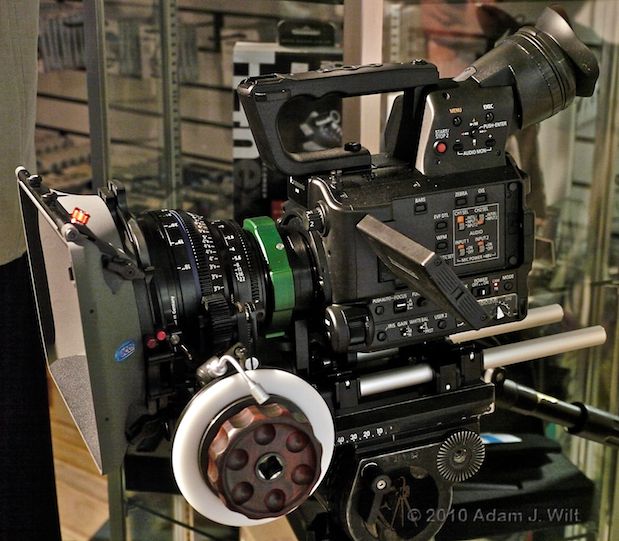

The AG-AF100 with 50mm CP.2 and Cinetech follow-focus (with tiny scale-illuminating LED light).

The AF100 will show no moiré, no color shimmering or aliasing. Its anti-aliasing / optical low-pass filter is optimized for 1080p and 720p (when Jan brought the AF100 to the 3D workshop and had it hooked up to a 25” display, the images looked smooth, natural, unaliased, and very clean).

Its CMOS sensor is “best in class” with fast scanning for minimal skew. Yes, it showed some jellocam on fast motion, but it took some pretty severe whip-panning to make it at all noticeable.

The shallow flange depth (MFT is a “mirrorless” or “live view” format in still cameras, so there isn’t the need for a deep mirror box behind the lens as on reflex cameras) allows just about any lens other than C-mount lenses to be attached with an adapter (the demo camera had Illya Friedman’s Hot Rod Cameras PL-mount adapter on it with a Zeiss 50mm Compact Prime CP.2 lens and a Cinetech follow-focus). Jan had a Novoflex Nikon F to MTF adapter with her, and she said a Birger EOS adapter (with, presumably, electronic aperture control for Canon’s lenses) may be available by the end of the year.
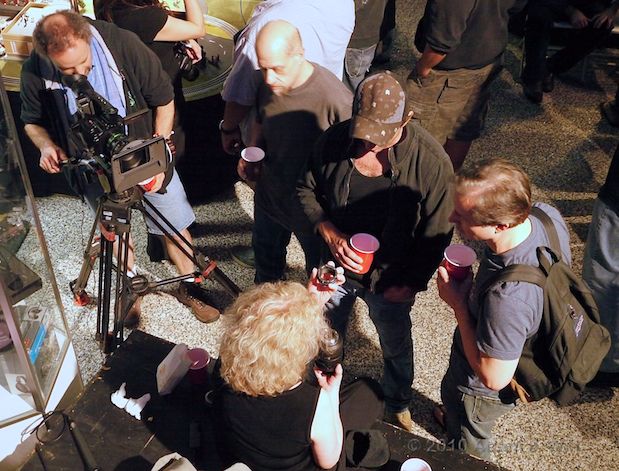

Jan demonstrates the Novoflex Nikon F to MFT adapter ring.

The PL-mount adapter will be about $1200 when it ships; the prototype on this camera is the first one with a support mechanism specifically for the AF100.
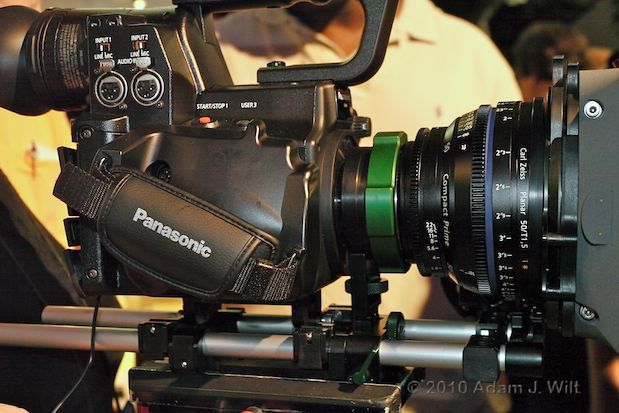

Right-side view of prototype Hot Rod Cameras PL mount with support standoffs for the AF100.

With Panasonic’s own 14-140mm f4-f5.8 MFT zoom (the one sold with DMC-GH1 still camera) the AF100 will have optical image stabilization and face tracking: if the camera recognizes a face, you can have it track that face in a scene and lock focus and exposure to it.

The camera has slow shutters down to 1/2”. It will grab stills at HD resolution while live, while shooting video, or when playing back. Still are always in HD resolution: remember, the AA/OLPF is optimized for HD resolution; larger pix would look soft.

Six scene files will be present. They aren’t named yet but figure on HPX170-like options: HD norm, SD norm, B. Press, etc.

The camera will have HDMI out, plus either HD-SDI or EVF (only two out of three at any one time to prevent overheating).  The HD-SDI is 4:2:2 8-bit, either 1080/23.98 PsF or 29.97 Hz; cannot output HD-SDI in off-speed modes. HD-SDI has TC and audio. HDMI does not have TC but is full res 4:2:2. Audio is uncompressed 16-bit in 24 Mbit/sec PH recording mode, otherwise Dolby AC3 in lower-bitrate modes.
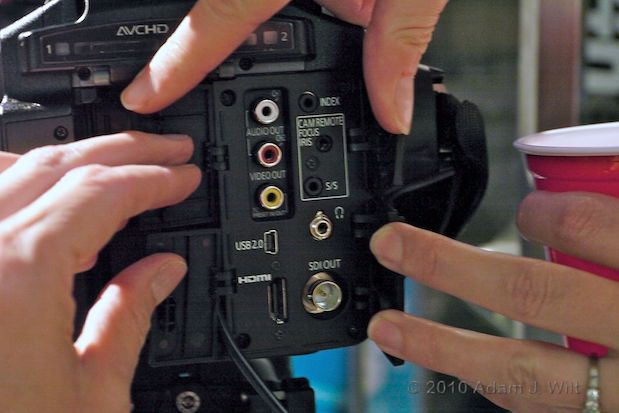

I/O: SD composite in/out, RCA audio out, USB, HDMI, HD-SDI, remote control (visible thanks to the helping hands of other attendees!).

The EVF is 16x9, .45”, 1.22 Megapixel; the flip-out LCD is 16x9 3.45” with 921 kilopixels (and it’s the best-looking LCD I’ve seen on a Panasonic camcorder—there is almost no change in color or tone as the viewing angle is changed). Viewing aids: WFM and vectorscope, focus bar, color peaking, 2 zebras ranging from 55% to 105%, spot meter readout.
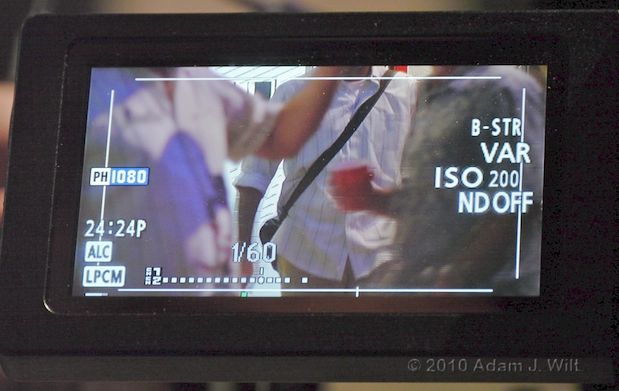


LCD readouts: more elegant typography than we’re used to on a Panasonic.

You will be able to jam-sync timecode on the composite video in (presumably the composite out from the camera includes VITC, though I didn’t ask at the time; otherwise, how would this work?). Four-position ND filter wheel with 0/2/4/6 stops of ND; white balance variable in 100 degree from 2400 K to 9900 K. Dynamic Range Stretch in all frame rates, all modes (not for all shots, only contrasty scenes; Jan warns against using it otherwise). Three levels of DRS plus off.

Viewfinder has aspect-ratio markers for 2.35:1, 1.85:1, 14x9, 90% safe area, 4x3, “rule of thirds” grid.

Relay recording across two SD cards. No 12 minute limit, grin, unlike certain HDSLRs. Ping-pong across multiple cards for unlimited recording time.

Programmable FN button: area focus, area iris, area Y-get (exposure level readout), area focus and Y-get, area focus and iris. The “area” is a square you steer around onscreen using a four-way joystick button.
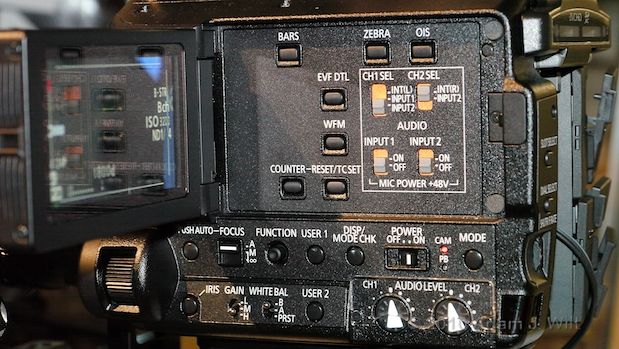

Operator-side controls, with FUNCTION joystick and two USER buttons.


There is no start/stop button, or zoom rocker, on the handgrip! Start/stop is on the right side top plate, where your forefinger will fall; another is on the left of the EVF tower.
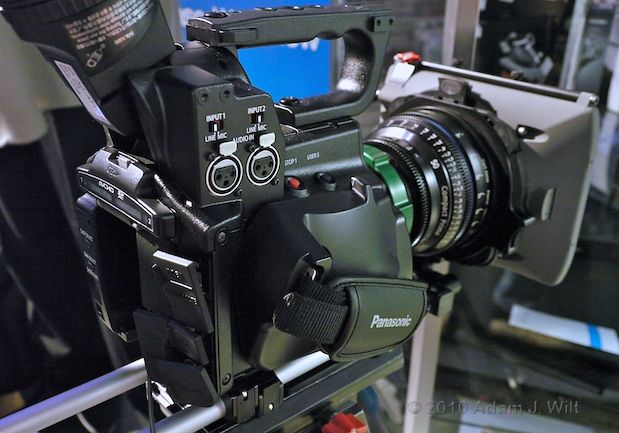

XLR audio in; START/STOP1 and USER3 buttons.

Handgrip is removable with two bolts, as is the top handle.
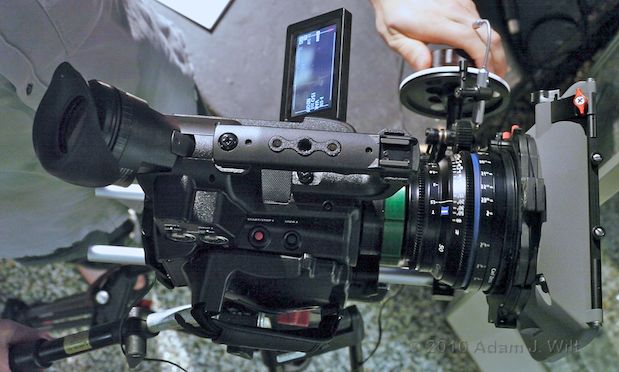

Top view. Two 1/4” and one 3/8” sockets on the handgrip.

There’s a smart battery interface with time remaining indicated in the finder (hooray!). You should get up to 4 hours on one 5400mAH battery (same battery form factor as on DVX, HVX, HPX series cameras).

Wireless IR remote control plus standard Panasonic wired iris, focus, stop/start (think Varizoom, Bebob controllers).

Accessories: “if you could do it on a film camera, you can do it on this camera.”

Compression: AVCHD, a content-adaptive codec, with different block sizes from 4x4 to 16x16. The more B-Frames, the better (in an IBBPBBP-type GOP structure); DSLRS are IP only, “and I don’t care what their bitrates are, they’ll never look as good”. GOP length is 15 frames.
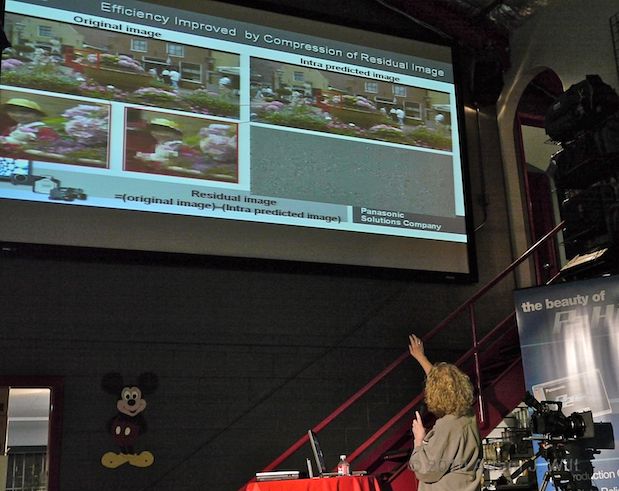

All praise be unto the codec: Jan explains AVCHD.

Native ISO is not officially established yet, though it seems to be roughly around 320, with 10 stops dynamic range. ISO range selectable in the camera will be 200-3200.

The AF100 is (or will be) US warranted and supported, the AF101 will be warranted and supported in Europe; both the 100 and 101 work the same and have the same 50 Hz / 59.94 Hz switchability, so it’s just a question of who’s got your back if something breaks.

Don’t take as gospel any AF100 sample clips you see online. The codec isn’t finalized yet, and according to Jan there weren’t supposed to be any cameras handed out to third parties yet for any sort of video-quality evaluation.

Why SDHC cards and AVCHD instead of P2 cards and AVC-Intra? P2/AVC-I would add $8000 to the cost, including making 60p work in 1080 AVC-I (this camera has variable frame rates in 1080p, not in 720p, and it tops out at 1080/60p overcranking).
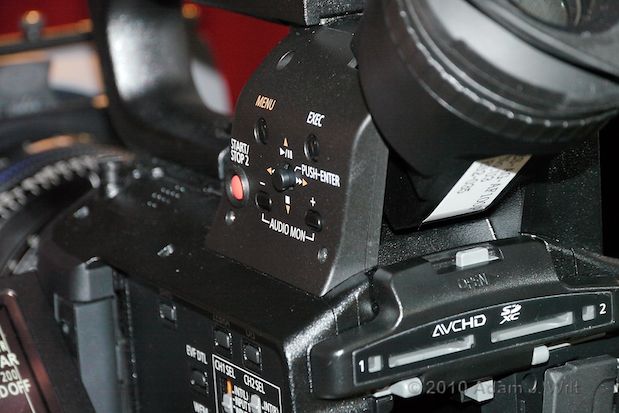


DVX-style menu controller; START/STOP 2, dual SDHC/SDXC card slots.

Sensor native resolution is unspecified as yet. It’s not the GH2 chipset, and “not even in the same ballpark” as the GH1 chipset.

Panasonic is looking at it as a production camera, for film work. However, a lot of folks are looking at it for wedding video.

The body weighs only 2.2 pounds. I pulled the thing off the tripod and handheld it; with the 50mm CP.2 lens and Cinetech FF it was front-heavy, but not much worse overall than an HVX200 or an EX1. IMHO the handycam form factor isn’t ideal for a camera of this size and weight, but I was pleased to see that it was at least somewhat usable. Moving the start/stop trigger off the back of the thumb-rest portion of the grip actually made it easier to hold, as I could really get a “thumb lock” on the thing and stabilize it better.

The cameras are supposed to start shipping in late December (not in time for Christmas, though!). Panasonic is already back-ordered a couple of months (but Jan says that’s her backlog; that doesn’t really indicate how many cameras the dealers will have available, and it may be better or worse at the retail level). Jan said she’ll see about getting me a finalized prototype—one with production firmware that I can test as a valid example of how the shipping cameras will perform—for a few days in late November or early December. If that happens, you’ll read about it here. Stay tuned…

FTC Disclaimer: No material connection exists between me and Panasonic and/or Birns & Sawyer, except as a customer. No payments or other considerations were offered for writing this article. I did, however, partake of perhaps a dozen cubes of cheese, several carrot sticks, and half a plastic cup of wine at Birns & Sawyer’s follow-on party.

The figure of Mickey Mouse appearing on the wall at Birns & Sawyer is copyrighted and trademarked by the Walt Disney Company. Mr. Mouse appears in these photographs purely incidentally, and his presence here is not intended as support, endorsement, or commentary on the subject at hand.

(Page 1 of 1 pages for this article )


You must be registered to comment. This is an effort to reduce spam. Please REGISTER HERE.

Thank you for the very informative article!

One question, tough: how can the OLPF be optimized for both 1080 and 720 and the same time? Hope it’s not the case, or it would limit resolution in 1080!

Regards,

Uli

Posted by .(JavaScript must be enabled to view this email address)  on  11/08  at  02:32 AM


Thanks Adam for this overview of Jan’s presentation, I wasn’t in town so didn’t get a chance to stop by. wink

The AF-100/101 sounds lke a great cam. I look forward to getting a chance to shoot with one. There is one thing though that really caught my attention, and I’m sure someone must have brought it up during, or after, the presentation : Why is the HD-SDI out only 8-bit ? That really seems like a big flake out from Panasonic, the kind of thing Sony usually do, supposedly so as not to have cheaper cameras compete with their more expensive models. I’m really dissapointed about that and, I think it’s a strategic mistake. Most people will record to AVC anyhow, but those that want to use the the HD-SDI with this camera, will want to do so because this is the camera that fits their needs, and if 10-bit HD-SDI is what they need they’ll look elsewhere for it, and not necessarily in the Panasonic line-up.

Panasonic, if you’re listening, please don’t cheap out on the HD-SDI out, make it 10-bit.

Cheers,
Damien

Posted by earthling  on  11/08  at  02:42 AM


Isn’t HD-SDI natively 10 bit? So they’re purposely limiting it?

Also: is it just me, or is that a high price for a PL-mount adapter?

Posted by .(JavaScript must be enabled to view this email address)  on  11/08  at  08:22 AM


P2 and AVC-Intra @ 1080p60 would add $8,000, fine. But what about 1080p60 AVCHD @ 28 Mbit/s? It is available on consumer Panasonic cams for as low as $500 and looks better than anything else I’ve seen from a camera 10 times more expensive.

Posted by .(JavaScript must be enabled to view this email address)  on  11/08  at  04:53 PM


I had to stop here and ask:

“cannot output HD-SDI in off-speed modes.”

Does that mean that over-cranked footage cannot be captured to a separate recorder like the KiPro Mini? This would be a major MAJOR drawback. I would actually not be able to buy this camera if overcrank is not supported except for internal recording.

I figured they would make the HD-SDI 8 Bit… I can live with that. The CMOS sensor I’m really not thrilled about. I like CCDs, I know them well.

Why no c-mount lens adapters? you could use them on the gh1? wish i could use all my bolex glass too… oh well.

Guess I might have to stick it out with my HVX200 a little longer until I find a replacement I can live with.

Posted by georgemanzanilla  on  11/08  at  07:03 PM


“How can the OLPF be optimized for both 1080 and 720 and the same time? ” They aren’t that far apart, resolution-wise; one is about 70% of the other, so if the OLPF is optimized for 1080, then 720 will be very slightly aliasy, but not hugely so. Vendors have been doing this for years on 1/3” and 2/3” HD cameras and it hasn’t been seen to be a problem as fas as I know.

“Why is the HD-SDI out only 8-bit?” I asked Jan, and she said that the final 4:2:2 YUV pathway inside the camera is 8-bit. Panny saves some money by not pushing things to 10-bit (how, much, I cannot say, but I wouldn’t be surprised if this camera borrows technology from the DMC-GH still cams with MFT sensors).

“Isn’t HD-SDI natively 10 bit?” HD-SDI (and SD-SDI) allow both 8-bit and 10-bit video. In 8-bit, the two LSBs are simply set to zero. Panny isn’t “limiting” the AF100 to 8-bit; rather, they aren’t “building it up” to 10-bit.

“What about 1080p60 AVCHD @ 28 Mbit/s?” You’d have to ask Panny that question. 28Mbit/sec AVC exceeds the maximum bitrate allowed in the AVCHD spec; presumably there would be issues with decoding the files in current-generation NLEs. But you’d really have to ask Panasonic about that.

“Does that mean that over-cranked footage cannot be captured to a separate recorder like the KiPro Mini?” Correct; off-speed shooting disables HD-SDI. But before you reject it out of hand, wait and see what the pix look like using the on-board recording. My general impression from other 24 Mbit/sec AVCHD camcorders is that it’s not something you want to chroma-key or motion-track with on high-end productions, but 99 times out of 100 it looks fine.

“Why no c-mount lens adapters?” MFT has a flange depth of about 20mm; C-mount is 17.5mm, so an adapter would have to recess the C-mount inside and 2.5mm behind the MFT flange. I see that Fotodiox makes just such an adapter (Google “c-mount to MFT adapter”). Whether it would work on the AF100, or if there’s something behind the lens mount that would prevent it from working (like the four-position ND filter wheel, which the still cams don’t have), I cannot say at this time.

Posted by Adam Wilt  on  11/08  at  07:37 PM


Thanks Adam for your helpful insights.

I’ll wait to try the camera out before I judge it.

Posted by georgemanzanilla  on  11/09  at  12:19 AM


I use a Kipon C mount m-4/3 adapter for my GH1 for c mount CCTV and Bolex lenses.  AF100 should be no different.

Posted by .(JavaScript must be enabled to view this email address)  on  11/10  at  09:37 AM


Some brief questions:

From some comments I conclude that the specs for the camera are still not complete.  Is that true?

Is there a technical reason HDMI output cannot include time code?

Are third-party recorders such as AJA supported?

Many thanks for the great review.  This camera has definitely risen to the top of the list.

—Paul

Posted by .(JavaScript must be enabled to view this email address)  on  11/10  at  10:45 AM


“I conclude that the specs for the camera are still not complete.  Is that true?” My understanding is that it is true; there is still some more work to be done.

“Is there a technical reason HDMI output cannot include time code?” As far as I know, there is no specification for TC on HDMI, but I could be wrong.

“Are third-party recorders such as AJA supported?” I don’t see why not. Jan discussed removing the handgrip (two bolts!), attaching a Ki Pro in its place using a custom mounting bracket, and then bolting the handgrip on the outside of the package. Now, (a) I don’t think the custom bracketry exists; that was just a “for example” sort of thing, and (b) I can’t imagine such a fat, laterally-unbalanced camera would be much fun to handhold, but there’s no reason it couldn’t be done. I presume that the HD-SDI includes start/stop signaling for attached recorders, but I don’t know that. We’ll have to wait for production-line cameras (or at least production-level firmware) to answer that one.

Posted by Adam Wilt  on  11/10  at  09:05 PM


The AF-100/101 sounds lke a great cam. I look forward to getting a chance to shoot with one. There is one thing though that really caught my attention, and I’m sure someone must have brought it up during, or after, the presentation : Why is the HD-SDI out only 8-bit ? That really seems like a big flake out from Panasonic, the kind of thing Sony usually do, supposedly so as not to have cheaper cameras compete with their more expensive models. I’m really dissapointed about that and, I think it’s a strategic mistake. Most people will record to AVC anyhow, but those that want to use the the HD-SDI with this camera, will want to do so because this is the camera that fits their needs, and if 10-bit HD-SDI is what they need they’ll look elsewhere for it, and not necessarily in the Panasonic line-up.

http://padana.com

Posted by .(JavaScript must be enabled to view this email address)  on  11/21  at  11:25 PM


Name:

Email:

Location:

URL:

Smileys

Remember my personal information

Notify me of follow-up comments?

Submit the word you see below:


Quick Look: Sony F65 4K Digital Cine Camera

Adam Wilt | 01/28

BandPro’s Jeff Cree shows off the F65 at Videofax in San Francisco.

Last week, San Francisco rental house extraordinaire Videofax took delivery of Sony F65 #15, and on Thursday BandPro’s Jeff Cree came up to show off the camera to local DPs, ACs, and DITs. I was able…

Review: Panasonic AG-AC160 and AG-HPX250 1/3” 3-MOS camcorders

Adam Wilt | 01/22

Panasonic delivers full-res, full-function, feature-rich 3-chippers.

While all the attention is focused on large-single-sensor cine-style camcorders, Panasonic has come out with a line of high-quality 1/3” 3-MOS handhelds that leave little to be desired. The HPX250 is a handheld version of the shoulder-mount…

So You Want to Buy a RED Scarlet?

Matt Jeppsen | 01/01

Do you really need that new camera? An intervention.

image

I got a question on Twitter recently regarding the pros and cons of purchasing a Red Scarlet camera. After responding,…

Open for Optics

The Sony Tech Guy | 07/13

Lens choices with the NEX-FS100U and Sony’s E Mount system

image

It’s Cinematography 101: the right lens does more than establish the frame.  It can help communicate emotion and tell us something about space, character and story. …

To be considered for listing, contact pr (at) provideocoalition (dot) com


Copyright © 2011, HD Expo, LLC a division of Diversified Business Communications. DBA Createasphere

All rights reserved. HD EXPO, High Def EXPO, Createasphere, E-Tech, Entertainment Technology Exposition, 3D Production Workshop, VariCamp, P2 Camp, ColorCamp 101, and Lighting, Filters & Gels for HD are all trademarks of HD Expo, LLC.

Terms of Use  |  Privacy Policy

Check PageRank