

Filmtools
Filmmakers go-to destination for pre-production, production & post production equipment!
Shop NowZeiss lenses show what they’re really made of.

[Originally published 3 February 2011. Republished because who doesn’t like lenses cut in half?]
I attended a local tradeshow yesterday and today, and Zeiss had a display table showing off still and cine lenses. Herewith, some images for your viewing pleasure.
San Francisco bay area reseller and systems integrator Snader and Associates just held their annual ETECS show. Among the various displays, one in particular caught my eye: a tableful of Zeiss lenses for still camera and cine camera applications.
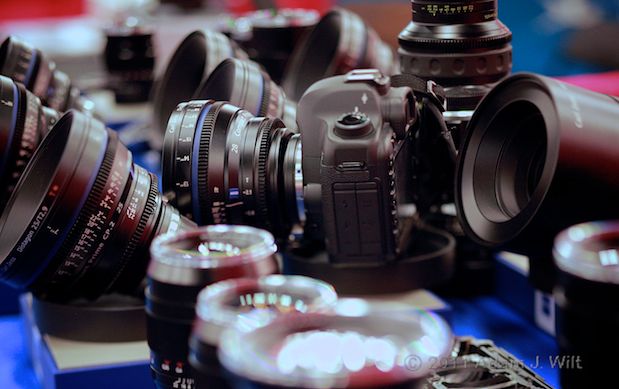
Nikon-mount ZF lenses and Canon-mount ZE lenses flanked a selection of Compact Prime CP.2 lenses.
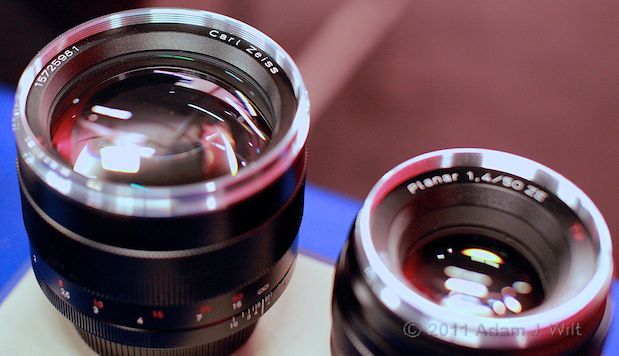
Zeiss lenses have a jewel-like appearance and are always a pleasure to see.
The CP.2 lenses have interchangeable mounts, so they can be used both on PL-mount cine cams and on EF-mount Canons, like this one:
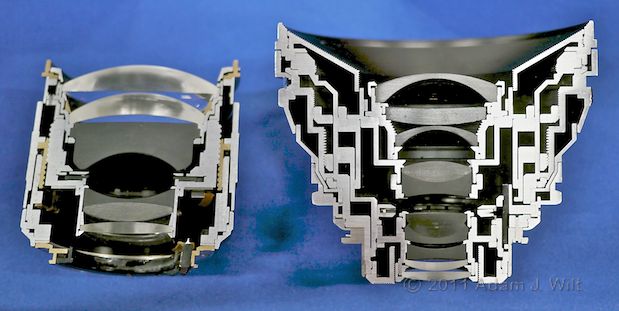
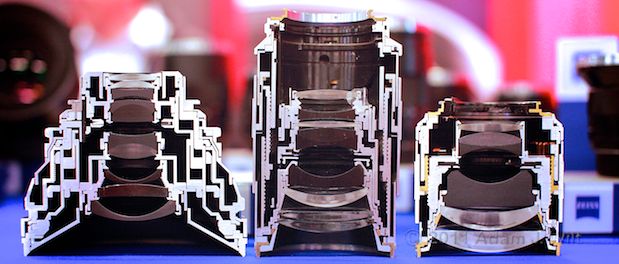
Lurking among the display models were several transected lenses, showing the intricacy of their mechanical and optical designs.
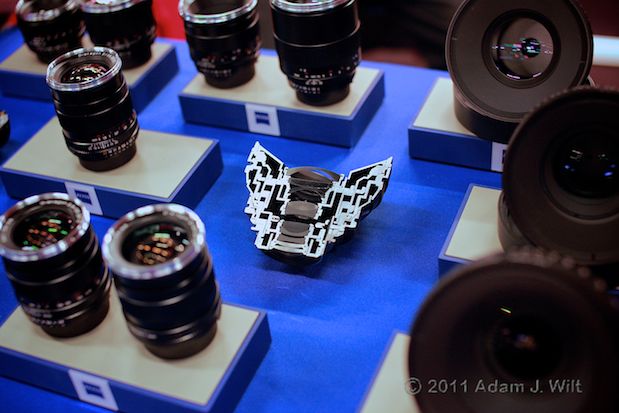
The kind folks manning the booth allowed me to grab some detailed images…
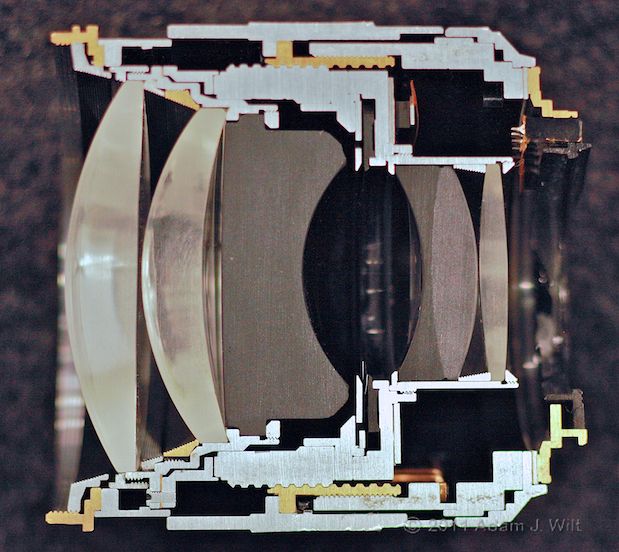
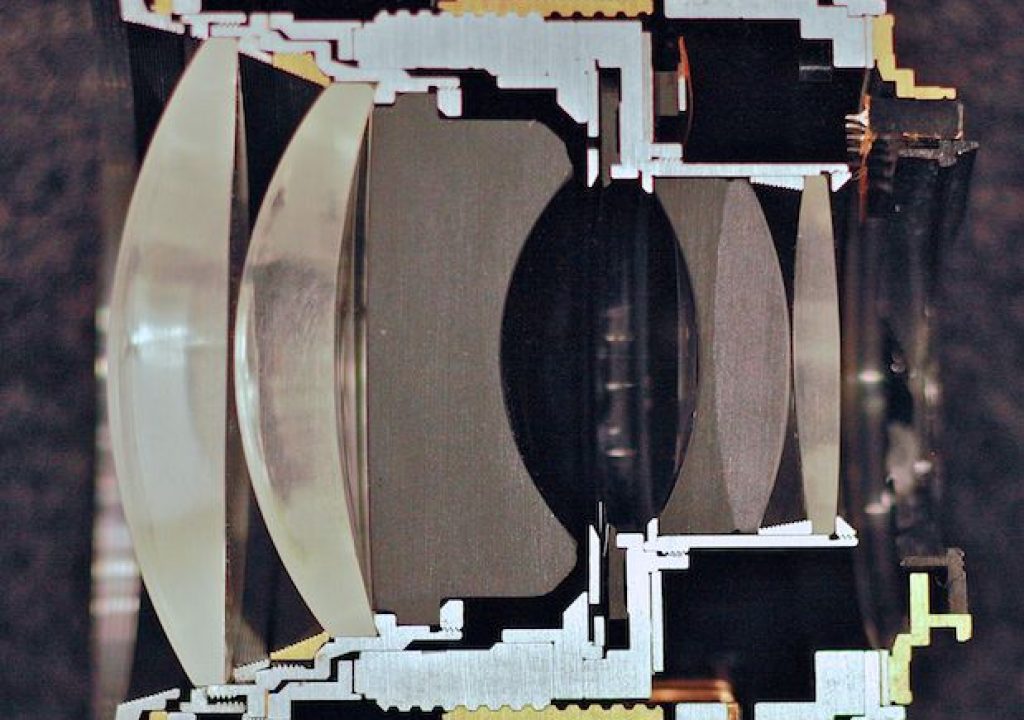
Planar T* 1,4/85mm in ZE (Canon) mount.
(I apologize for the blown focus in this image; clearly I’ll never work as a 1st AC ever again.)
The surface appearance of the lens elements differs depending on what sort of glass they’re made of.
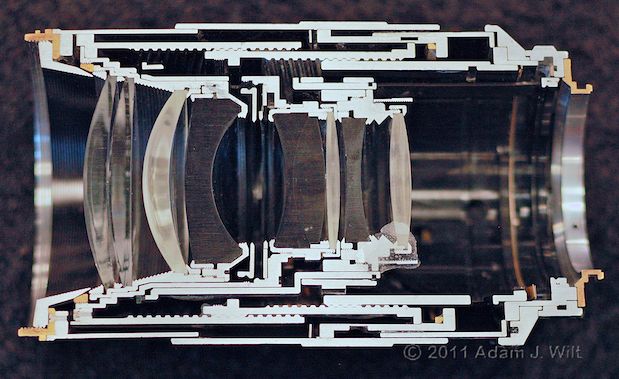
Makro-Planar T* 2/100 in ZE (Canon) mount.
This tele-macro focuses down to 0.44m, for a 1:2 reproduction ratio. You can see the long serrated edges of the two-stage helical focusing mechanism.
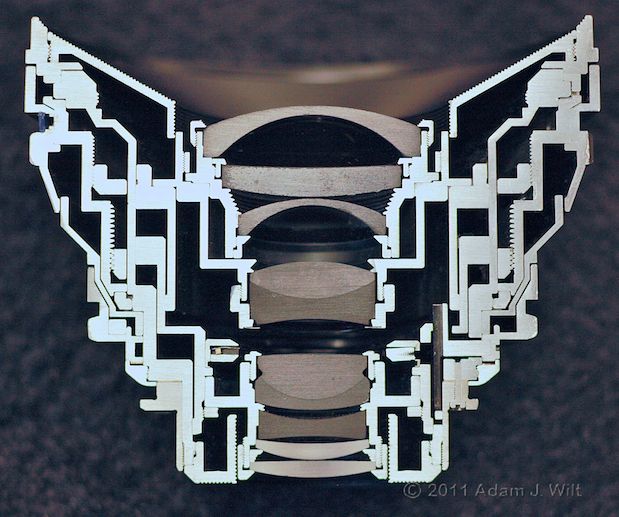
CP.2 28mm/T2.1 with PL mount.
This lens is based on the Distagon T* 2/28, if I understand it correctly; a lens similar overall to the two still lenses shown above. But look how much more complex the mechanical arrangement is. A cine lens uses a 300-degree focus throw (note how finely pitched the focus gear is compared to those on the stills lenses), and it must have the same overall dimensions and focus / iris ring placements as its stablemates so that the various primes can be interchanged without repositioning the follow-focus gear and the matte box.
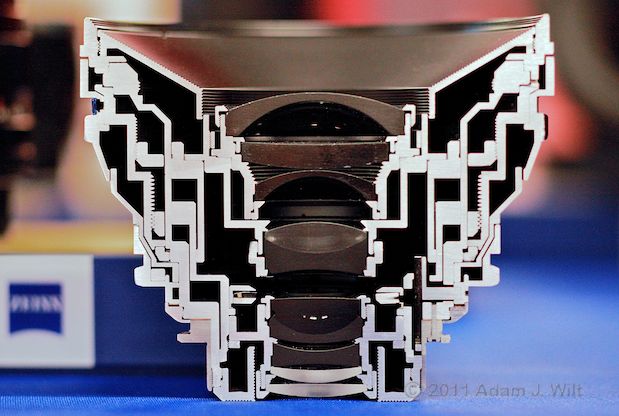
Another view, with lens propped on the table instead of lying on the floor (!) (those Zeiss guys really were very trusting). Many elements appear black, and almost opaque.
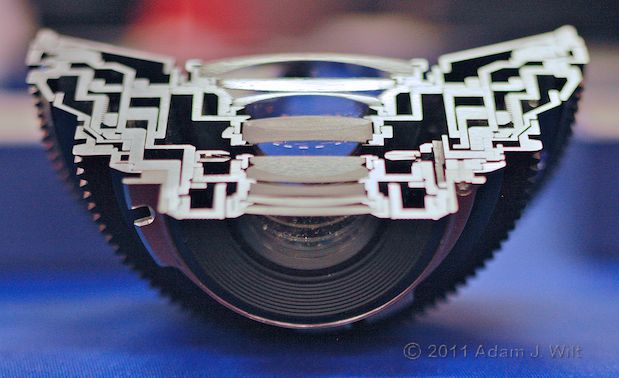
Yet when seen at a more normal angle, through their polished surfaces, they are just as clear as you’d expect.
There’s no story here, just pretty glass and masterful machining. I hope you enjoy these pictures as much as I do.
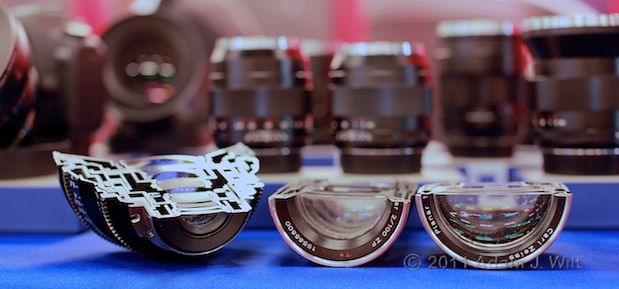
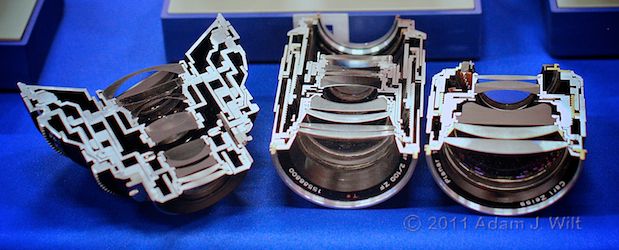
Disclaimer: Neither Zeiss nor Snader offered me any blandishments, emoluments, considerations or bribes of any sort to shoot and publish these pictures or blow their respective horns. There is no material connection between me and either Zeiss or Snader. I just have a weakness for precision optics, that’s all.