
(Page 1 of 1 pages for this article )

Saturday, January 15, 2011

Filed under: Cameras

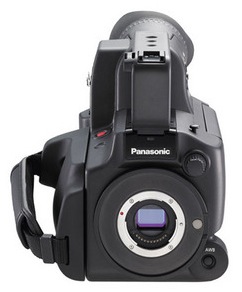
Panasonic AF100 Sensor Size Comparison

Matt Jeppsen | 01/15

An answer for those who think the AF100 sensor is too small

image

One of the common questions that I’ve personally gotten in the past few weeks is in regards to the AF100’s sensor size. There seems to be a common belief that this camera’s 4/3s sensor is objectionably small in size. I personally think that this size issue has been overstated, that the 4/3s size is actually rather large…and that the real issue is one of expectations and perception. Read on, I’ll explain…

In my opinion, the problem arises because many folks are comparing the AF100 to the 5D. Yes, compared to a full-frame Canon 5D Mark II sensor, the AF100 is rather small. However, why are we comparing the AF100 to full-frame? Full-frame is not “normal.” ANYTHING compared to full-frame is relatively small. The standard in filmmaking right now is not full-frame, rather it is film, specifically the Super35 frame size. Which the AF100’s sensor size compares relatively favorably to.

But why are we even comparing a sub-$5000 camera to the film gold standard? Because DSLRs have in the past two years enabled large sensors for the very first time at ridiculously affordable price points. We’ve given up a LOT of features and we work around their issues, simply because of the sensor size and the look it lends. We have somewhat spoiled ourselves on the topic of sensor size. The AF100 is something of a return to what a camcorder SHOULD be…proper camera features like ND filters, proper audio, proper output jacks, proper image colorimetry controls, etc…along with a reasonably large image sensor. I want to take a few moments and illustrate where the AF100 stands using Abel Cine’s Field of View calculator that shows visually how sensor sizes compare.

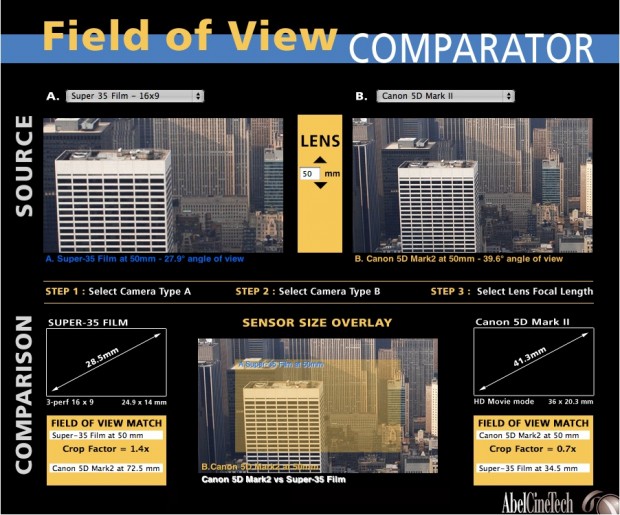
The first thing you need to do is to reboot your expectations. Here is an angle of view comparison of the Canon 5D MKII (full-frame) sensor vs Super 35mm film frame size on a 50mm lens.
image

Look at that…the 5D’s sensor dwarfs S35’s frame size! Breathe deeply and repeat after me, “full frame is not normal.” Got it? Good.

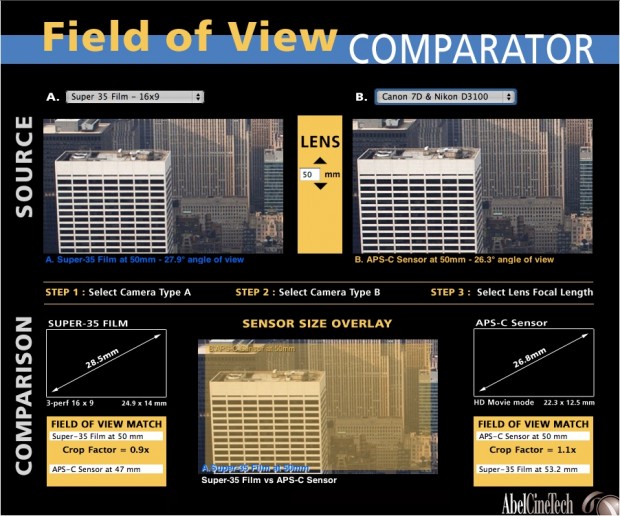
A much better comparison from the DSLR video world to S35’s frame size is a DSLR equipped with an APS-C sized sensor, like the Canon 7D or the Nikon D3100. APS-C is just a touch smaller than S35.
image

As a side note, APS-C is very slightly larger than the Red One sensor, which is generally considered to be Super35 equivalent…in other words, the Red is close enough.

Now let’s compare the AF100 to Super35, on a 50mm lens just like the above “baseline” comparisons.
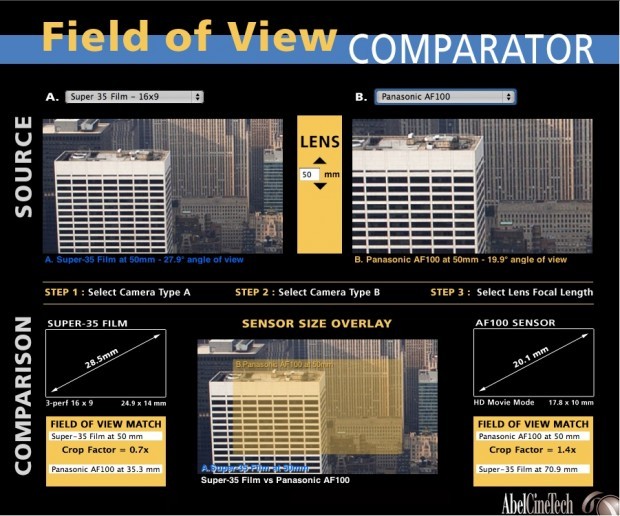
image

Clearly, the AF100 is smaller in comparison to S35. Smaller than APS-C, and the Red One. So yes, there is a crop factor to be aware of. AF100 shooters will want to make sure they have access to slightly wider glass than what you might use on a DSLR, Red, Alexa, etc. However, the size difference is not huge, the AF100 still has a relatively-large sensor.

I personally do not see the AF100’s crop factor as very objectionable, and here is why. Look at this comparison of the AF100 to the 1/2” sensor equipped Sony EX1/EX3 (an excellent camera in it’s own right).
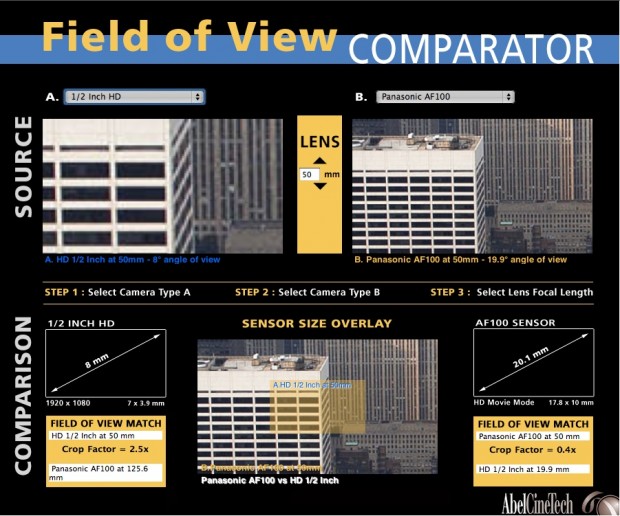
image

You can see that the AF100 dwarfs the 1/2” sensor! It’s a laughable comparison, really. Interestingly enough, both cameras are priced very close, under $5000 USD for the AF100 (body only), and around $6000 for the EX1.

The AF100 offers an interesting solution…the DOF and image qualities of a reasonably-large sensor, not quite matching S35, but coming fairly close. It’s probably close enough that it doesn’t matter for most people, and for those that it DOES matter to, well, you know who you are…and you’ll already know when to choose other systems for a given application.

The AF100 clearly surpasses (at least in terms of sensor size) the EX1, which was to date really the only affordable large sensor camera you could get your hands on. And it does all this without forcing you to make the myriad workarounds and concessions required when shooting DSLR. Early reports on the AF100 indicate that moire is under control, that the codec is robust and malleable, audio works as you’d expect, and that the camera in general is solid. You can use PL lenses, Nikon lenses, all sorts of lens mounts on this system. It really is an amazing offering, particularly at this sub-$5K price point. So with all those benefits over DSLRs…let’s not get hung up on a small sensor size difference, ok?

Related: Here’s a great post over at Abel Cine’s blog, this one answers a few other common AF100 questions.
(Page 1 of 1 pages for this article )


                    Clip to Evernote


NAB 2012: Cameras & Lenses

Adam Wilt | 05/02

A brief sampling of interesting photographic tools at NAB.

I’ve already covered the basics of what Sony and Panasonic announced, as well as looking at Canon’s…

NAB 2012: Canon C300 Image Processing

Adam Wilt | 05/01

Canon’s Larry Thorpe on the C300’s quad-HD sensor and “super green” sampling

Canon held a press dinner Monday night at NAB, where Larry Thorpe held forth on the Canon C300’s use of a quad-HD sensor (2x HD resolution in both H and V dimensions) and how Canon’s “super green” sampling boosts MTF and…

Overshadowed at NAB

Mark Spencer | 05/01

3 interesting products that passed under the radar

image

While I was once again teaching at Post|Production World at NAB this year, with classes every day, I did manage to make it to the show floor a few times. Since the…


You must be registered to comment. This is an effort to reduce spam. Please REGISTER HERE.

As far a DOF, I agree with you. M4/3 is big enough for good DOF control.

The issue of wide-angle coverage, however, is not an insignificant one. Cinema glass wider than 16mm typically carries a cost premium, whether for rental or ownership, and you really need something in the traditional 16-18 FOV on S35.

To get the angle of view of a 16mm on the AF100, you would need a 12mm.

Food for thought.

Posted by Charles Angus  on  01/15  at  05:40 PM


A fair point, Charles. I’d counter that the Tokina 11-16mm f/2.8 zoom is available in a Nikon mount for $600, which is cheap as lenses go. It’s also readily available for rental from lensrentals.com and borrowlenses.com (among others). It’s my feeling that most of the shooters using the AF100 will likely be satisfied with still glass for most applications.

For proper cinema glass, I agree with your point…it seems that many rental houses only offer an 18mm on the wide end of things. If it was me, I’d probably just drop back and punt with still image glass (like the Tokina) in those situations where my PL rentals didn’t get me wide enough.

-MJ

Posted by Matt Jeppsen  on  01/15  at  06:01 PM


And Duclos has a PL version of it with an iris ring, so it even sort of counts as a cinema lens.

Other than that, you can get wider lenses than 16 in the S4 kit, the Ultra Primes, the Master Primes, and the Standard Speeds. There are a few zooms that go to 15, but that’s not quite enough. Any others?

Posted by Charles Angus  on  01/15  at  06:30 PM


I’ve had a chance to briefly use the Tokina 11-16mm on Steve Martin’s 7D, and I was pleasantly surprised at the lack of distortion - I was expecting fisheye city. Instead, no drama.

Excellent article BTW, Matt! Nothing like a dose of reality. The 5D has indeed skewed expectations. It’s sensor size is the holy grail of still image photographers, but it’s beyond what those who are trying to replicate film need.

Posted by Chris Meyer  on  01/16  at  08:45 AM


On the other hand you can get extremely filmic 2.35:1 aspect footage with the 5d.

Yes the 5d is “abnormal”. But the Vistavision quality is exactly why people love it more than the 7d or equivalents.

If you want the 7d or RED to have the same depth of field on a 2.35:1 image you have to use anamorphic adapters. The 5d on the other hand provides that immediately. You would basically need f1.0 lenses on the af100 to try to come close and forget wide angles.

Posted by hmcindie  on  01/24  at  12:12 PM


Name:

Email:

Location:

URL:

Smileys

Remember my personal information

Notify me of follow-up comments?

Submit the word you see below:


NAB 2012: Cameras & Lenses

Adam Wilt | 05/02

A brief sampling of interesting photographic tools at NAB.

I’ve already covered the basics of what Sony and Panasonic announced, as well as looking at Canon’s…

NAB 2012: Canon C300 Image Processing

Adam Wilt | 05/01

Canon’s Larry Thorpe on the C300’s quad-HD sensor and “super green” sampling

Canon held a press dinner Monday night at NAB, where Larry Thorpe held forth on the Canon C300’s use of a quad-HD sensor (2x HD resolution in both H and V dimensions) and how Canon’s “super green” sampling boosts MTF and…

Overshadowed at NAB

Mark Spencer | 05/01

3 interesting products that passed under the radar

image

While I was once again teaching at Post|Production World at NAB this year, with classes every day, I did manage to make it to the show floor a few times. Since the…

Overshadowed at NAB

Mark Spencer | 05/01

3 interesting products that passed under the radar

image

While I was once again teaching at Post|Production World at NAB this year, with classes every day, I did manage to make it to the show floor a few times. Since the…

To be considered for listing, contact pr (at) provideocoalition (dot) com


Copyright © 2012, HD Expo, LLC a division of Diversified Business Communications. DBA Createasphere

All rights reserved. HD EXPO, High Def EXPO, Createasphere, E-Tech, Entertainment Technology Exposition, 3D Production Workshop, VariCamp, P2 Camp, ColorCamp 101, and Lighting, Filters & Gels for HD are all trademarks of HD Expo, LLC.

Terms of Use  |  Privacy Policy

Check PageRank