
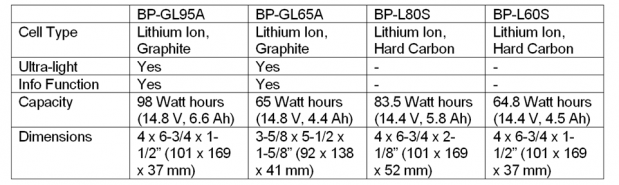
Excuse me, Miss, but I couldn’t help noticing your BP-L80S is down to 10%.
Treat your Lithium Ion batteries right and they’ll return the favor, with longer life and optimum operating time. Herewith, the secrets to maximum performance.
Lithium Ion batteries are small miracles of chemistry, packing mega juice in a compact size. Not only are they smaller and lighter than batteries with conventional chemistry, they also retain their charge longer. But there is no free lunch. In exchange for the high performance, Li-Ion needs to be treated with respect. That’s why Sony builds in multiple protection circuits to monitor overload, short circuit, voltage drop, temperature and physical shock. You also need to be aware of flight safety rules.
Batteries and air travel
The US Department of Transportation has restricted Lithium Ion batteries in flight. Li-Ions in checked bags must be installed in equipment, and that equipment must be switched off and protected from accidentally switching on. Spare Lithium Ions-those not installed in equipment-are not permitted in checked luggage. They must be placed in carry-on luggage.
The government classifies the batteries according to Equivalent Lithium Content (ELC). Eight grams of ELC is roughly equal to 100 Watt hours of capacity. Li-Ions rated at 300 Watt hours or more are forbidden in US air travel. Those between 100 and 300 Watt hours are classified as larger batteries and you’re permitted to carry on one battery attached to equipment plus two spares. Any spares should be packaged or wrapped to prevent accidental short circuits. The Sony Lithium Ion batteries discussed here are all less than 100 Watt hours and classified as smaller batteries. There is no limit to the number of spare smaller batteries you can carry on, however they should be packaged or wrapped to prevent accidental short circuits. Complete information is available at safetravel.dot.gov
Choosing the right battery for your camcorder
You should plan for about two hours of camcorder operating life from the battery. To achieve this, take the power consumption spec of your camera, multiply it by two and find a battery with that number of Watt hours.
Links:
BP-95GLA
Care & feeding dos & don’ts
- Only recharge batteries on manufacturer-specified chargers. Consult the battery operating instructions for details. For these Sony batteries, the approved chargers are the BC-L70, BC-L160 and BC-L500.
- Don’t use a slow charger.
- Don’t even think of using conventional NiCad chargers. This means you.
- Keep the batteries away from temperature extremes. Wherever possible, operate between -4 to 133 degrees Fahrenheit (-20 to 45 degrees Celsius). Those folks in the Antarctic who put warming pads on their batteries know what they’re doing. Store between 32 to 73 degrees Fahrenheit (0 to 23 degrees Celsius).
- Always change batteries as soon as the low-voltage alert comes on. Resist the temptation to drain batteries down to zero.
- Do not drop batteries or subject them to severe impact. Don’t use your Li-Ions as surrogate hockey pucks.
- Avoid long-term storage of your batteries. You’ll get maximum cycles when you’re using Li-Ions regularly.
- Do not store your batteries at 100% charge. Store them at 90% charge if you’re going to use them within 24 hours. Sony’s “Low” charge mode stops at 90% for this precise reason. If you’re setting batteries aside for 30 days or more, store them at 50% charge. This is indicated by two LEDs. Recharge to 50% every six months.
- Charge to 100% capacity just before use.
- Li-Ion life expectancy is 12 to 18 months. If your batteries are older than that, it’s time to replace.
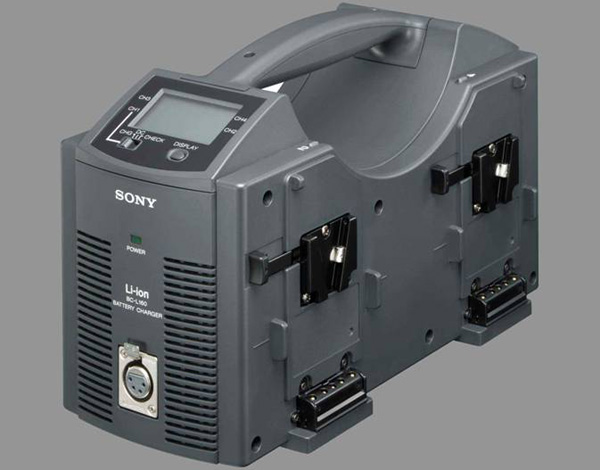
Slay four birds with one stone: the BC-L160 portable quad charger.


Filmtools
Filmmakers go-to destination for pre-production, production & post production equipment!
Shop Now