

Filmtools
Filmmakers go-to destination for pre-production, production & post production equipment!
Shop Now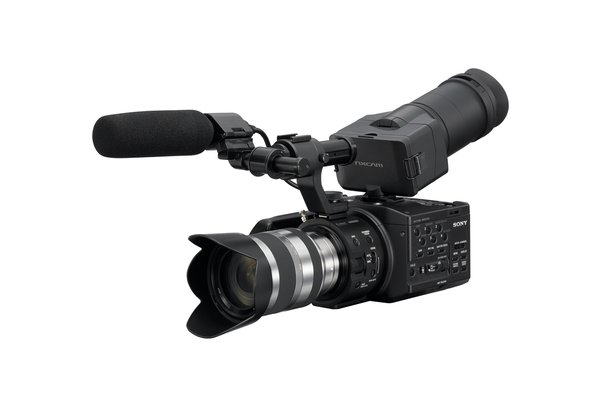
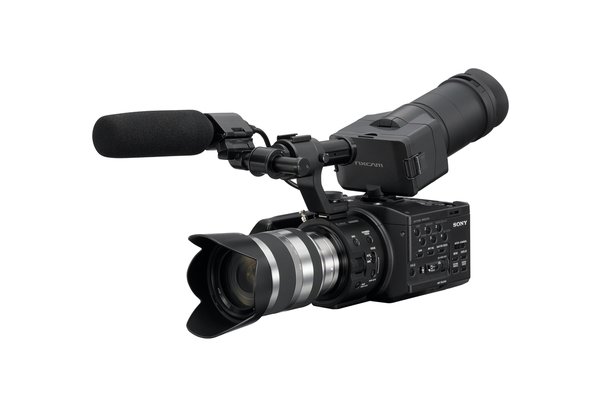
The NEX-FS100U is designed from the ground up for motion pictures.
From the moment they came out, HD-capable DSLRs have intrigued shooters with their ability to deliver Hollywood-style selective focus on a micro-budget. But even as HDSLRs have gained adherents, shooters have pointed to a list of pictorial, practical and ergonomic shortcomings. To be fair, these issues are the result of taking an excellent platform carefully optimized for still photography and adapting it for moving pictures. Sony understands. We know DSLRs, we love DSLRs, and we make a growing family of Alpha HDSLRs along with a large-sensor Handycam camcorder with still camera roots: the NEX-VG10, which uses an APS-C size image sensor. But we also wanted to create a purpose-designed professional camcorder that would combine the key benefits of HDSLRs without the limitations. The result is the NEX-FS100U.
Doing what DSLRs do
To our way of thinking, shooting motion pictures on a DSLR provides five key benefits, all of which are present in the NEX-FS100U.
- Shallow depth of field. The APS-C image sensor featured in many DSLRs has seven times the area of the 2/3-inch type sensors common in broadcast television. Large sensors have an innate advantage when it comes to controlling focus via shallow depth of field. It becomes far, far easier to direct audience attention by blurring the background. Rather than pull an image sensor from our Alpha DSLR parts bin, we endowed the NEX-FS100U (and PMW-F3) with a Super 35mm image sensor purpose-built for motion pictures.
- High sensitivity; high dynamic range. Other things being equal, large sensors can have large pixels for superb low-light sensitivity and dynamic range.
- Interchangeable lenses. The camera not only supports still lenses, but the 18-mm flange-back distance of Sony’s E Mount system creates distinct opportunities. Many affordable still camera lenses and even some old classics from rangefinder cameras will cover the sensor via simple third-party adaptors.
- Relative stealth. Stripped down, the camera is small enough to pass for a consumer product.
- Relatively low cost. Among professional camcorders, the NEX-FS100U is one of Sony’s most accessible, with an MSRP of $5,850 without lens.
Excelling where DSLRs don’t
Video professionals often depend on features that DSLRs lack. And there are some DSLR attributes that video shooters would rather live without.
- No line skipping, minimal aliasing. DSLR sensors may skip rows of pixels in order to capture HD video. This may have a pernicious side-effect: aliasing. Repeating, lined patterns in clothing, brickwork, roof tiles, car grilles or venetian blinds can generate crazy, artificial moving patterns that can distract audiences. The Sony NEX-FS100U minimizes these distortions.
- Photosites four times the size. On a DSLR, the image sensor and optical low-pass filter (OLPF) are optimized for still pictures. So it’s not unusual to see an APS-C sensor with 14 megapixels. As we’ve noted, the NEX-FS100U Super 35mm image sensor is built expressly for motion pictures. It has just 3.37 Megapixels (effective, 16:9) and the OLPF is specifically optimized for this pixel count. Having one-fourth the pixels means that each pixel can be four times the size. Other things being equal, this equates to a two-stop advantage in sensitivity and much better dynamic range.

What humongous pixels mean in practice: shooting in candlelight.
- True production audio facilities. The camera is supplied with an outboard shotgun mic, XLR inputs that provide phantom power, headphone output, plus physical dials for left and right input level control.
- Full-resolution, real-time HD output. DLSRs are notably lacking when it comes to connections for real-time monitoring or outboard recording. The NEX-FS100U incorporates an HDMI™ version 1.4 output that even supports uncompressed RGB 4:4:4 signals and embedded SMPTE time code.
- Ergonomics for motion pictures. The NEX-FS100U chassis was designed after consultation with real-world videographers including Den Lennie of F-Stop Academy and Pro Video Coalition’s own Art Adams and Adam Wilt. The result is a whole bunch of hard mounting points and an amazing ability to build up or strip down the camera as needed.
- Et cetera. There’s also viewfinder zebras and peaking, Sony’s most sophisticated AVCHD encoding, supplied LCD viewfinder extension tube, Slow & Quick motion (over and undercranking), six assignable buttons, and a detachable handgrip with Run/Stop button.
A useful tool
While DSLRs will continue to have their adherents, we’re convinced that the NEX-FS100U is an attractive new choice in digital motion picture cameras. From the reaction of early users, the crowds at NAB, and the Black Diamond Award from DV magazine, it appears we’re not alone in that opinion.