

Filmtools
Filmmakers go-to destination for pre-production, production & post production equipment!
Shop Now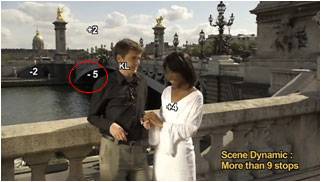
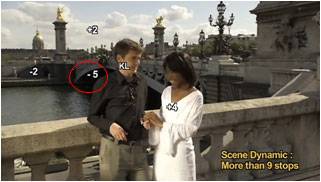
This scene ranges from 4 stops over key to 5 under. HyperGamma holds it together.
How do you capture high-contrast exterior day shots without blowing out the highlights or crushing the blacks? What’s the secret to recording low-key scenes without unwanted color shifts in the highlights? How can you keep shooting without periodic tweaks of Knee and Slope? A growing number of DPs are finding the answers in gamma adjustments, such as Sony’s HyperGamma curves.
Defining gamma
Gamma manipulation is relatively new. Traditionally gamma compensation has been a mandatory and unvarying process in television broadcast cameras. Camera gamma corrects for the nonlinearity of cathode ray tube (CRT) monitors and televisions. If we chart the CRT transfer characteristic of output brightness versus input voltage, we get a curve where output equals input raised to an exponent called gamma. For CRTs, gamma equals 2.2. To compensate, video cameras have always applied a corrective gamma of 1/2.2.
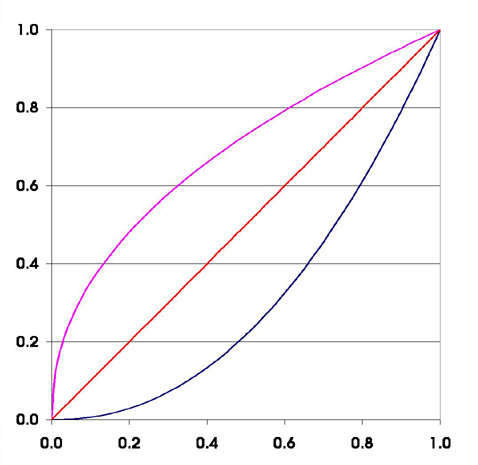
The CRT transfer characteristic (lower curve) is nonlinear. Camera gamma (upper curve) corrects for the nonlinearity. The two curves combine to create a linear system (central line).
Compared to Knee and Slope.
Sony HyperGamma curves teach the old gamma dog some useful new tricks. The curves gently adjust the camera’s gamma characteristic to overcome common exposure challenges. Where conventional Knee and Slope adjustments affect only part of the exposure range, HyperGamma adjusts it all. Knee and Slope can generate color shifts in severe highlights-a tell-tale sign that a project was shot on video. HyperGamma maintains natural color and a more filmic look in the highlights.
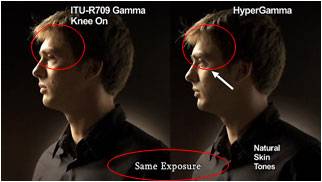
Sony HyperGamma holds natural skin tones, even in challenging shots.
Compared to LOG encoding
The S-LOG encoding of Sony’s top CineAlta® cameras can also protect the highlights. But S-LOG results in a relatively flat image that requires a Look Up Table (LUT) for proper monitoring and postproduction. HyperGamma footage can be viewed on any monitor without LUTs.
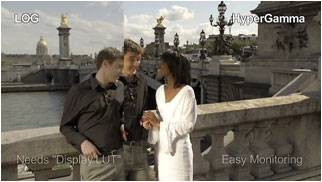
While the S-LOG image (left) appears flat without a LUT, HyperGamma (right) supports direct, WYSIWYG monitoring.
Four HyperGamma curves
Every Sony CineAlta camera has at least four HyperGamma curves:
- HyperGamma 1. Enhanced midtones in low-key areas. Ideal for challenging low-light shots. Compatible with all post processing.
- HyperGamma 2. Full dynamic range in high-contrast scenes. An excellent problem solver for exterior day shots. Compatible with all post processing.
- HyperGamma 3. Enhanced midtones in low-key areas. Only compatible with post processing that can handle extended 109% digital range.
- HyperGamma 4. Full dynamic range in high-contrast scenes. Only compatible with post processing that can handle extended 109% digital range.
Sony has also created a complete tutorial on HyperGamma accompanied by sample video.
The following Sony products offer HyperGamma:
- F35 Digital Cinema camera
- F23 Digital Cinema camera
- SRW-9000 HDCAM® SR camcorder
- HDW-F900R HDCAM camcorder
- HDW-650F HDCAM camcorder
- PDW-F800 XDCAM® HD422 camcorder
- PDW-700 XDCAM® HD422 camcorder
- PDW-F355 XDCAM HD camcorder (Called CINE Mode gamma)
- PDW-F335 XDCAM HD camcorder (Called CINE Mode gamma)
- PMW-350 XDCAM EX camcorder
- PMW-EX3 XDCAM EX camcorder (Called CINE Gamma)
- PMW-EX1R XDCAM EX camcorder (Called CINE Gamma)
- HDC-1000R Studio camera
- HDC-1500R444 Portable camera
- HDC-1550R Portable camera
- HDC-1500R Portable camera
- HDC-1450R Portable camera
- HDC-1400R Portable camera
Study this carefully because there will be a 15 minute quiz next period. It will of course be graded on a curve.