(Page 1 of 1 pages for this article )

Saturday, September 11, 2010

Filed under: CamerascompressionHardware

The Panasonic AG-AF101 intro video and global premiere

Scott Simmons | 09/11

A full overview of the highly anticipated micro 4/3 camera

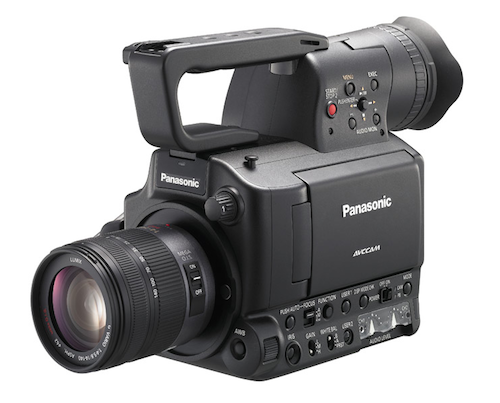
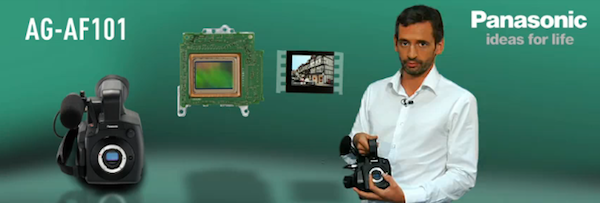
It’s been just a week or so since Panasonic posted the official website for their micro 4/3 AG-AF camera family. Here we are with IBC in full swing and they’ve now posted a video with details galore about the AG-AF101. It’s the global introduction of the camera and it professes to combine both the benefits of a DSLR’s large sensor with the functionality, ergonomics and features of a proper video camera. Watching the video will probably answer quite a few questions about exactly what features Panasonic have packed into the unit.

It really does look like it has all proper inputs and output of a real video camera. It records AVCHD up to 24 mbps to SD cards. One thing I found interesting is that you can take the HDSDI out and connect it to Panasonic’s AG-HPG20 portable recorder to record in AVC-Intra, Panasonic’s “master quality codec.” AVC-Intra is a nice codec so this ability to get a less compressed signal out of the AF101 should quite some of the critics who’ll say that the 24 mb AVCHD on-board is too compressed. Hopefully devices like the Cinedeck will be able to work in this camera too since it includes both HDSDI and HDMI outputs. And don’t forget about the new AJA Ki Pro Mini!

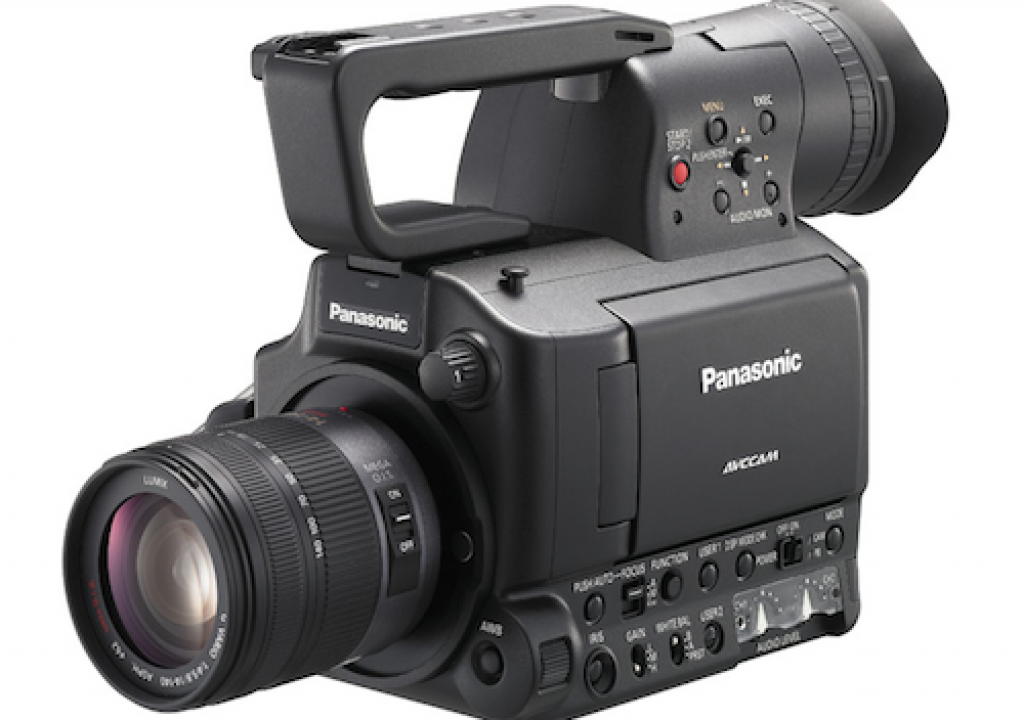
It’s a bit funny looking ...

image

… but does that really matter when you have that big sensor?
image

And here’s an interview with Barry Green from the IBC floor, who shot with the camera while in Amsterdam at IBC:

He sure seems to like the image that he got from the camera. Now all we need to do is to actually see some footage from the thing! And get a final cost too. Will Panasonic actually get the cheese?

(Page 1 of 1 pages for this article )

                    Clip to Evernote


The Best of Stunning Good Looks

Art Adams | 08/30

A directory of my best articles, sorted by topic.

This entry is a guide to my best articles, sorted by topic. Enjoy!

NAB 2012: Assorted Snapshots

Adam Wilt | 05/08

A few cool things I saw at the show that didn’t fit into any other articles.

NAB is too big a show in too short a time to see more than a fraction of it. I’ve covered a few things in some depth (as have other PVC folks), but there’s plenty more that slips by without proper coverage. Here, I have a few photos…

NAB 2012: RED

Adam Wilt | 05/07

RED’s Ted Schilowitz discusses 2012’s products, and a photo gallery.

RED’s “Leader of the Rebellion” Ted Schilowitz held a press conference at NAB on Monday, describing the projects and products RED is working on. Rather than paraphrase him, I’ve got him on card (well, it’s not “on…


You must be registered to comment. This is an effort to reduce spam. Please REGISTER HERE.

Half the data rate of the hacked GH1?

Oh wait I can spend an additional 4k, not counting p2 cards, to record to the HPG20 to get a proper codex that should have been in the camera to begin with.  What, just cause I like lugging around a 2 and a half pound brick with extra wires, batteries and mounting problems?

Seriously Panasonic?

Posted by Bighatcowboy  on  09/11  at  09:27 PM


Great point. Would seem like they’re maybe hobbling this cam a bit since they do still sell Varicams and the like. Interesting quandary that this puts Panasonic in. This might be solved if Canon came out with a camera to compete with this since they have to super high end cam lines to worry about like Panasonic and Sony do.

Posted by Scott Simmons  on  09/12  at  05:31 AM


I agree the codec is probably the biggest downside, and yeah, they’re probably hobbling it so it doesn’t cannibalize the Varicam. Though if the KiPro Mini DOES work with it (which it seems like it should), that’s only an extra $2000 for ProRes recording.

Posted by .(JavaScript must be enabled to view this email address)  on  09/12  at  06:16 AM


24 Mbit/sec AVCCAM, when recorded as 24p (not 24p on 60i with 2:3 pulldown and interlaced 4:2:0 chroma) isn’t too bad; 1080/24p from the HMC40 is much cleaner and less “muddy” than the 1080/60i from the GH1. It ain’t perfect, but it’s acceptable.

Still, I’ll bet this thing will sell a lot of nanoFlash and Ki Pro Mini offboard recorders.

And the ergonomics… crikey! It’s like a pregnant HVX200. It’ll be a great box camera for tripod use, but handheld? Fuggedaboudit! Maybe on a Mantis rig… but why should I have to spring for a Mantis (or a tinkertoy kit from Redrock, Zacuto, or Cinevate) when the GH1 form factor handholds so well?

Posted by Adam Wilt  on  09/12  at  12:09 PM


Acceptable, maybe, but isn’t the whole point of this camera so we wouldn’t have to deal with the “acceptable” aspects of DSLRs? If you’re going to make a DSLR killer, at least give it something with 4:2:2!

Posted by .(JavaScript must be enabled to view this email address)  on  09/12  at  12:17 PM


“Acceptable” is always a sliding scale, dependent on time, money, resources, etc. Progressive 4:2:0 isn’t awful (interlaced is, however). It’s not as good as 4:2:2, but 4:2:2 isn’t as good at 16-bit 4:4:4 at 4K, either. Where do you draw the line?

I shot a low-budget feature on 4:2:0 XDCAM EX and was well pleased with the results, though I’ve been less pleased with the format when I’ve tried to do pixel-level motion tracking and greenscreen compositing. It all depends on what you need to do.

I’m more disappointed by the AG-AF101’s low maximum bitrate and the attendant compression compromises than I am by the 4:2:0 chroma subsampling.

Posted by Adam Wilt  on  09/12  at  01:26 PM


I just look at what they’re obviously trying to do (trump the DSLR), and while they’re moving in the right direction in terms of form factor, the codec really isn’t that much of an improvement over the 5D’s H.264 (at 38mbps). In terms of sheer bitrate, it’s worse.

Speaking of DSLR inadequacies, what’s the deal with rolling shutter on this thing?

Posted by .(JavaScript must be enabled to view this email address)  on  09/12  at  01:47 PM


I don’t think it’s a bit rate only issue is it? There’s the question of exactly how they are getting that image from the sensor into its final form. I would hope they could do better than the line-skipping job that Canon does in the DSLRs. And in terms of codec, while AVCHD is H264 based it’s got to have a better compression scheme that the ‘plain ‘ole’ H264 out of the Canons. From my understanding, H.264 was designed to scale all over the spectrum though it seems to predominately be delivery at this point in time.

Posted by Scott Simmons  on  09/12  at  02:08 PM


AVCHD is a bad move. AVC-Intra 100 should be the default on Panny’s cams.

Posted by Charles Angus  on  09/12  at  02:24 PM


I would love to hear an explanation as to why Panny didn’t go with AVC-Intra on this cam. Even if it is some towthe corporate line BS .....

Posted by Scott Simmons  on  09/12  at  02:30 PM


Preventing cannibalization of the high-end, it has to be.

Posted by .(JavaScript must be enabled to view this email address)  on  09/12  at  02:31 PM


“Preventing cannibalization of the high-end, it has to be.”

Yup. That’s what I don’t get about Canon. They have no real high-end to protect in the video biz, not like Sony and Panasonic. They could own if they wanted to. Maybe they will. Who the hell knows, I’m going back to editing.

Posted by Scott Simmons  on  09/12  at  02:37 PM


“Yup. That’s what I don’t get about Canon. They have no real high-end to protect in the video biz, not like Sony and Panasonic.”

Perhaps they have more to lose, considering they make the lenses for those high end Sony and Panasonic cameras.

That said, this is a boon for Aja and Convergent Design et al… and given HDSDI, they won’t really be protecting their high end, so it’s a wonder they didn’t just include a better codec.  Perhaps that’s being saved for theAG-AF150?

Posted by Josh Dahlberg  on  09/12  at  06:28 PM


Now Nikon on the other hand…

Posted by Josh Dahlberg  on  09/12  at  06:29 PM


Nikon doesn’t really have a pro video background to draw from. Canon has both the motive AND the means to stick a large sensor in a pro video form factor. Nikon just has the motive, if that.

Posted by .(JavaScript must be enabled to view this email address)  on  09/12  at  07:01 PM


It’s beyond Nikon’s capacity to reconfigure and optimise the chipset, dsp and form factor of their existing technology for video, and employ a decent codec?  Perhaps. 

Be that as it may, surely Canon - who sell lenses for five figure sums - has more to lose than Nikon.

Posted by Josh Dahlberg  on  09/12  at  07:19 PM


“Perhaps they have more to lose, considering they make the lenses for those high end Sony and Panasonic cameras.”

Great point.

Posted by Scott Simmons  on  09/12  at  07:49 PM


While I’ve never been a huge fan of Panasonic, and the obvious flaws in this new camcorder have been noted above, I’ll give them credit for moving in the right direction. A camcorder with true depth of field, that offers flexibility in codecs, etc for an affordable price is the Holy Grail for indie film makers. There are still other issues with the sensors like the omni present “jello” effect I’d like to see solved. This to me is more important than the codec issue since we all know that codecs come and go like fads.
As for the arguement that Panasonic, Sony, and Canon won’t make a product that competes with thier high end professional cameras, It really doesn’t make sense. In the end, some camcorder manufaturer is going to make a cost effective camcorder that does what the Viper, Genesis, and do I dare say, Red One do now, and the above mentioned manufacturers would have to follow suit or lose market share.
The real question is which one of these companies will win the race. Panasonic and Canon have made imperfect forays in the right direction. It will be interesting to see if Sony follows suit.

Posted by .(JavaScript must be enabled to view this email address)  on  09/13  at  08:28 AM


“In the end, some camcorder manufaturer is going to make a cost effective camcorder that does what the Viper, Genesis, and do I dare say, Red One do now, and the above mentioned manufacturers would have to follow suit or lose market share.”

That’s only true to a point. RED shook up the industry with the RED ONE, but there’s still a market for the EPIC and the SCARLET. If they didn’t think there was a market for the EPIC, they would just be making SCARLETs and that would be it.

There will always be a line between “good” and “good enough”.

Posted by .(JavaScript must be enabled to view this email address)  on  09/13  at  10:20 AM


Of course! Nikon just needs a small business loan.

Posted by .(JavaScript must be enabled to view this email address)  on  09/13  at  01:04 PM


Sony is following suit – there was an unnamed prototype under a glass box at IBC…

Posted by .(JavaScript must be enabled to view this email address)  on  09/14  at  02:50 AM


Plus: as long as the camcorder is good, I don’t care to bolt an AJA KiPro mini to the back of it – Alexa for the rest of us wink

Posted by .(JavaScript must be enabled to view this email address)  on  09/14  at  02:53 AM


I think what you are seeing here is the seed of a sea change. The manufacturers I think are confused. They know what we want, but they also know that they have serious problems reconciling the quality that people now know they can get affordably, compared to their high end lines.

The base level ENG cameras need to go now. I see (or rather desire) the near future like this.

Base level professional cameras:
- 50Mb/s 422 minimum codec.
- 4/3” or larger single chips.
- Balanced body similar to the JVC 700. Compact, yet great ergonomics.
- Minimum overcranking capabilities of 60p at 1080.

Mid to high end:
- FF 35mm sized chips (perhaps 3 chip designs)
- SR or better recording codecs.
- High frame speed capability (ie up to 200fps)

However things turn out I think that the manufacturers are going to have to consider very carefully where to head next. They know we aren’t stupid, and Canon’s use of a 50Mb/s 422 codec in even their lowest end cameras is making the other two companies look a bit silly.

One of them needs to be truly daring. Yes, it might piss off a load of people who have invested in heavy gear. But then that gear isn’t going to stop working, and the change has to be made at some point. Better to get it over with.

A bread and butter camera should not cost £25k (or near £40k to get a full setup) anymore given the rate that new and better models are being released. The prices should reflect the modern upgrade cycle.

Posted by Simon Wyndham  on  09/14  at  04:22 AM


Panasonic did not prohibit comments for its YouTube videos, but it removes those that it does not like. Hilarious. So I will repeat what they deleted.

Panasonic had shot itself in the foot. DVCPROHD is aging, AVC-Intra 50 is no good, so they had to choose between AVC-Intra 100 and AVCHD. The former requires better media than even Class 10 SDHC cards. CompactFlash could be a possible solution, but Panasonic has never allowed DVCPROHD and AVC-Intra on anything but P2. AVCHD, on the other hand, is no better - or not much better - than XDCAM EX, but is harder to edit and has lower color resolution than DVCPROHD.

Canon, on the other hand, demonstrated that it is willing to use MPEG-2 422 @ 50 Mbit/s even on smallest and cheapest pro models (XF100/XF105), and it has chosen sensible media (CompactFlash). If I were looking for a cine-style camcorder, I would wait for Canon.

Posted by .(JavaScript must be enabled to view this email address)  on  09/14  at  09:00 AM


This is a very good point, and really makes you wonder why they didn’t just make an HPX170 with AVC-I and a full sensor, rather than reinventing the wheel with this guy.

Not having used it personally, is AVC-I 50 really not any good? It seems like it’d be decent by the specs.

Posted by .(JavaScript must be enabled to view this email address)  on  09/14  at  10:19 AM


But ENG cameras with smaller sensors will not go away. A large sensor isn’t good for all situations – it’s excellent for fiction and nice for nature and wildlife.

But sports, news, run-n-gun? Why?

Posted by .(JavaScript must be enabled to view this email address)  on  09/14  at  01:58 PM


A full frame sensor might be too much for ENG. But a micro 4/3 one might just be a good sweet spot. Easier to shoot better looking interviews in confined rooms, and more low light sensitivity than 2/3”. But not so shallow a depth of field as to be unmanageable.

Posted by Simon Wyndham  on  09/14  at  02:07 PM


4/3 is very close to a a full 35mm cine frame…

Posted by .(JavaScript must be enabled to view this email address)  on  09/14  at  02:26 PM


I agree the codec is probably the biggest downside, and yeah, they’re probably hobbling it so it doesn’t cannibalize the Varicam

Posted by JohnReen  on  09/15  at  12:18 AM


I’m no expert on 35mm sizes, but AFAIK the 4/3 format is smaller than S35mm.

Posted by Simon Wyndham  on  09/15  at  01:12 AM


True, but very close to standard 35mm cine. My point was that it’s not an easy task to focus if you are on your own, like in news.

Large sensors are primarily good for well planned productions with a reasonably sized crew.

Posted by .(JavaScript must be enabled to view this email address)  on  09/15  at  01:41 AM


Bad news guys.
it seems that this promising device output just 8b Unc through the SDI. The same happens with the new Canon line: only 8b SDI.
Mean.
rafael

Posted by .(JavaScript must be enabled to view this email address)  on  09/18  at  10:39 PM


More or less normal at this price level. They would completely cannibalize their higher end range with 10 bits. But 8 bits at 4:2:2 aint that bad.

Posted by .(JavaScript must be enabled to view this email address)  on  09/19  at  02:14 AM


Simon,
the MOS sensor on the 101 is 17.3x12.9 mm (35 mm film is 22x16 mm) not far from 35, but not too close either smile.

Rafael, “Bad news guys.
it seems that this promising device output just 8b Unc through the SDI”

where did you get this info from?
could you post a link to a valid source?

as Panasonic advertises that you can connect the cam to an AVC-i recorder, that would seam strange…
also, isn’t HD-SDI standardized to output 4:2:2 10b?

Posted by .(JavaScript must be enabled to view this email address)  on  09/25  at  01:25 AM


Hi Simon,
I’ve got that from Mike Shell from Convergent-Design.
Its seems that this info is to be checked.
I thought the same than you when I saw this clip suggesting the AVC-Intra.
I would ask again.
About the HD/SD-SDI, it can be 8b.
Rafael

Posted by .(JavaScript must be enabled to view this email address)  on  09/26  at  11:20 PM


thanks Rafael

HD-SDI is always 4:2:2, 10 bit signal, you can read the somewhat long, yet interesting wikipedia entry.
However, some camera manufacturers (malevolently)  limit the data coming from the sensor resulting in a 10 bit signal with 2 last bits zeroed, basically , an 8 bit embedded in 10 bits.
as we should always doubt what camera manufacturers publish, only true way to tell would be via tests…
connecting it to a good external scope,
or capturing an uncompressed signal to a valid codec, and carefully exporting a frame (using appropriate settings) for testing in a graphic software
(i prefer the first method)

Convergent-Design makes nanoflash which is limited to 8 bit encoding… i don’t want to sound accusing but it isn’t farfetched to imagine they would have some interest in claiming that ALL cameras output only 8 bits ... wink

see the video in this link
http://www.dvxuser (DOT) com/V6/showthread.php?t=223342

Jan Crittenden Livingston from Panasonic claims the camera is 70% complete… maybe our answer lays in the remaining 30%

regards

Hector

Posted by .(JavaScript must be enabled to view this email address)  on  09/27  at  02:50 AM


Hi Hector (sorry I call you Simon before),
The Wiki says “The default (and most common case) is 10-bit linearly sampled video data encoded as 4:2:2 YCbCr”.
I’ve saw 8b HDI implemented in some monitors (8b).
I’n one way is very logic to cut the output to 8b to protect theyr bigs cameras.
About the people of Convergent-Design I know them well enough to dismiss any wrong intention on this info.
Sure the Mini Ki-Pro with hurt them.
And don’t forget that AJA owes a lot to the NANO-Flash. 
Rafael

Posted by .(JavaScript must be enabled to view this email address)  on  09/27  at  04:31 AM


Name:

Email:

Location:

URL:

Smileys

Remember my personal information

Notify me of follow-up comments?

Submit the word you see below:


Final Cut Pro X Multicam Editing webinar now available on-demand
10 Final Cut Pro things FCP editors might be missing in Adobe Premiere Pro CS6
A collection of Avid Media Composer related links for my NAB Migrating to Avid class
An elegant iPhone timecode calculator
Random notes from my first “real world” Adobe Premiere Pro CS6 edit
NAB 2012: SpectraCal
NAB 2012: Apple and Final Cut Pro X
NAB 2012: Lightworks
NAB 2012: Baselight for Avid Media Composer
NAB 2012: Quantel new Pablo and Neo Nano
NAB 2012: Promise Technology’s portable Thunderbolt J4 and J2
NAB 2012: NewBlueFX Titler Pro
NAB 2012: PluralEyes 3.0 from Singular Software
NAB 2012: Technicolor CineLights from the GoPro booth
Autodesk Smoke 2013: it really changed for the better
My top 5 (or so) Adobe Premiere Pro CS6 features
How to preview Avid Media Composer’s MXF files for free without Media Composer
My NAB 2012 Post|Production World classes
Baselight for Final Cut Pro is one of the most powerful legacy FCP grading plugins ever
ARRI’s DNxHD Alexa update, Sorenson Squeeze Pro and OP this, OP that
What’s happening at NAB 2012?
The C300 short Hustle and some before and after images
Tip Tuesday: Disable a clip in the Avid Media Composer timeline
Testing the 7toX Final Cut Pro 7 to Final Cut Pro X conversion
Q and A with Bunim/Murray’s Mark Raudonis about their recent Avid switch
Kicking the tires on the Final Cut Pro X 10.0.3 Multicam update
Update Alert: Final Cut Pro X goes to 10.0.3
Adobe teases Prelude at the San Francisco Supermeet, FCPUG changes its name
Tangent Element panels are now shipping
Avid Media Composer 6 review online


The Best of Stunning Good Looks

Art Adams | 08/30

A directory of my best articles, sorted by topic.

This entry is a guide to my best articles, sorted by topic. Enjoy!

NAB 2012: Assorted Snapshots

Adam Wilt | 05/08

A few cool things I saw at the show that didn’t fit into any other articles.

NAB is too big a show in too short a time to see more than a fraction of it. I’ve covered a few things in some depth (as have other PVC folks), but there’s plenty more that slips by without proper coverage. Here, I have a few photos…

NAB 2012: RED

Adam Wilt | 05/07

RED’s Ted Schilowitz discusses 2012’s products, and a photo gallery.

RED’s “Leader of the Rebellion” Ted Schilowitz held a press conference at NAB on Monday, describing the projects and products RED is working on. Rather than paraphrase him, I’ve got him on card (well, it’s not “on…

NAB 2012: Camera Support

Adam Wilt | 05/05

A few of the interesting bits ‘n’ bobs that make cameras usable.

At NAB I found support vendors at the affordable end of the spectrum I hadn’t seen before, comfy Aaton-style handgrips, F65 tweaks by Carlos Acosta, and a “drive-by demo” of a handy zoom/focusing lever.

To be considered for listing, contact pr (at) provideocoalition (dot) com


Copyright © 2012, HD Expo, LLC a division of Diversified Business Communications. DBA Createasphere

All rights reserved. HD EXPO, High Def EXPO, Createasphere, E-Tech, Entertainment Technology Exposition, 3D Production Workshop, VariCamp, P2 Camp, ColorCamp 101, and Lighting, Filters & Gels for HD are all trademarks of HD Expo, LLC.

Terms of Use  |  Privacy Policy

Check PageRank